Dumortierite
Also known as: Dumortierite Quartz, Blue Quartz, Blue Denim Stone
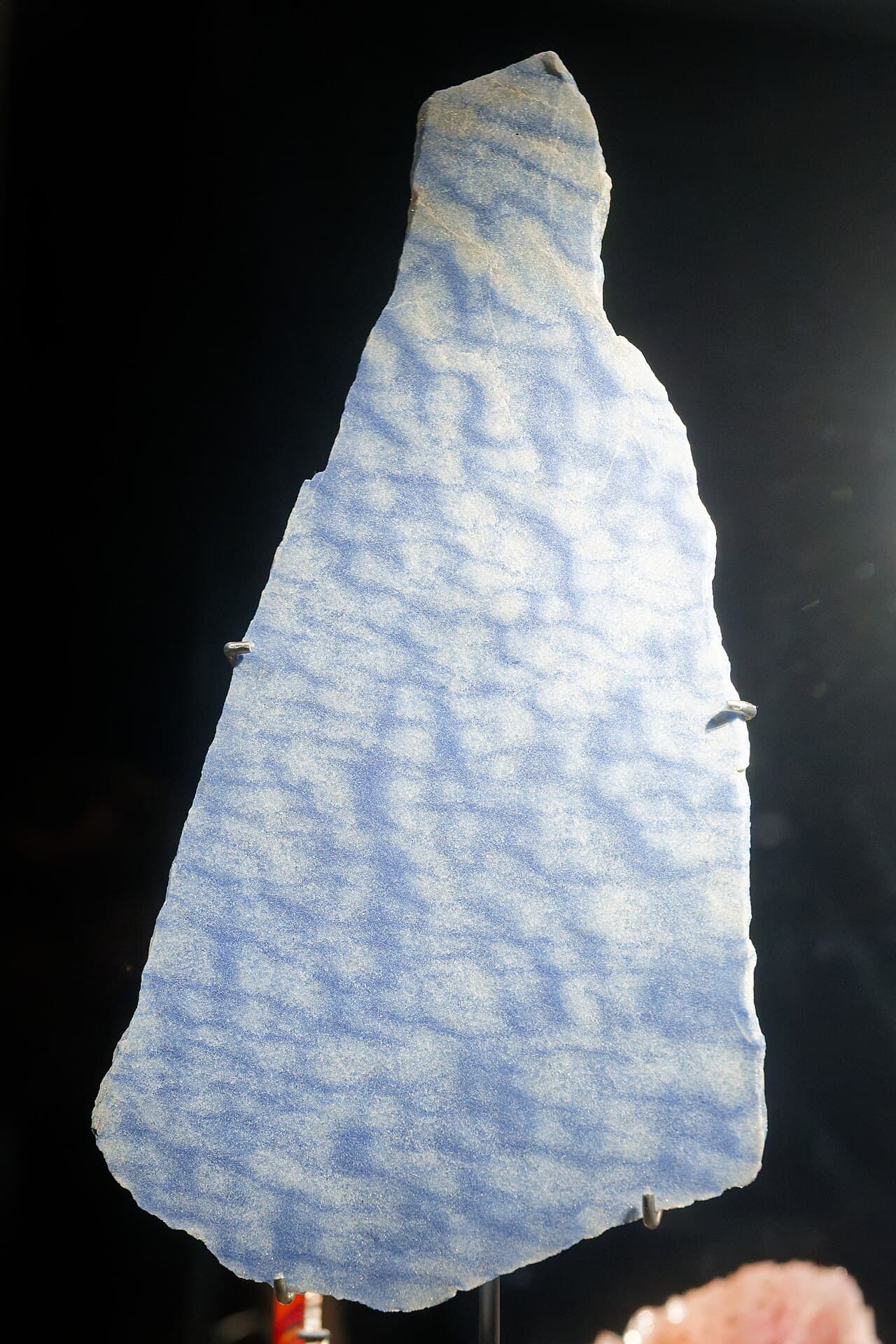
Dumortierite is a deep blue to violet-blue aluminum borosilicate mineral prized for its rich, saturated color and surprising hardness. Although the name describes a specific mineral, most stones sold as "dumortierite" are actually dumortierite quartz: a quartz host shot through with countless fine blue fibers of dumortierite, which lend the rock its denim-like color. Pure massive dumortierite is rarer and tends to be darker and more uniformly blue, while the quartz-hosted variety shows mottled, streaky, or cloudy blue patterns mixed with gray and white.
Geologically, dumortierite forms in aluminum-rich metamorphic and high-temperature hydrothermal environments, often appearing as radiating fibrous masses, columnar aggregates, or felt-like clusters of needles. It is found in places such as Brazil, Madagascar, Sri Lanka, France (where it was first described), and the western United States. Because its hardness rivals that of quartz, dumortierite is durable enough for cabochons, beads, tumbled stones, and carvings, and it is occasionally mistaken for far more expensive blue gem materials.
Dumortierite at a glance
- Classification
- Borosilicate mineral (aluminum borosilicate)
- Composition
- Al7(BO3)(SiO4)3O3
- Hardness
- 7 to 8.5
- Luster
- Vitreous to dull (silky in fibrous masses)
- Streak
- White to pale blue
- Colors
- Deep blue, violet-blue, blue-gray; rarely pink or brown
- Crystal system
- Orthorhombic
- Transparency
- Translucent to opaque
How to identify it
The first clue is color: dumortierite shows a distinctive deep, slightly grayish blue often described as denim or ink blue, sometimes leaning toward violet. In dumortierite quartz you will see this blue distributed as fibrous streaks, swirls, or cloudy patches within a paler quartz matrix, rather than as one even tone. Under magnification, the blue often resolves into masses of fine, parallel or radiating needle-like fibers, which is a strong diagnostic feature.
Hardness is the second key test. Dumortierite is very hard (Mohs 7 to 8.5), so it will scratch glass easily and resist scratching from a steel knife. This separates it from softer blue stones like sodalite and lapis lazuli, which a knife can mark. The mineral is also notably tough and does not show the bright metallic flecks of lapis or the white veining typical of sodalite. A white to faintly bluish streak and a vitreous-to-silky luster round out the profile.
Colors and varieties
The blue color of dumortierite comes from its essential chemistry rather than from trace impurities, which is why the hue is so consistent and stable. Tones range from a soft blue-gray through classic denim blue to a deep, almost inky violet-blue; the violet shades are caused by the way light interacts with the fibrous structure. Rare specimens can appear pink, reddish-brown, or greenish, and some material is pleochroic, shifting in color when viewed from different angles.
The two main forms on the market are massive (pure) dumortierite, which is darker and more uniformly colored, and dumortierite quartz, where blue fibers are embedded in clear or milky quartz. Dumortierite quartz is the most common variety sold as beads and cabochons and is often marketed simply as "blue quartz." Both forms may be cut into cabochons, spheres, and tumbled stones, with the most evenly colored, crack-free pieces being the most desirable.
Meaning and properties
In crystal-healing traditions, dumortierite is associated with mental clarity, focus, patience, and orderly thinking, and is sometimes nicknamed the "stone of patience." Because of its blue color it is commonly linked to the throat and third-eye energy centers and to themes of communication, self-discipline, and calm under pressure. Many people simply keep it as a study or work stone they find grounding and visually soothing.
These meanings come from spiritual and metaphysical belief systems, not from scientific evidence. Dumortierite has no proven medical or psychological effect, and it should never be used as a substitute for professional medical, mental-health, or other qualified care. Enjoy it for its beauty and as a personal focus object, and consult an appropriate professional for any genuine health concern.
Value
Dumortierite is an affordable stone rather than a precious gem. Value is driven mainly by depth and evenness of color, with rich, uniform deep-blue material commanding more than pale or heavily mottled pieces. Clean stones free of cracks, pits, and dull gray patches are preferred, and well-cut cabochons or polished spheres carry more value than rough or poorly finished pieces.
Dumortierite quartz tends to be very inexpensive and widely available as beads and tumbles, while denser pure dumortierite of strong color is somewhat scarcer and priced a little higher. Even so, this remains a budget-friendly material, which is part of its appeal for collectors and jewelry makers who want a hard, durable blue stone without a gemstone price.
Real vs fake
Genuine dumortierite is rarely faked outright because the natural material is cheap, but two issues come up. First, dyed stones: porous, pale blue rocks (including some quartzite and howlite) are sometimes dyed and sold under blue trade names; a true dumortierite color is built into the fibers and will not concentrate in cracks or rub off on a damp cotton swab. Second, mislabeling, where unrelated blue stones are sold as dumortierite.
To confirm authenticity, check hardness (it should scratch glass and resist a steel knife), look for the characteristic fibrous blue inclusions under magnification, and be wary of suspiciously uniform, glassy material that may be dyed glass or composite. The absence of metallic pyrite flecks rules out lapis lazuli, and the lack of white mottling and its greater hardness separate it from sodalite. When in doubt, buy from a reputable seller who discloses the exact material.
Care
Dumortierite is hard and reasonably durable, so routine care is simple. Clean it with lukewarm water, mild soap, and a soft cloth or brush, then dry thoroughly. Avoid harsh chemicals, bleach, and prolonged soaking, especially for dumortierite quartz, which can contain micro-cracks that trap liquid. Ultrasonic and steam cleaners are best avoided because vibration or thermal shock can exploit hidden fractures.
Although the stone resists scratching, store it separately from harder gems like topaz, corundum, and diamond to prevent abrasion, and keep it away from sharp impacts that could chip a cabochon edge. Prolonged, intense sunlight is generally fine for the mineral's stable blue, but dyed imitations may fade, which is another reason to confirm you have the genuine material.
Dumortierite look-alikes
Frequently asked questions
Is dumortierite the same as blue quartz?
Often, yes. Much of the material sold as "blue quartz" is dumortierite quartz, where fine blue dumortierite fibers are embedded in a quartz host. Pure massive dumortierite also exists and is darker and more uniformly blue, but the quartz-hosted form is what most beads and cabochons are made from.
How hard is dumortierite and can I wear it daily?
It is quite hard, around Mohs 7 to 8.5, similar to or harder than quartz, so it stands up well to everyday wear. It can still chip on a sharp impact, so rings and bracelets benefit from a protective setting and a bit of care during rough activities.
How can I tell dumortierite from lapis lazuli or sodalite?
Use hardness and surface clues. Dumortierite scratches glass and resists a steel knife, while lapis and sodalite are softer and a knife can mark them. Lapis shows gold pyrite flecks, sodalite shows white veining, and dumortierite shows fibrous blue streaks instead.
Does dumortierite have healing powers?
In crystal-healing belief it is linked to focus, patience, and calm communication, but these ideas are spiritual rather than scientific. There is no proven medical effect, so enjoy it for its beauty and never use it in place of professional medical or mental-health care.
Is yours dumortierite? Find out from a photo
Photograph your crystal in good light and get an identification with an honest confidence level, the look-alikes to rule out and the at-home tests that confirm it.
Identify my crystal freeOn Android? Get the free rock identifier app
Related
More crystals in the field guide
Keep exploring
More on crystals: the full list of crystal types, how to identify a crystal and crystals by color.
Last updated 2026-06-25. Identification guidance is educational — confirm important results with the diagnostic tests described or a qualified expert.