Coprolite
Also known as: Fossilized dung, Fossil feces, Fossil excrement
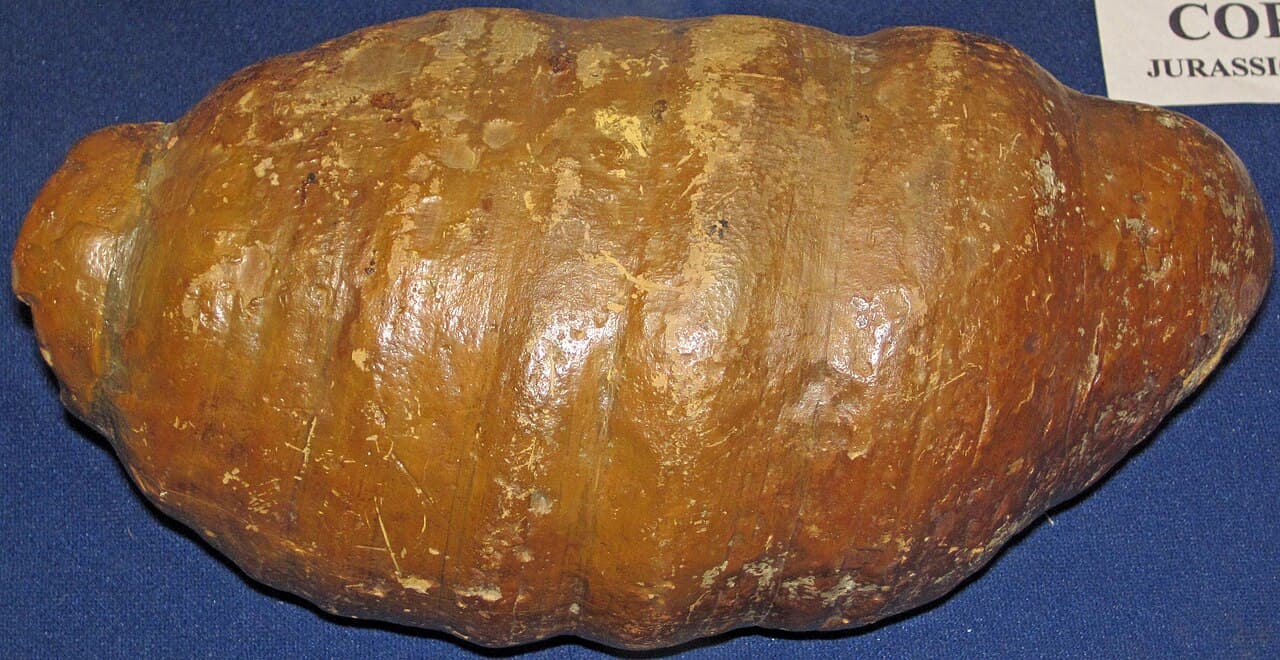
A coprolite is fossilized excrement — the petrified droppings of an animal that lived long ago. The name comes from Greek words meaning "dung stone," and that is exactly what it is: feces that, instead of decaying, were buried quickly and slowly turned to stone as minerals filled and replaced the original material. Because they preserve the actual waste of ancient creatures, coprolites are classed as trace fossils — fossils of an animal's activity rather than its body — and they can be left behind by fish, reptiles, dinosaurs, mammals and many other animals across a huge span of geologic time.
Far from being a novelty, coprolites are scientifically valuable, because what an animal ate is locked inside what it left behind. Cut one open and you may find fragments of bone, fish scales, teeth, shell, plant matter or other dietary clues, which let paleontologists reconstruct who ate whom and how ancient food webs worked. The shapes vary widely — some are neatly coiled or spiral, some are pellet-like, and many are simply lumpy and irregular — and they are usually hard, dense and stony, often colored gray, brown, tan or black. The honest catch is that a plain mineral lump can look very similar, so confidently identifying a true coprolite is genuinely difficult and frequently needs an expert eye.
Coprolite at a glance
- Classification
- Trace fossil — fossilized animal excrement (ichnofossil)
- Composition
- Variable; often phosphatic (calcium phosphate), sometimes replaced or cemented by silica (SiO₂) or calcite (CaCO₃)
- Hardness
- Roughly 3–5 or more, depending on the replacing minerals; generally stone-hard
- Luster
- Dull to earthy; can be slightly glassy where silica has replaced the material
- Colors
- Gray, brown, tan, buff to black; occasionally with paler internal inclusions
- Texture
- Coiled, spiral, pellet-shaped or irregular masses; may contain visible bone, scale, shell or plant fragments inside
How to identify it
Identifying a coprolite starts with shape and what is inside it, not with surface appearance alone. The most suggestive specimens have a recognizable dropping-like form — a smooth coil or spiral, a string of pellets, or a tapering, sausage-like lump with rounded ends — that hints at how it was originally extruded. The piece is typically hard, dense and stony, since the original soft material has been mineralized, and it is commonly some shade of gray, brown, tan or black. None of this on its own is proof, because plain rounded nodules can mimic these shapes, so external form is only a starting clue.
The strongest evidence is internal. Because a coprolite is fossilized waste, it can trap fragments of the animal's diet — bits of bone, fish scales, teeth, crushed shell, or plant material — and finding such inclusions inside a stony lump of the right shape is a powerful sign that it is genuine dung rather than an ordinary concretion. Cutting or examining a broken surface can reveal these contents, and sometimes a swirled or layered internal texture that reflects how the material passed through the gut. Be honest with yourself about the limits, though: many true coprolites are featureless inside, many ordinary stones are not coprolites, and distinguishing the two reliably often calls for examination by a specialist.
How it formed / when it lived
A coprolite forms only under fairly special conditions, which is part of why a well-preserved one is interesting. After an animal deposited its droppings, the material had to be buried quickly — for example under sediment on a sea floor, lake bed or river bottom — before scavengers, weather and decay could break it down. Once protected, groundwater carrying dissolved minerals slowly permeated the mass, and over long periods those minerals precipitated within and replaced the original organic matter, turning soft waste into solid rock. The minerals involved are often phosphates (the droppings are already rich in phosphorus), but silica and calcite commonly play a role too, which is why coprolites differ in hardness and feel.
Coprolites are not tied to one moment in Earth's history; they are found across many periods and were produced by a wide cast of animals, from ancient fish and marine reptiles to dinosaurs and later mammals. This long range is exactly what makes them scientifically useful: a coprolite is direct evidence of a living animal's behavior and diet at a particular time and place, complementing the body fossils — bones, teeth and shells — found in the same rocks. By studying the inclusions trapped inside, researchers can piece together predator-and-prey relationships and reconstruct the feeding habits of creatures whose soft tissues are otherwise long gone.
Types and varieties
Coprolites are usually grouped by their form and, where it can be worked out, by the kind of animal that produced them. Spiral or coiled coprolites are a well-known type, their twist reflecting the corkscrew-shaped gut found in some fish and sharks; pellet-shaped coprolites come from animals that produced small, discrete droppings; and many specimens are simply irregular, lumpy or sausage-like masses with no tidy geometry. Some are large and clearly from a sizable animal, while others are tiny. Because the producer is rarely certain, coprolites are generally described by these shapes rather than confidently assigned to a single species.
Preservation creates further variety. The replacing minerals control color and hardness, so coprolites range from soft-looking buff and tan pieces to dense gray, brown or near-black stones, and a few take a faint sheen where silica has done the mineralizing. Internally, some are plain and homogeneous while others are crowded with bone, scale, shell or plant fragments — and those content-rich specimens are the most prized, both scientifically and among collectors. Cut-and-polished cross-sections that display the inclusions or a swirled internal texture are a popular way to present the more attractive examples.
Value, and real vs. fake
Most coprolites are modestly priced curiosities, valued as much for the novelty of owning fossilized dung as for anything else. What lifts a specimen above the ordinary is scientific and visual interest: a clear, recognizable shape such as a well-formed spiral; visible dietary inclusions like bone, teeth, scales or plant matter; large size or unusual preservation; and a documented locality and, ideally, an identified or strongly suspected producer. Cut-and-polished pieces that reveal attractive internal contents also command more than plain, featureless lumps.
The real difficulty with coprolites is not deliberate fakery so much as honest misidentification. Ordinary mineral nodules, concretions, weathered pebbles and even some burrow trace fossils can closely resemble droppings, and many lumps sold or found as "coprolite" are not genuinely dung at all. The best reassurance is internal evidence — recognizable diet fragments and a fecal-looking texture inside a piece of the right shape — together with a credible source. Because telling a true coprolite from a look-alike rock is so often a judgment call, a confident identification frequently depends on examination by a knowledgeable collector or a paleontologist rather than on appearance alone, and it is reasonable to treat an unverified lump as only a possible coprolite until experts confirm it.
Coprolite look-alikes
Frequently asked questions
What is a coprolite?
A coprolite is fossilized excrement — the petrified droppings of an ancient animal. Buried quickly and then mineralized over long periods, the original waste turned to stone, so a coprolite is hard and rock-like. It is classed as a trace fossil because it records an animal's activity rather than its body, and it can come from fish, reptiles, dinosaurs, mammals and more.
Why are coprolites scientifically valuable?
Because what an animal ate is preserved inside what it left behind. Coprolites can contain fragments of bone, teeth, scales, shell or plant matter, which let paleontologists work out the animal's diet and reconstruct ancient food webs and predator-prey relationships. They give direct evidence of behavior that body fossils like bones and teeth cannot, complementing those finds from the same rocks.
How can I tell if a rock is really a coprolite?
Look at both shape and contents. A suggestive specimen has a dropping-like form — coiled, pelleted or sausage-shaped — and, most tellingly, contains diet fragments such as bone, scales or plant bits inside, sometimes with a swirled internal texture. Ordinary nodules and pebbles can mimic the shape but lack these contents, so positive identification is genuinely hard and often needs an expert.
Are coprolites smelly or unpleasant to handle?
No. A coprolite is fully mineralized — the original organic material has been replaced by minerals such as phosphate, silica or calcite — so it is simply stone. It carries no odor and is safe to handle like any other rock. The only thing "dung" about it is its origin; physically it is a hard, dense fossil.
Is yours coprolite? Find out from a photo
Photograph your fossil in good light and get an identification with an honest confidence level, the look-alikes to rule out and the at-home tests that confirm it.
Identify my fossil freeOn Android? Get the free rock identifier app
Related
More fossils in the field guide
Keep exploring
More on fossils: identify a fossil from a photo, how to identify a rock and the Mohs hardness scale.
Last updated 2026-06-25. Identification guidance is educational — confirm important results with the diagnostic tests described or a qualified expert.