Orthoceras
Also known as: Orthocone, Straight-shelled nautiloid, Orthoceras fossil
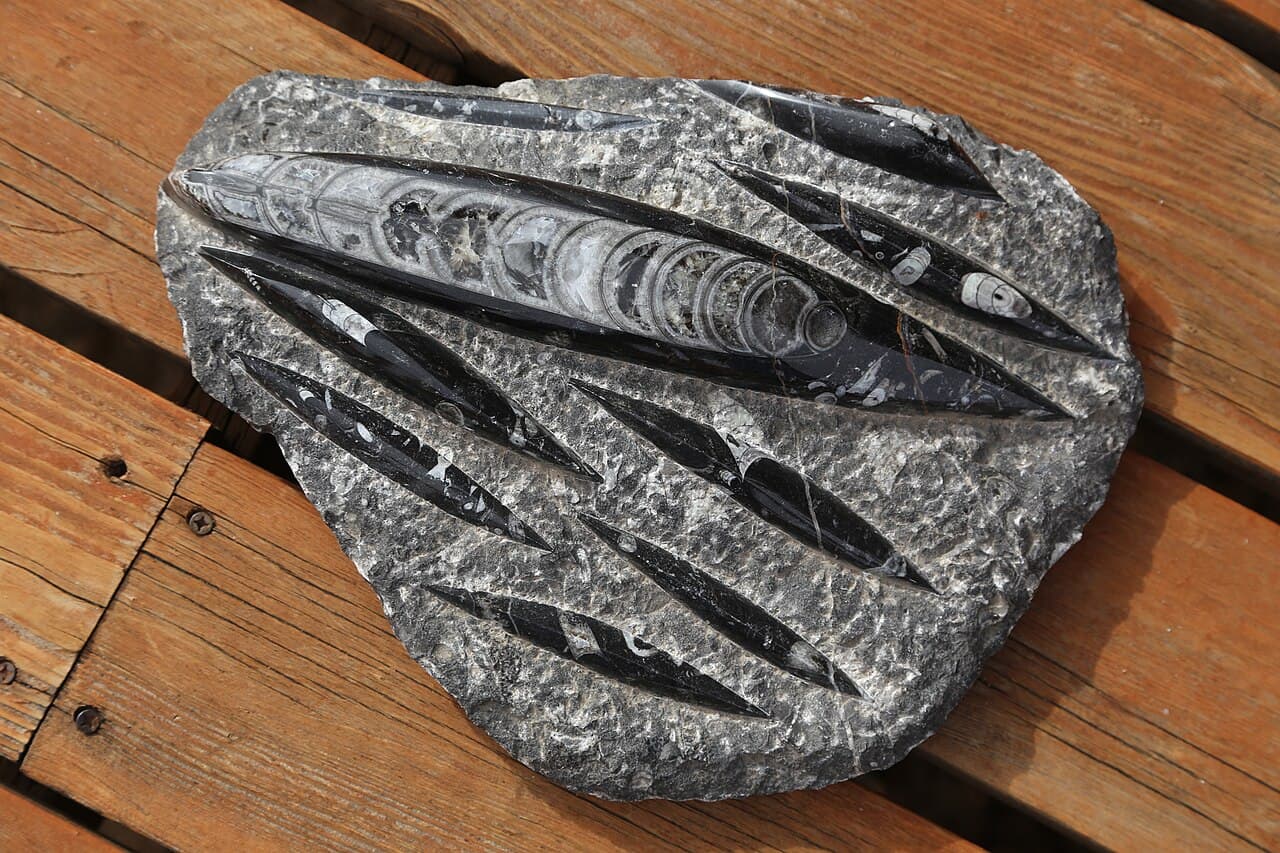
Orthoceras is the fossil of an extinct, straight-shelled marine cephalopod — an early relative of today's squid, cuttlefish, octopuses and the living nautilus. The name means "straight horn," and it is used loosely for a whole range of straight-shelled nautiloids known as orthocones. In life the animal lived inside a long, slender, gently tapering cone, jetting through Paleozoic seas and seizing prey with tentacles that reached out from the wide, open end of the shell. What you find as a fossil is that cone-shaped shell, usually preserved in cross-section so the internal structure is laid bare.
These are among the most recognizable of all fossils, largely because they are sold worldwide as polished black slabs, plates, dishes, bookends and clocks cut from a dark Moroccan limestone packed with their shells. On a cut and polished surface an Orthoceras shows the two features that define it: a series of curved internal walls (septa) that once divided the shell into gas-filled buoyancy chambers, and a thin tube (the siphuncle) running lengthwise through those chambers, often visible as a fine line or row of beads down the center. Because Orthoceras lived mainly in the Ordovician and Silurian periods, hundreds of millions of years ago, every genuine specimen is a window onto some of the earliest complex life in the oceans.
Orthoceras at a glance
- Classification
- Fossil — extinct straight-shelled marine cephalopod (nautiloid orthocone)
- Composition
- Shell originally aragonite/calcite (CaCO₃); fossils usually preserved or replaced in calcite within limestone matrix
- Hardness
- About 3, the hardness of the calcite that makes up the fossil and its limestone matrix
- Luster
- Dull on raw breaks; glassy and reflective on cut and polished surfaces
- Colors
- Cream, tan or pale gray shells set against dark gray to black polished limestone; some are brown or honey-toned
- Texture
- Elongated, tapering cone divided by curved internal walls (septa) with a central tube (siphuncle); commonly seen sliced and polished
How to identify it
An Orthoceras is identified by its shape and its internal plumbing. The overall form is a long, straight, gently tapering cone — narrow and pointed at one end (the earliest, juvenile part of the shell) and wider at the other (the body chamber, where the animal lived). Specimens range from a couple of centimeters to well over a foot long. On most pieces you are looking at a lengthwise slice through that cone, because the shells are usually cut and polished to reveal what is inside, but even on a weathered, uncut specimen you can often see faint ribbing or growth lines running around the cone.
The two clinching features are internal. First, the shell is divided along its whole length by a regular series of curved walls called septa; these were the partitions between the gas-filled chambers that made the shell buoyant, and on a polished face they show up as evenly spaced, gently curved lines crossing the cone like the rungs of a ladder. Second, running lengthwise through those chambers is the siphuncle, a slender tube that the living animal used to control buoyancy; it usually appears as a fine line or a string of small beads along the central axis. A straight, tapering, chambered cone with a central tube is an Orthoceras. The chambers are the key — they separate it instantly from solid fossils like belemnite guards.
How it formed / when it lived
Orthoceras and its kin were nautiloid cephalopods, part of the great early radiation of shelled cephalopods that ruled the seas long before fish became dominant. They lived chiefly during the Ordovician and Silurian periods of the Paleozoic Era — roughly the time when the first complex marine ecosystems were taking shape — though straight-shelled nautiloids as a broader group span a long stretch of geologic time. In life the animal occupied only the open body chamber at the wide end of the shell; behind it, the older chambers were sealed off by the septa and filled with gas, working like the flotation tanks of a submarine and letting the creature hover and move through the water while the siphuncle adjusted the balance.
When an Orthoceras died, the empty, gas-filled shell often settled to the sea floor and was buried in fine lime mud. Over time that mud hardened into limestone and the shell's chambers were filled and the original material recrystallized or replaced, usually as calcite, so the internal structure was locked permanently into the rock. In a few famous localities — most notably in Morocco, but also in parts of Scandinavia and elsewhere — the sea floor accumulated countless shells together, producing dense beds of dark limestone studded with Orthoceras. It is those beds that are quarried and sliced into the polished slabs and ornaments sold around the world today, which is why a single decorative plate can show many shells at once.
Types and varieties
Strictly speaking, "Orthoceras" once served as a catch-all name for almost any straight-shelled nautiloid, and many of the fossils sold under that label actually belong to a range of related orthocone genera. Scientists tell these apart by details such as how quickly the cone tapers, the spacing and curvature of the septa, the size and position of the siphuncle, and the patterning on the shell surface. For a collector or a curious finder, the practical varieties are mostly about shape and size — slender, fast-tapering cones versus longer, nearly parallel-sided ones — and about how the specimen has been preserved and presented.
Presentation is where most people meet Orthoceras. Common forms include single shells freed from the rock, lengthwise-polished half-cones that display the chambers and siphuncle beautifully, and whole black limestone slabs, plates, dishes, spheres and clocks crowded with multiple specimens. Color depends on the matrix: the classic look is pale cream or tan shells against a near-black polished background, but browner and grayer stones occur too. Whatever the form, the diagnostic combination stays constant — a straight, tapering, chambered cone with a central tube — and that is what separates a genuine Orthoceras from a smooth or solid look-alike.
Value, and real vs. fake
Orthoceras fossils are among the more affordable, because the Moroccan beds yield them in enormous quantity; simple polished pieces and mass-produced slabs and ornaments are inexpensive. Value rises with size, with the clarity and completeness of the internal chambers and siphuncle, with attractive contrast between a pale shell and a dark matrix, and with skillful preparation and polishing. Large single specimens, unusually long or well-defined shells, and pieces that also preserve other Paleozoic fossils alongside them sit above the common decorative material.
An important point of honesty: most polished Orthoceras pieces are genuine fossils set in genuine, naturally fossil-bearing limestone — the dark stone is simply cut and polished to show off the real shells inside, which is preparation, not faking. That said, a few cautions apply. Some shells on a slab may be enhanced or partly carved to make their outlines crisper, and entirely man-made resin or cast replicas do exist, so look for the genuine recrystallized internal structure — real septa and a real siphuncle have natural, slightly irregular detail, whereas a molded copy looks uniform, feels light or plasticky, and shows no true chambers. Buying from a seller who is clear about locality and preparation is the best protection, but with Orthoceras the visible internal anatomy is usually proof enough on its own.
Orthoceras look-alikes
Frequently asked questions
What is an Orthoceras?
Orthoceras is the fossil of an extinct, straight-shelled marine cephalopod — an early relative of squid and the nautilus. It lived inside a long, tapering cone divided into gas-filled buoyancy chambers, with a slender tube (the siphuncle) running through them. The name is also used loosely for many similar straight-shelled nautiloids, called orthocones.
How old are Orthoceras fossils?
Orthoceras lived mainly during the Ordovician and Silurian periods of the Paleozoic Era, hundreds of millions of years ago, with straight-shelled nautiloids as a group spanning a long stretch of geologic time. The polished specimens sold today commonly come from Ordovician–Silurian limestone in Morocco, so a genuine piece records life from very early in the history of complex animals.
Are polished black Orthoceras slabs real fossils or fakes?
They are almost always real. The shells are genuine fossils preserved in a naturally fossil-bearing dark Moroccan limestone, which is simply quarried, cut and polished to display them — that is preparation, not faking. Outlines are occasionally enhanced, and pure resin replicas do exist, so look for genuine internal chambers and a real siphuncle, which a molded copy cannot convincingly show.
How is Orthoceras different from a belemnite?
The quickest test is whether the fossil is chambered. An Orthoceras is a straight, tapering cone divided into chambers by curved walls (septa), with a central tube. A belemnite is a solid bullet-shaped guard of calcite with no chambers, showing a radiating sunburst pattern when broken or polished. Chambered cone equals Orthoceras; solid bullet equals belemnite.
Is yours orthoceras? Find out from a photo
Photograph your fossil in good light and get an identification with an honest confidence level, the look-alikes to rule out and the at-home tests that confirm it.
Identify my fossil freeOn Android? Get the free rock identifier app
Related
More fossils in the field guide
Keep exploring
More on fossils: identify a fossil from a photo, how to identify a rock and the Mohs hardness scale.
Last updated 2026-06-25. Identification guidance is educational — confirm important results with the diagnostic tests described or a qualified expert.