Ammonite
Also known as: Ammonite fossil, Snakestone (historical)
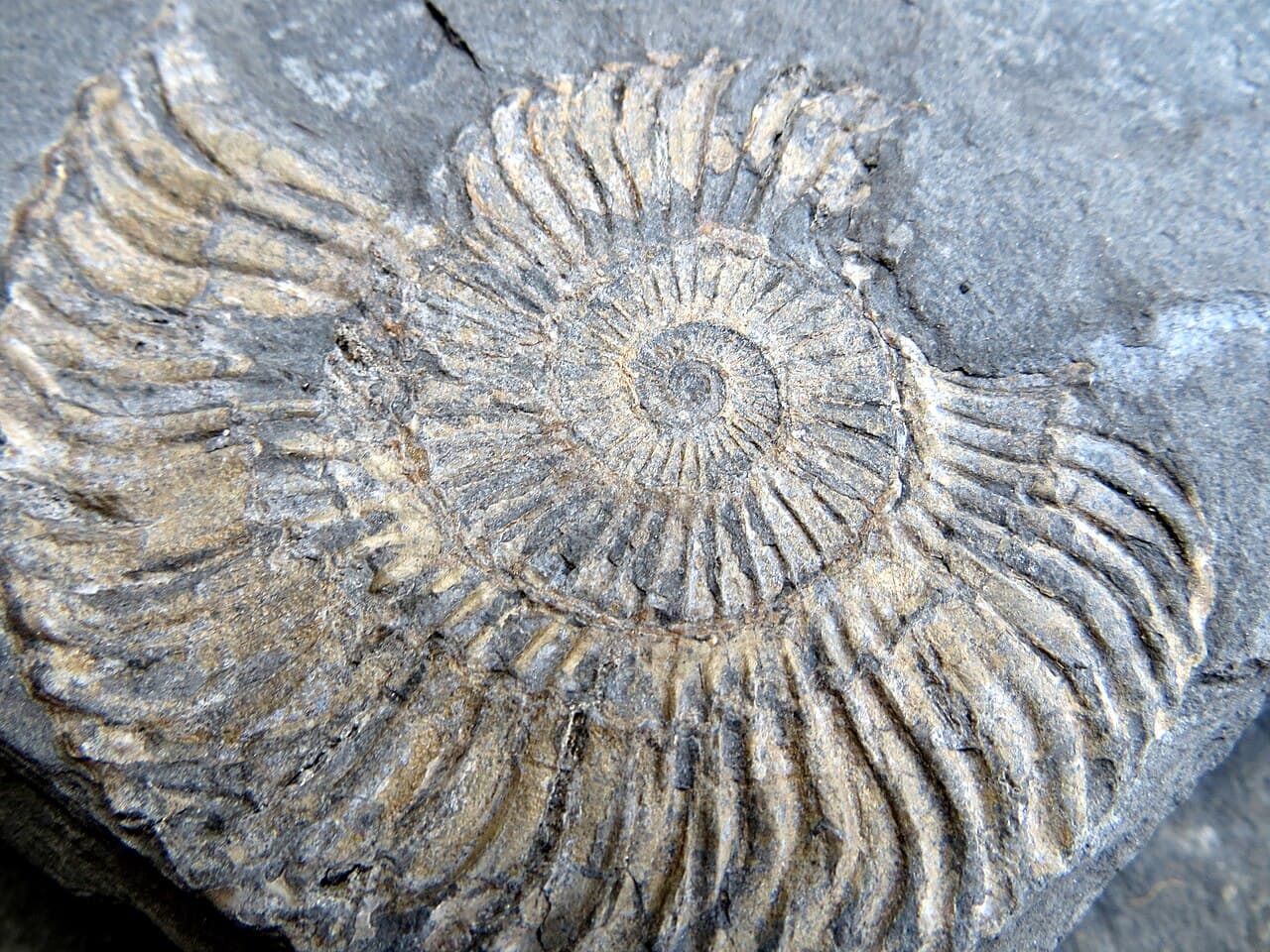
An ammonite is the fossilized shell of an extinct marine animal — not a snail, as the coiled shape might suggest, but a cephalopod, the same group that today includes squid, octopuses, cuttlefish and the living nautilus. The animal lived inside the open end of a coiled, chambered shell, jetting through ancient seas and trailing tentacles much like its relatives do now. Because the soft body almost never survived, what you find is the hard shell itself, wound into a flat spiral and divided inside into a series of gas-filled chambers that let the living animal control its buoyancy.
Ammonites are among the most beloved and recognizable fossils in the world, prized for their elegant geometry and for the wavy, frilly lines that run across the shell where the internal chamber walls met it. They first appear in rocks of the Devonian Period, more than 400 million years ago, and went on to fill the seas of the entire Mesozoic Era before vanishing completely in the same mass extinction that ended the age of dinosaurs. A coiled ammonite on a shelf is therefore a snapshot of a vanished ocean and a creature that has no exact living counterpart.
Ammonite at a glance
- Classification
- Fossil — extinct marine cephalopod (subclass Ammonoidea)
- Hardness
- Varies with the replacing mineral, not the original shell (e.g. calcite ~3, pyrite ~6, silica ~7)
- Colors
- Brown, gray, black, tan; iridescent green-red-gold when preserved as ammolite
- Texture
- Coiled chambered shell, originally aragonite/calcite; commonly recrystallized or replaced by pyrite, calcite or silica
How to identify it
The first thing to look for is the shape: a flat, tightly wound spiral that coils in a single plane, like a ram's horn pressed flat or a coiled rope seen from the side. Most ammonites you find are this planispiral form, and many show ribs, ridges or knobs running outward across the coil. The widening tube of the shell gets larger as it spirals out from the center, ending at the open mouth where the animal lived. That regular, expanding coil — rather than the screw-like, three-dimensional twist of a snail — is the strongest first clue that you are holding a cephalopod and not a gastropod.
The decisive feature, though, is the suture lines. Inside, an ammonite shell was partitioned into many chambers by thin curved walls called septa, and where each septum met the outer shell it traced a line. On a worn or polished specimen these lines show up as intricate, wavy, frilly patterns — like the outline of an oak leaf or a fern — looping back and forth across the shell. Truly complex, lacy sutures are unique to ammonites; their living relative the nautilus has only simple, smooth, gently curved partitions. If you can see frilly suture lines, or the spiral pattern of internal chambers on a cut and polished face, the identification as an ammonite is essentially settled.
When it lived
Ammonites belong to the subclass Ammonoidea, a branch of shelled cephalopods that first appears in the fossil record during the Devonian Period, roughly 409 million years ago. They survived several earlier extinction events and then radiated spectacularly through the Mesozoic Era — the Triassic, Jurassic and Cretaceous periods — evolving so rapidly into so many distinct forms that geologists use them as classic index fossils to date and correlate marine rock layers around the world. For much of that time they were abundant open-water animals, which is why their shells turn up so commonly in marine sediments.
Their long story ended at the close of the Cretaceous Period, about 66 million years ago, in the same end-Cretaceous mass extinction that wiped out the non-bird dinosaurs. Ammonites disappeared entirely and left no descendants, so every genuine ammonite fossil is at least roughly 66 million years old, and many are far older. Their close cousins the nautiloids squeaked through the same event and survive today as the pearly nautilus, which is the nearest living thing to a real ammonite — though even it is only a distant relative, not the same animal.
Types and varieties
Ammonites were enormously diverse, and thousands of species have been described across their long history. Most are the familiar tightly coiled, flat spiral, but the group also produced striking oddities: partly uncoiled and hook-shaped forms, loosely wound open spirals, and even nearly straight or irregularly twisted shells, especially toward the end of the Cretaceous. The ornament varies just as much — some shells are smooth, others carry strong ribs, rows of spines or bold knobs — and these differences in coiling and ornament, together with the exact pattern of the suture lines, are how specialists tell one kind from another.
Size ranges from small coins a centimeter or two across up to giants. While most collected specimens fit comfortably in the hand, the largest known ammonites reached well over a meter in diameter — close to two meters in a few exceptional cases — making them some of the biggest shelled animals that ever lived. Preservation also creates distinct 'looks': shells turned to glittering golden pyrite, specimens recrystallized into honey-colored or white calcite, and most prized of all, ammolite — the rare gem-quality fossil shell that displays a brilliant iridescent play of green, red and gold and is cut and sold as a gemstone in its own right.
Value, and real vs. fake
Common ammonites are inexpensive and widely sold; many polished halves and small whole specimens are affordable curiosities, because the animals were so abundant. Value climbs with size, completeness, sharp natural detail, attractive preservation (well-formed pyritized or fully iridescent ammolite pieces command the highest prices), and reliable information about the species and where it was found. Cut-and-polished pairs that reveal the internal chambers, and large display-quality specimens, sit well above the common tumbled or rough material.
Outright fakes of ammonites are less common than with some fossils, but a few traps are worth knowing. Resin casts and molded copies do exist: tell-tale signs are a suspiciously light, plasticky feel, visible mold seams, air bubbles, perfectly identical 'specimens' repeated across a seller's table, and color that sits on the surface rather than running through the material. More common than total fakes are composites and heavy restoration — real fragments assembled with sculpted or glued-in filler, or cracks and missing sections quietly repaired. Examine the piece for seams where texture, grain or color changes abruptly, and be cautious of detail that looks too crisp and symmetrical to be natural. Because a genuine fossil shows the small imperfections of a once-living shell, buying from a reputable dealer who states the species, locality and any restoration is the surest protection.
Ammonite look-alikes
Frequently asked questions
What is an ammonite?
An ammonite is the fossilized coiled, chambered shell of an extinct marine cephalopod — a relative of squid, octopuses and the living nautilus, not a snail. The animal lived in the open end of the shell and used the internal gas-filled chambers for buoyancy. Ammonites belong to the subclass Ammonoidea and are known for the wavy suture lines on their shells.
How old are ammonites and when did they go extinct?
Ammonites first appear in the Devonian Period, about 409 million years ago, and flourished through the Mesozoic Era. They went completely extinct at the end of the Cretaceous, roughly 66 million years ago, in the same mass extinction that ended the non-bird dinosaurs. Every genuine ammonite is therefore at least about 66 million years old, and many are much older.
How can I tell an ammonite from a nautilus or a snail?
Look at the partition lines and the coil. An ammonite shows complex, frilly, wavy suture lines where the chamber walls met the shell, and it coils flat in a single plane. A nautilus has simple, smoothly curved sutures, while a snail shell typically twists like a screw or cone and has no internal chambers or sutures at all.
Are ammonites worth money?
Common ammonites are inexpensive because the animals were so abundant, but value rises sharply with size, completeness, sharp natural detail and attractive preservation. Pyritized 'golden' shells and fully iridescent ammolite are the most prized. Documented species, locality and condition all drive the price, and you should watch for resin casts, composites and undisclosed restoration.
Is yours ammonite? Find out from a photo
Photograph your fossil in good light and get an identification with an honest confidence level, the look-alikes to rule out and the at-home tests that confirm it.
Identify my fossil freeOn Android? Get the free rock identifier app
Related
More fossils in the field guide
Keep exploring
More on fossils: identify a fossil from a photo, how to identify a rock and the Mohs hardness scale.
Last updated 2026-06-24. Identification guidance is educational — confirm important results with the diagnostic tests described or a qualified expert.