Limestone
Also known as: Calcium carbonate rock, Calcareous rock
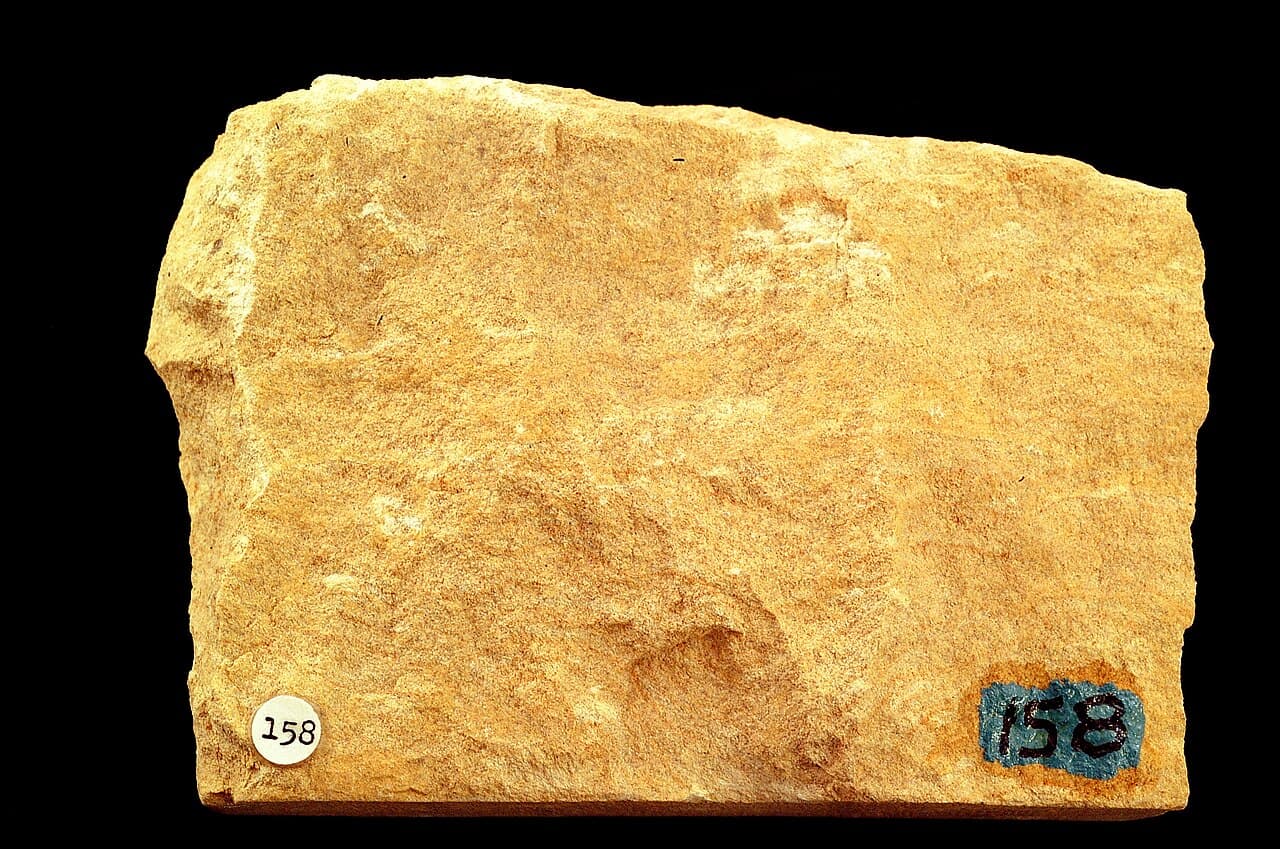
Limestone is a sedimentary rock made up mainly of calcium carbonate, almost always in the form of the mineral calcite (CaCO₃). Much of it is biochemical in origin, built from the calcium-carbonate shells, skeletons, and hard parts of marine organisms — corals, clams, snails, crinoids, and microscopic plankton — that pile up on the floors of warm, shallow seas and are gradually cemented into stone. Some limestone instead forms chemically, when calcium carbonate precipitates directly out of mineral-saturated water. Either way, the defining ingredient is carbonate, which sets limestone apart from the silica-based sandstones and the silicate-rich igneous and metamorphic rocks.
The single most useful fact about limestone is that it reacts with acid. Because it is calcium carbonate, a drop of dilute hydrochloric acid — or even ordinary household vinegar — placed on a fresh surface will fizz and effervesce as the carbonate breaks down and releases carbon dioxide gas. That fizz test is the classic, near-definitive field check for limestone. The rock is also relatively soft (calcite is only about 3 on the Mohs scale, so a steel knife scratches it easily), it comes in muted grays, tans, creams, and whites, and it very often contains visible fossils — making it one of the most recognizable and economically important rocks on Earth.
Limestone at a glance
- Classification
- Sedimentary rock — biochemical/chemical (carbonate)
- Rock type
- Sedimentary
- Composition
- Mainly calcite, CaCO₃ (calcium carbonate)
- Hardness
- ~3 (Mohs) — scratched by a steel knife
- Luster
- Dull to earthy
- Streak
- White
- Colors
- Gray, tan, cream, and white; sometimes buff or pale brown
- Texture
- Ranges from fine-grained and dense to coarsely fossil-rich; grains are carbonate (shells, ooids, mud) rather than silica sand
What type of rock is limestone?
Limestone is a sedimentary rock. Within the sedimentary group it is a carbonate rock, and it is usually described as biochemical — assembled from the carbonate hard parts of once-living organisms — or chemical, precipitated directly from water. This distinguishes it from clastic sedimentary rocks like sandstone, which are built from broken mineral grains; limestone is built from carbonate instead.
It is not an igneous rock: it does not crystallize from molten magma the way granite or basalt does. And in its ordinary state it is not metamorphic either — but it has an important metamorphic counterpart. When limestone is subjected to heat and pressure deep in the crust, its calcite recrystallizes into a coarser, interlocking, crystalline texture and becomes marble. So limestone is the sedimentary parent rock, and marble is the metamorphic rock that forms from it.
How limestone forms
Most limestone forms in warm, shallow, clear marine settings — the kind of seas that today host coral reefs and carbonate banks. There, a huge variety of organisms extract calcium and carbonate from seawater to build their shells and skeletons. As they die, those hard parts accumulate on the seafloor along with fine carbonate mud, and over time burial, compaction, and cementation lithify the mass into solid rock. Because the rock is essentially fossilized sea life, many limestones are packed with recognizable shells, coral fragments, and the button-like stem segments of crinoids.
Limestone can also form by direct chemical precipitation. In some warm or evaporating waters, calcium carbonate comes out of solution to coat sand grains in tiny concentric spheres called ooids, producing an oolitic limestone. On land, carbonate-charged groundwater emerging from springs and dripping through caves precipitates travertine and the dripstone of stalactites and stalagmites — also calcium carbonate. Across all these settings the common thread is the same: dissolved calcium carbonate is concentrated and then deposited, whether by organisms or by chemistry, to build the rock.
How to identify limestone
The acid test is the headline check. Put a drop of dilute hydrochloric acid — or household vinegar — on a fresh surface: limestone fizzes briskly as carbon dioxide bubbles off. A strong, immediate effervescence on solid rock is close to definitive for limestone, because the silica-based and silicate rocks it might be confused with do not react this way. Run the test on a small, inconspicuous spot, since the acid lightly etches the surface.
Back up the fizz test with hardness and appearance. Limestone is soft: its calcite is only about Mohs 3, so a steel knife or nail scratches it readily and a fresh scratch may yield a little white powder — far softer than quartz-rich rocks, which the knife cannot touch. The rock is typically a muted gray, tan, cream, or white, dull rather than glassy, and often fine-grained. Finally, look for fossils: visible shells, coral, or the round stem segments of crinoids are common in limestone and clinch the identification when present. Be aware of one near-relative — dolostone (dolomite rock) looks similar and is also a carbonate, but it reacts only weakly with acid and usually fizzes noticeably only when scratched to a powder, so a sluggish reaction points toward dolostone rather than true limestone.
Colors and varieties
Pure limestone is white to pale cream, and most of the variation in color comes from small amounts of other material mixed in: clay and organic matter darken it toward gray, while iron can lend tan, buff, or pale-brown tints. The overall palette stays muted and earthy rather than vivid.
Limestone takes many named forms depending on how it formed and what it contains. Fossiliferous limestone is crowded with visible shells and skeletal fragments. Oolitic limestone is built from tiny spherical ooids and has a fine, egg-roe texture. Chalk is a soft, fine-grained, porous white limestone made largely from the microscopic plates of marine plankton. Travertine and tufa are spongy or banded limestones precipitated from spring and cave waters on land. Coquina is a loosely cemented limestone composed almost entirely of shell debris. All of them are calcium carbonate at heart and all will respond to the acid test.
What limestone is used for
Limestone is one of the most heavily used rocks in industry, and its single biggest role is in cement. Crushed and heated, it is the primary raw material for Portland cement and for lime (calcium oxide), which underpin concrete, mortar, and plaster — making limestone a foundation of modern construction in the most literal sense. Enormous quantities are also crushed into aggregate for road base, concrete, and railway ballast.
It serves many other purposes as well. Cut and dressed, limestone is a classic building and dimension stone for walls, facing, and flooring, valued for its even color and workability. Ground limestone is spread on fields as agricultural lime to neutralize acidic soils and supply calcium. It is used as a flux in steelmaking to draw off impurities, in flue-gas treatment to capture sulfur, and as a filler and source of calcium carbonate in products ranging from glass to antacids. Underground, porous limestone also acts as an aquifer and, in places, as a petroleum reservoir.
Limestone look-alikes
Frequently asked questions
What type of rock is limestone?
Limestone is a sedimentary rock — a carbonate rock made mainly of calcium carbonate (calcite), usually formed from the shells and skeletons of marine organisms or by chemical precipitation. It is not igneous or metamorphic, though heat and pressure can transform it into the metamorphic rock marble.
How can I identify limestone?
The classic test is to place a drop of dilute acid or vinegar on a fresh surface — limestone fizzes as it releases carbon dioxide. It is also soft enough to be scratched by a steel knife, is usually gray, tan, or cream and dull rather than glassy, and frequently contains visible fossils such as shells or crinoid stems.
What is the difference between limestone and marble?
Marble is limestone that has been metamorphosed by heat and pressure, so its calcite has recrystallized into an interlocking, sugary, crystalline texture that takes a polish and rarely shows fossils. Limestone is duller, finer or more shell-rich, and often fossiliferous. Since both fizz in acid, tell them apart by texture rather than the acid test.
What is limestone used for?
Limestone is the main raw material for cement and lime, the basis of concrete and mortar, and is crushed in huge volumes for road and construction aggregate. It is also used as building stone, as agricultural lime to reduce soil acidity, as a flux in steelmaking, and as a source of calcium carbonate in many industrial and consumer products.
Is yours limestone? Find out from a photo
Photograph your rock in good light and get an identification with an honest confidence level, the look-alikes to rule out and the at-home tests that confirm it.
Identify my rock freeOn Android? Get the free rock identifier app
Related
More rocks in the field guide
Keep exploring
More on rocks: how to identify a rock, what kind of rock is this and the Mohs hardness scale.
Last updated 2026-06-24. Identification guidance is educational — confirm important results with the diagnostic tests described or a qualified expert.