Shark Tooth
Also known as: Fossil shark tooth, Fossilized shark tooth
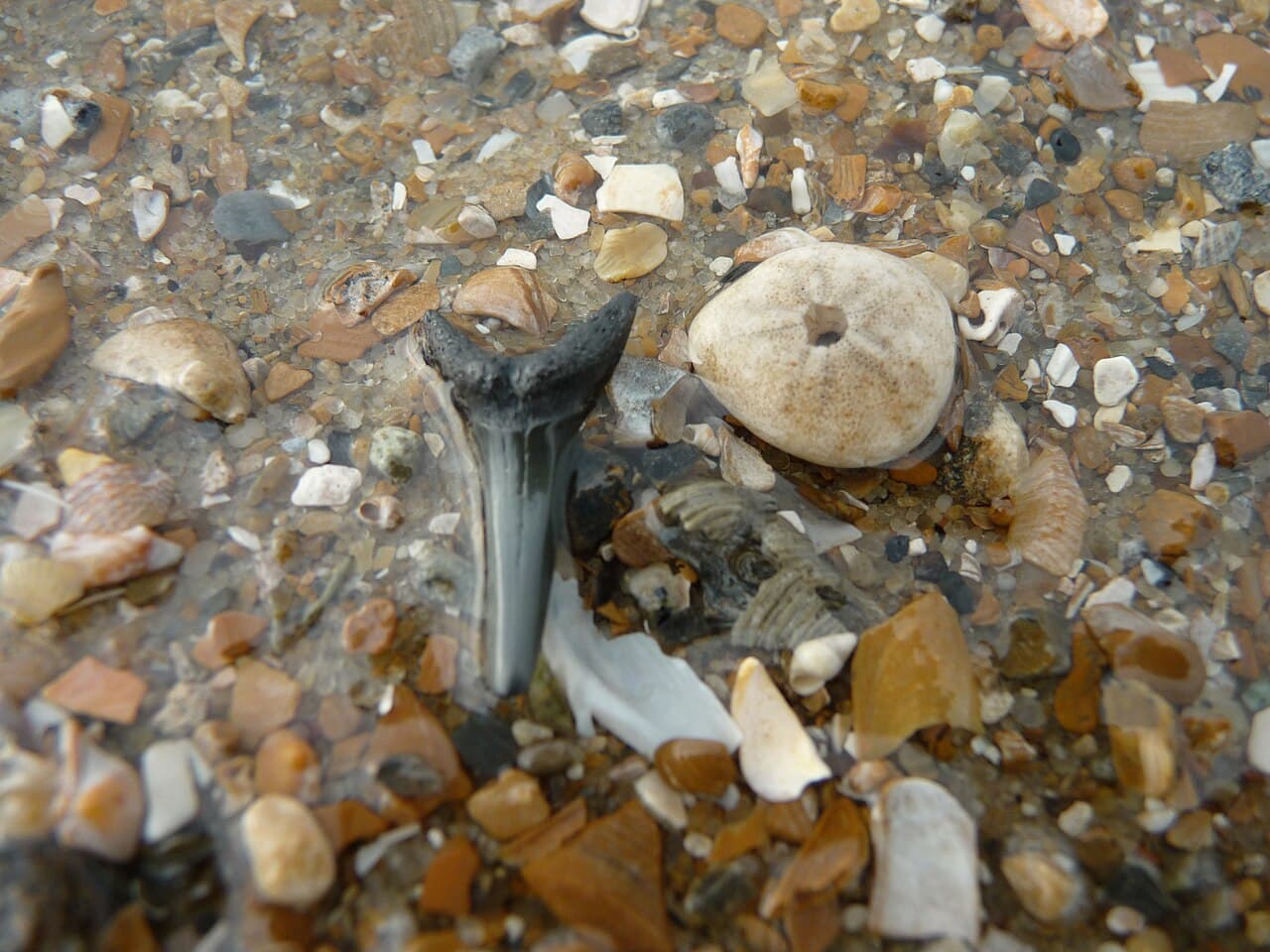
A fossil shark tooth is the mineralized, preserved tooth of a shark that lived in ancient seas. Sharks are unusual among predators in that they constantly grow and shed teeth — a single shark can produce and lose many thousands over its lifetime as worn or broken teeth are replaced by new ones moving forward like a conveyor belt. Because shark skeletons are made of cartilage, which rarely fossilizes, those hard, mineral-rich teeth are by far the most common shark remains left in the rock record, and they litter certain marine deposits in extraordinary numbers.
Over thousands to millions of years, a buried tooth slowly absorbs minerals from the surrounding sediment and turns to stone, a process that usually darkens it to gray, brown, blue-black or jet black, in contrast to the white of a modern or recently shed tooth. The basic anatomy survives beautifully — a hard, enamel-like crown, sometimes finely serrated edges, and a porous root — so even a small black triangle picked off a beach is an identifiable piece of a long-dead animal. The most famous fossil teeth of all belong to the giant extinct shark Otodus megalodon, whose teeth can exceed the span of a human hand.
Shark Tooth at a glance
- Classification
- Fossil — mineralized shark tooth (class Chondrichthyes)
- Hardness
- Crown is hard and glassy; mineralized teeth vary with the replacing minerals
- Colors
- Gray, black, brown, blue-black, tan; modern (un-fossilized) teeth are white
- Texture
- Hard enamel-like crown over a porous root; original material gradually replaced and darkened by minerals during fossilization
How to identify it
Three features do most of the work: the crown, the edges and the root. The crown is the hard, often glossy blade that did the cutting; its outline — broad triangle, narrow dagger, hooked spike or low cusp — is the single biggest clue to which kind of shark and roughly which era a tooth comes from. Run a fingernail or a loupe along the cutting edges: many predatory sharks have fine serrations like a steak knife, and the size and regularity of those teeth-on-the-edge help pin down the species. Below the crown sits the root, the thicker, often two-lobed base that anchored the tooth in the jaw; in fossils it is typically more porous and duller than the enamel crown, and its shape and the small nutrient opening on it are further identification clues.
Color and feel separate a true fossil from a recent tooth. Fossilization usually turns teeth gray, brown, blue-black or black as minerals replace the original material, so a dark, stone-heavy tooth pulled from sediment or surf is almost certainly fossilized, whereas a chalky-white, lightweight tooth is likely modern. A fossil tooth feels dense and rock-like and may show the dull, slightly porous texture of the root against the smoother crown. Note that color alone cannot pin down the age precisely — local minerals tint teeth differently — so it confirms 'fossil versus fresh' more than it dates the specimen.
When it lived
Sharks are an ancient group: recognizable sharks and their relatives go back to the Devonian Period, well over 400 million years ago, and the broad lineage has survived every major mass extinction since. That deep history means fossil shark teeth can in principle come from an enormous span of geologic time. In practice, the great majority of teeth that collectors actually find weather out of much younger marine rocks and sediments — broadly Cretaceous through the Neogene, the tens of millions of years in which many familiar shark groups were abundant and their shed teeth piled up in shallow seas.
The celebrity of the group, Otodus megalodon, lived during the Neogene — flourishing in the Miocene and Pliocene before dying out a few million years ago — and was one of the largest predatory sharks that ever lived. Its teeth are broad, heavy triangles with fine serrations and can reach around seven inches along the slant, which is why they are so coveted. Because a single tooth rarely carries a precise date on its own, collectors lean on where it was found — the formation and locality — to assign an age, which is one more reason good provenance matters.
Types and varieties
The variety of fossil shark teeth mirrors the variety of sharks and their diets. Broad, triangular, finely serrated teeth come from cutting predators built to take large prey; the teeth of Otodus megalodon and of fossil relatives of the great white are classic examples of this heavy triangular design. Narrow, smooth, gently curved or dagger-like teeth belong to sharks that gripped slippery fish — sand tiger teeth, with their slender central spike flanked by tiny side cusps, are among the most commonly found and easily recognized. Low, flattened or button-like teeth come from sharks and rays that crushed shellfish rather than slicing flesh.
Size ranges from teeth just a few millimeters across, shed by small sharks, up to the giant megalodon teeth measured in inches. When identifying a specimen, collectors weigh the whole package: overall shape and size, whether the edges are serrated or smooth, the form of the root, and the position the tooth held in the jaw (teeth from the front, side and rear of the same shark can look quite different). Matching all of those against known species — ideally alongside the locality it came from — is what turns 'a shark tooth' into a named one.
Value, and real vs. fake
Most fossil shark teeth are inexpensive: small, common teeth turn up by the thousands in many marine deposits and sell for very little. Value climbs with size, completeness and condition — an intact tip, undamaged serrations, an unbroken root and good color all matter — and with the desirability of the species. Large, complete megalodon teeth are the prizes of the field and can be genuinely valuable, especially when they are big, sharp-edged, richly colored and come with reliable locality information; broken, repaired or restored teeth are worth far less than flawless ones.
Because megalodon teeth are so sought after, they are also the most heavily faked, usually as resin or plaster casts. The tells are learnable. A real fossil tooth is dense and heavy for its size and feels like stone; a cast often feels suspiciously light. Look for mold seams along the edges, trapped air bubbles, and detail that is too perfect — natural teeth carry small chips, wear and slight asymmetry, while casts are eerily symmetrical and uniform. A genuine tooth shows a real distinction between the glassy crown and the porous, fibrous-looking root, and its serrations are crisp where preserved and worn where not; a cast tends to have flat, uniform color, no true enamel sheen, and a smooth or fake-looking root. Repairs and composites are also common on large teeth — watch for color or texture that changes abruptly across the surface, hinting at filler. As always, an honest seller who states the species and locality, and is upfront about any restoration, is the best safeguard.
Shark Tooth look-alikes
Frequently asked questions
What is a fossil shark tooth?
It is the mineralized, preserved tooth of a shark that lived in ancient seas. Sharks shed thousands of teeth in a lifetime, and because their cartilage skeletons rarely fossilize, the hard teeth are by far the most common shark remains. Buried for thousands to millions of years, a tooth absorbs minerals, turns to stone and usually darkens to gray, brown or black.
How can I tell a fossil shark tooth from a modern one?
Color and weight are the quickest checks. Fossilization usually darkens teeth to gray, brown, blue-black or black and makes them dense and stone-like, while modern or recently shed teeth are typically white or cream and feel light. A dark, heavy tooth from sediment or surf is almost certainly fossilized; a chalky-white, lightweight one is likely modern.
How big do megalodon teeth get?
Otodus megalodon was one of the largest predatory sharks ever, and its teeth are broad, heavy, finely serrated triangles that can reach around seven inches along the slant. Most teeth collectors find are smaller, but those very large, complete examples are the most coveted in the field.
How do I spot a fake megalodon tooth?
Most fakes are resin or plaster casts. Warning signs include a suspiciously light weight, mold seams along the edges, trapped air bubbles, flat uniform color with no enamel sheen, and detail that is too perfect and symmetrical. A real tooth is heavy and stone-like, shows a glassy crown distinct from a porous root, and carries natural chips and slight asymmetry. Large teeth are also often repaired, so watch for color or texture that changes abruptly across the surface.
Is yours shark tooth? Find out from a photo
Photograph your fossil in good light and get an identification with an honest confidence level, the look-alikes to rule out and the at-home tests that confirm it.
Identify my fossil freeOn Android? Get the free rock identifier app
Related
More fossils in the field guide
Keep exploring
More on fossils: identify a fossil from a photo, how to identify a rock and the Mohs hardness scale.
Last updated 2026-06-24. Identification guidance is educational — confirm important results with the diagnostic tests described or a qualified expert.