Crinoid
Also known as: Sea lily, Feather star, Indian beads, Star stones, Fairy money
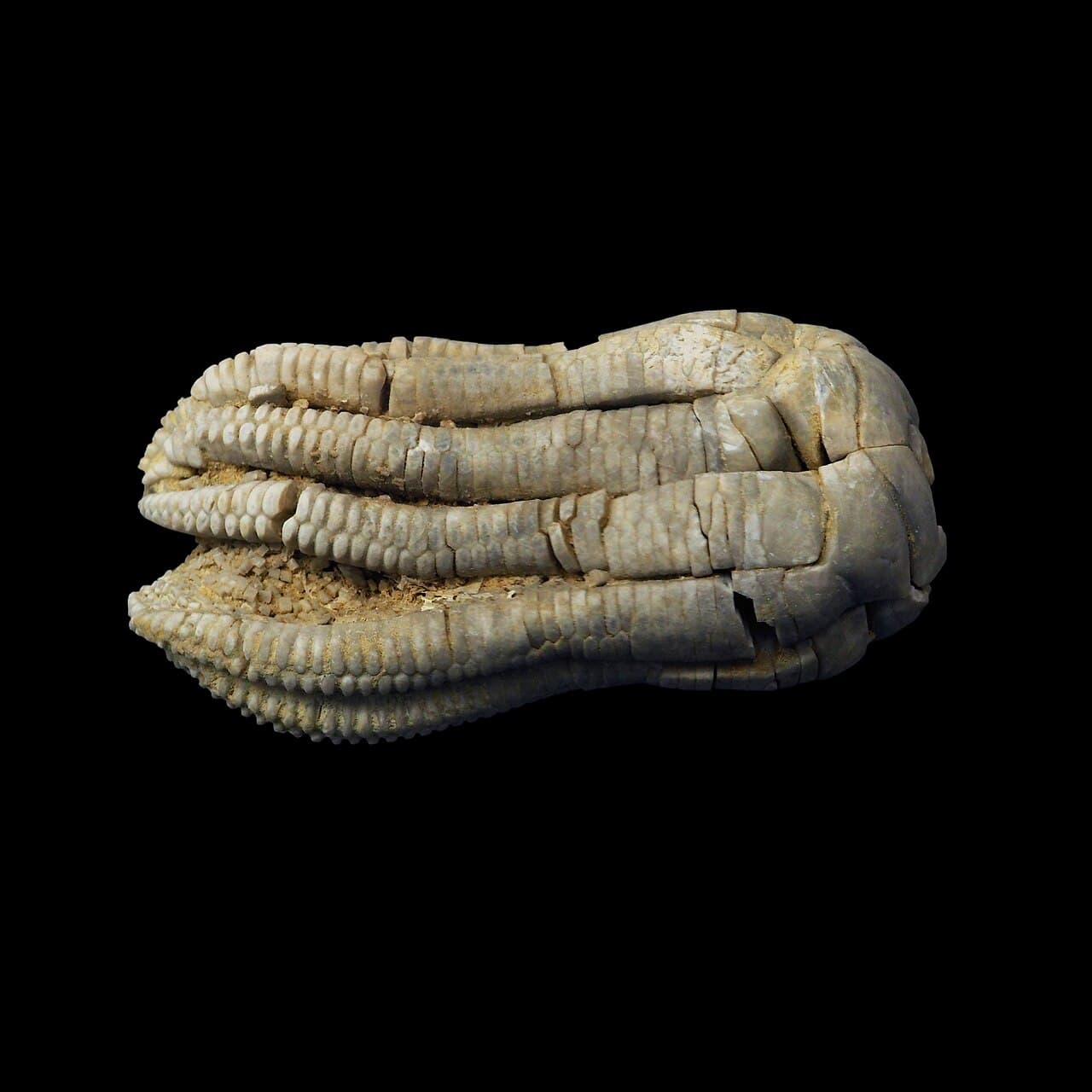
A crinoid is the fossil of a marine animal called a crinoid — and despite common nicknames like "sea lily," it is an animal, not a plant. Crinoids are echinoderms, the same group as starfish, sea urchins and sand dollars, and they are still alive in today's oceans. A living crinoid looks deceptively flower-like: a cup-shaped body holding the animal's organs, crowned by a ring of feathery arms used to filter food from the water, and in many species a long stalk that anchors it to the sea floor. That plant-like appearance is exactly why people have mistaken them for fossilized flowers or plants for centuries.
What you almost always find as a fossil is not the whole animal but pieces of its stalk. Crinoid skeletons are built from many small plates of calcite, and the stalk is a stack of disc- or star-shaped segments called columnals (also known as ossicles). When the animal died and broke apart, these little beads scattered and fossilized in huge numbers, which is why crinoid stem segments are some of the most abundant fossils in many limestones. Folklore gave them charming names — "Indian beads," "star stones" and "fairy money" — because the round, often star-centered segments look like tiny coins or beads with a hole through the middle.
Crinoid at a glance
- Classification
- Fossil — marine echinoderm (class Crinoidea); relatives of starfish and sea urchins
- Composition
- Skeleton of calcite, CaCO₃ (often recrystallized or silica-replaced during fossilization)
- Hardness
- About 3 (Mohs) where the calcite is preserved; higher if replaced by silica
- Luster
- Dull to slightly vitreous; calcite segments may show a crystalline sparkle on a fresh break
- Colors
- Cream, tan, gray, brown, black; often the color of the surrounding limestone
- Texture
- Disc- or star-shaped stem segments, sometimes whole crowns with cup and feathery arms; preserved in limestone
How to identify it
By far the most common crinoid fossil is the stem segment, and it has an instantly recognizable shape: a small, round (or sometimes five-pointed star-shaped) disc, usually a few millimeters across, with a tiny hole or a small central pattern in the middle, like a bead, washer or Cheerio. They often turn up as separate beads weathered out of the rock, or stacked in short columns that look like a screw or a tiny roll of coins where part of the stalk stayed together. The central canal — the hole that ran down the living stalk — and the radial star pattern around it are the clinching details that mark a piece as a crinoid columnal rather than just a pebble.
Far rarer, and much more prized, are crinoid "crowns" — fossils that preserve the cup-shaped body (the calyx) together with the feathery arms fanning out above it. These look genuinely flower-like and are usually found pressed flat on a slab of limestone or shale. If you find a fossil showing a small cup with delicate, branching, fern-like arms, that is the complete head of the animal. Whether you are looking at a single bead, a stacked stem, or a full crown, the underlying clue is the same: crinoid skeleton is made of calcite plates with five-fold (star-like) symmetry, the hallmark of an echinoderm.
When it lived
Crinoids have an exceptionally long history. They first appear in the fossil record in the Ordovician Period, around 480 million years ago, and they are still living in the oceans today, which makes them one of the longest-surviving animal groups you can hold in fossil form. During the Paleozoic Era — especially the Mississippian (Lower Carboniferous) — crinoids were astonishingly abundant, carpeting shallow tropical sea floors in vast "meadows" of stalked animals. So many of them lived and died in these warm seas that their broken-up calcite plates piled up to form thick rock layers; a great deal of the world's "crinoidal limestone" is literally made of crushed crinoid debris, which is why their stem beads are such common fossils.
After near-extinction in the great end-Permian event about 252 million years ago, the group recovered and evolved into new forms, including the stalkless, free-swimming "feather stars" that are common in modern seas. Fossilization itself happened in the usual marine way: when a crinoid died, soft tissue decayed and the calcite skeleton fell apart, and the pieces were buried in lime mud or sand on the sea floor. Over time that sediment hardened into limestone or shale, with the calcite segments preserved inside it — sometimes still as calcite, sometimes recrystallized or replaced by silica. A whole, articulated crown is rare precisely because it required rapid, gentle burial before the animal disintegrated.
Types and varieties
For a collector or identifier, crinoid fossils fall into a few practical categories based on what part is preserved. The most common is loose stem segments — the individual round or star-shaped "beads," the basis of the "Indian bead" and "fairy money" folklore. Next are stem sections, short stacks of columnals still joined into a column that can resemble a screw, a worm, or a roll of tiny coins. Less common are partial crowns showing the cup, and rarest of all are complete crowns with the calyx and a full spread of feathery arms, which are the showpiece specimens that fetch real interest from collectors.
Among living and fossil crinoids there is also a basic split in body plan that affects what you find: stalked crinoids (the classic "sea lilies," which anchor to the bottom by a stem) versus stalkless crinoids (the "feather stars," which can crawl and swim and dominate modern reefs). Most Paleozoic fossils are stalked forms, which is why stem beads are everywhere, while complete feather-star fossils are unusual. The shape of the columnals helps narrow things down too — round, pentagonal (five-sided) and elliptical stem segments all occur, and the five-pointed star pattern in the center is a particularly satisfying confirmation that a small disc is genuinely a crinoid.
Value, and real vs. fake
Crinoid fossils span a wide range of value, driven almost entirely by completeness. Loose stem segments and chunks of crinoidal limestone full of beads are extremely common and inexpensive — they are often sold by the bag and are a favorite first fossil for children. Short articulated stem sections are a step up. The real value lies in well-preserved crowns: a complete crinoid with an intact cup and a clean, fully spread fan of arms, expertly prepared on an attractive slab, can be a genuinely valuable and sought-after specimen, especially from famous fossil beds. Size, the sharpness of detail, how much of the animal is preserved, and the quality of preparation all push the price up.
Outright faking of crinoids is uncommon, mainly because loose segments are so cheap that copying them makes no sense, but two honest pitfalls are worth knowing. First, beautifully prepared crown specimens sometimes involve composites or restoration — arms or a cup assembled or reconstructed from multiple individuals, or missing pieces filled in — so for high-value crowns it pays to ask about restoration and buy from a reputable dealer. Second, and more common, is simple misidentification: small round stem beads can be confused with other little fossils or with non-fossil grains. The safeguards are the diagnostic features themselves — a genuine crinoid columnal shows the central canal (the hole) and the five-fold star or radial pattern, and is made of calcite, so it is relatively soft (around hardness 3) and will fizz in dilute acid unless it has been silicified.
Crinoid look-alikes
Frequently asked questions
What is a crinoid?
A crinoid is a marine animal — an echinoderm related to starfish and sea urchins — that is often nicknamed a 'sea lily' or 'feather star' because of its flower-like shape. It has a cup-shaped body, feathery filter-feeding arms and, in many species, a long stalk. As a fossil you usually find pieces of that stalk: small, round or star-shaped calcite segments called columnals. Crinoids first appeared in the Ordovician and still live in the oceans today.
Are crinoids plants or animals?
Crinoids are animals, not plants, even though 'sea lily' makes them sound botanical. They are echinoderms, the same group as starfish, sea urchins and sand dollars, and they feed by filtering tiny particles from seawater with their arms. The plant-like look — a 'stem,' a 'cup' and feathery 'fronds' — is just a coincidence of body shape that has fooled observers for centuries.
What are the little round 'beads' people call Indian beads or fairy money?
Those are crinoid stem segments (columnals). When a crinoid died, its calcite stalk broke into many small disc- or star-shaped pieces, each with a tiny central hole, that look like beads or coins. Folklore names them 'Indian beads,' 'star stones' and 'fairy money.' They are extremely common in Paleozoic limestone, and you can recognize them by the central canal and the five-fold star pattern.
Are crinoid fossils valuable?
It depends entirely on completeness. Loose stem segments and crinoid-rich limestone are very common and inexpensive, often sold by the bag. The value is in complete crowns — fossils preserving the intact cup and a full fan of feathery arms, well prepared on a slab — which can be genuinely valuable, especially from famous fossil beds. For pricey crowns, ask about restoration, since some are composites, and buy from a reputable dealer.
Is yours crinoid? Find out from a photo
Photograph your fossil in good light and get an identification with an honest confidence level, the look-alikes to rule out and the at-home tests that confirm it.
Identify my fossil freeOn Android? Get the free rock identifier app
Related
More fossils in the field guide
Keep exploring
More on fossils: identify a fossil from a photo, how to identify a rock and the Mohs hardness scale.
Last updated 2026-06-25. Identification guidance is educational — confirm important results with the diagnostic tests described or a qualified expert.