Trilobite
Also known as: Trilobite fossil
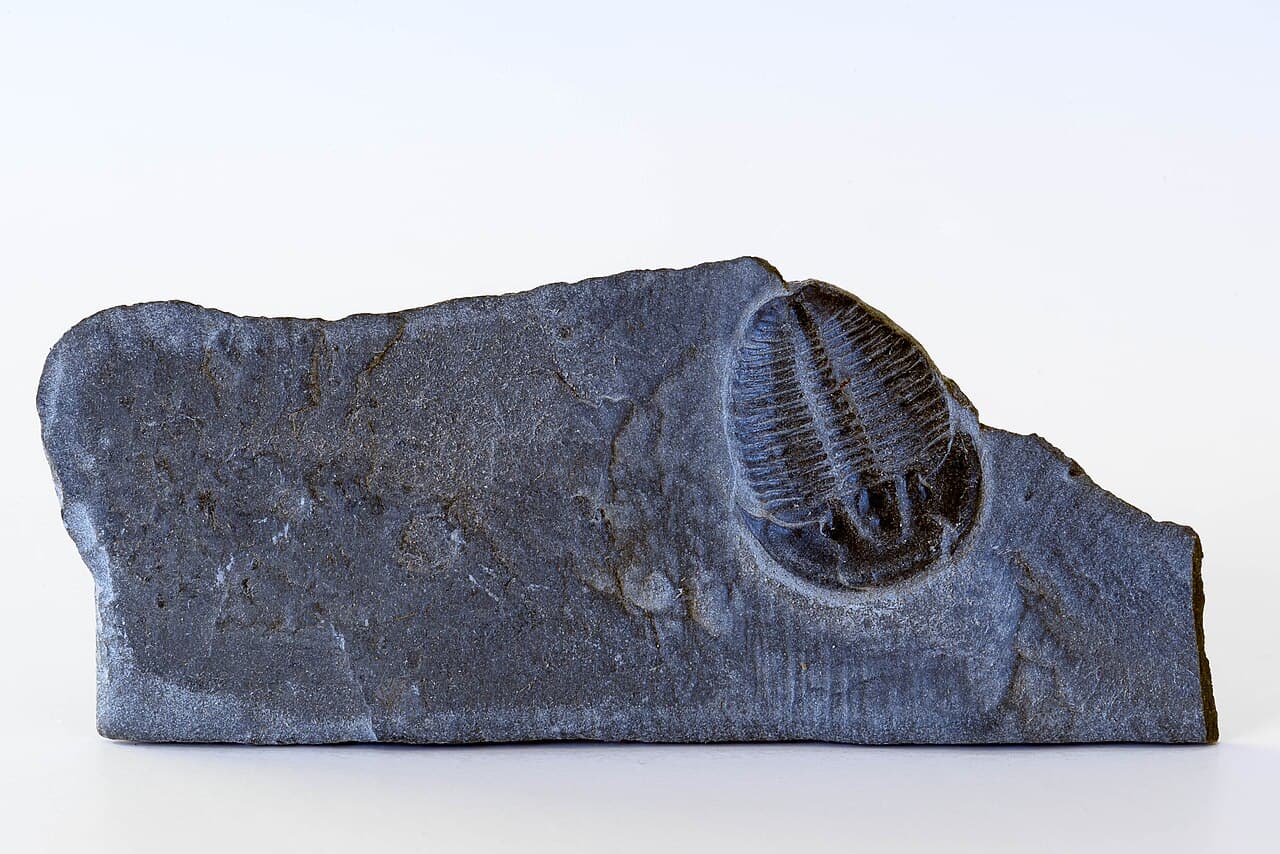
A trilobite is the fossilized remains of an extinct marine arthropod — a distant relative of today's crabs, insects and horseshoe crabs — that lived only in the ancient oceans of the Paleozoic Era. The name means "three-lobed," and it describes the animal's most distinctive feature: a hard, segmented shell divided lengthwise into three ribbed sections. Trilobites were among the most successful creatures of their time, and because their tough exoskeletons fossilized so readily, they are one of the most recognizable and widely collected fossils in the world.
What you actually find is almost never the soft animal itself but its mineralized outer shell, usually preserved in limestone or shale and often replaced over millions of years by calcite, silica or pyrite. Specimens range from tiny fragments to complete, beautifully detailed bodies, and because trilobites died out long before the dinosaurs ever appeared, even a modest specimen on a shelf is a piece of life that is at minimum a quarter of a billion years old.
Trilobite at a glance
- Classification
- Fossil — extinct marine arthropod (class Trilobita)
- Hardness
- Varies with the replacing mineral, not the original animal (e.g. calcite ~3, silica ~7, pyrite ~6)
- Colors
- Brown, gray, black; depends on the preserving minerals
- Texture
- Often preserved in limestone or shale; exoskeleton replaced by calcite, silica or pyrite
How to identify a trilobite
The feature that names the animal is the easiest way to recognize it: look down on the fossil from above and you should see the body divided into three lengthwise lobes — a raised central ridge (the axial lobe) flanked by a flatter lobe on each side. Crossing that, the body also splits into three parts from front to back: a rounded head shield called the cephalon, a flexible middle of repeated segments called the thorax, and a tail piece called the pygidium. Counting the thoracic segments and noting the shape of the head and tail are exactly how specialists tell one kind from another.
Two further clues seal an identification. Many trilobites carried prominent eyes on the cephalon — among the earliest complex eyes in the fossil record, some built from tiny calcite lenses — so a pair of crescent- or kidney-shaped eyes near the front is a strong sign. And because trilobites could roll up like a pill bug to protect their soft undersides, you will sometimes find an enrolled specimen curled into a tight ball, head tucked against tail; that defensive posture is unmistakable and unique to this group.
When trilobites lived
Trilobites first appear in the rock record early in the Cambrian Period, roughly 521 million years ago, and they quickly became one of the dominant forms of life in the sea. They flourished for the entire Paleozoic Era — through the Ordovician, Silurian, Devonian and Carboniferous — diversifying into a vast number of forms as they crawled, swam and burrowed across ancient sea floors. Their abundance and rapid evolution make them prized index fossils, letting geologists date the layers of rock in which they are found.
Their long reign ended in the end-Permian mass extinction about 252 million years ago, the largest extinction event in Earth's history, which wiped out the last surviving trilobites along with most other marine life. Because the group vanished completely at that point and never returned, any genuine trilobite fossil is at least roughly 252 million years old — older than every dinosaur, and a reliable signal that the rock around it is Paleozoic in age.
Types of trilobites
Trilobites were enormously varied: scientists have described thousands of species spread across many genera, occupying a huge range of body shapes and lifestyles. A handful of names turn up again and again in collections. Elrathia, a small, smooth Cambrian trilobite from Utah, is one of the most common fossils sold anywhere. Phacops, a Devonian form famous for its large, bulging compound eyes, is frequently found enrolled. Calymene — the classic "Dudley locust" of old British collections — is a sturdy, easily recognized Silurian and Devonian trilobite.
Size varies just as widely. Many trilobites were only a few millimeters to a couple of centimeters long, the size of a fingernail, while the largest known kinds reached tens of centimeters — bigger than a dinner plate. When you identify a specimen, the combination of overall size, the proportions of head to tail, the number of body segments, and the presence or shape of the eyes is what narrows it down from "a trilobite" to a particular kind.
Value, and real vs. fake
Trilobites are one of the most heavily faked fossils on the market, and Morocco in particular produces a flood of composites and outright casts. A "composite" combines real fragments with sculpted filler; an outright fake is a plaster or resin copy pressed from a mold and set into a slab of matrix. The warning signs are learnable: be suspicious of identical specimens repeated across a dealer's table (real fossils are never carbon copies of one another), of matrix that looks smooth, bubbly or molded like plaster rather than like natural stone, of detail that is suspiciously crisp and perfectly symmetrical, and of any sign of paint or color that sits on the surface rather than running through the fossil.
A genuine trilobite, by contrast, shows the small natural asymmetries of a once-living animal — a slightly crushed segment here, a missing spine there — and it sits in rock whose grain, color and hardness are consistent with the fossil itself, with no seam where one material meets another. Honest, common specimens such as Elrathia are inexpensive, while large, complete, finely prepared and well-documented trilobites of sought-after kinds can be genuinely valuable. Because the fakes are so good, buying from a reputable dealer who states the species and locality is the single best protection.
Trilobite look-alikes
Frequently asked questions
What is a trilobite?
A trilobite is the fossil of an extinct marine arthropod that lived only during the Paleozoic Era. Its name means "three-lobed," after the three lengthwise sections of its hard, segmented shell. What you find is the mineralized exoskeleton, usually in limestone or shale.
How old are trilobites and when did they live?
Trilobites first appear about 521 million years ago in the Cambrian Period and dominated the seas throughout the Paleozoic. They went completely extinct in the end-Permian mass extinction around 252 million years ago, so every genuine trilobite is at least roughly 252 million years old.
How can I tell a real trilobite from a fake?
Watch for warning signs of casts and composites: identical repeated specimens, matrix that looks smooth or molded like plaster, suspiciously perfect detail, and surface paint. A real trilobite shows natural asymmetry and sits in rock whose texture and color are consistent with the fossil, with no seam between fossil and matrix. Buying from a reputable dealer who lists species and locality is the safest route.
Are trilobites worth money?
Common species such as Elrathia are inexpensive and widely sold, but large, complete, expertly prepared specimens of sought-after kinds can be genuinely valuable. Because fakes are common, documented species, locality and condition all drive the price.
Is yours trilobite? Find out from a photo
Photograph your fossil in good light and get an identification with an honest confidence level, the look-alikes to rule out and the at-home tests that confirm it.
Identify my fossil freeOn Android? Get the free rock identifier app
Related
More fossils in the field guide
Keep exploring
More on fossils: identify a fossil from a photo, how to identify a rock and the Mohs hardness scale.
Last updated 2026-06-24. Identification guidance is educational — confirm important results with the diagnostic tests described or a qualified expert.