Belemnite
Also known as: Belemnite fossil, Thunderbolt (folklore), Devil's fingers (folklore)
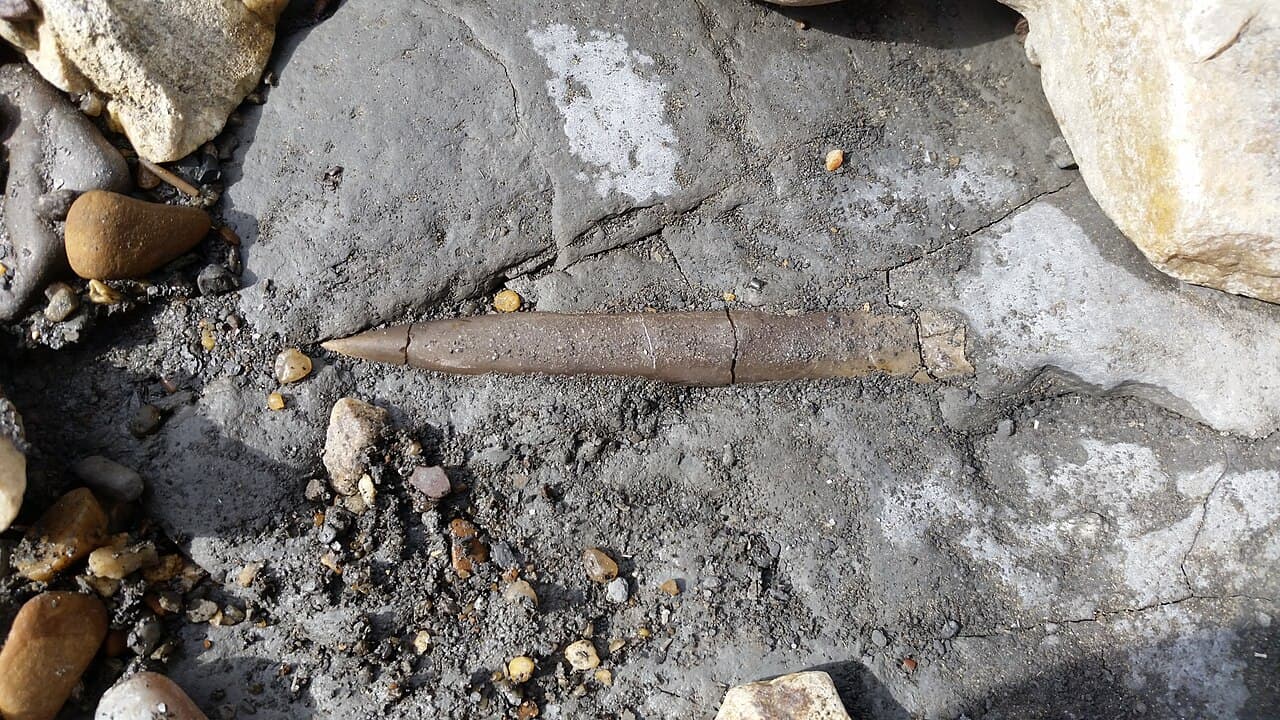
A belemnite is the fossil of an extinct squid-like marine animal — a cephalopod, in the same broad group as today's squid, cuttlefish, octopuses and the living nautilus. Belemnites swam the Mesozoic seas in great numbers, jetting through the water and catching prey with hooked arms, but their soft bodies almost never survived. What you actually find is the one hard, internal part of the skeleton that fossilized easily: a bullet- or cigar-shaped piece called the guard, or rostrum, which sat near the tail end inside the living animal as a counterweight and stiffening rod.
These guards are among the most distinctive and commonly collected fossils, and their shape gave rise to centuries of folklore — they were called "thunderbolts" or "Devil's fingers" because people imagined they had fallen from the sky during storms or were the petrified fingers of demons. In reality a belemnite guard is solid calcite, often amber- to honey-brown, built from crystals that radiate outward from a central line so that a broken or polished cross-section shows a sunburst pattern. Because belemnites died out at the end of the Cretaceous alongside the ammonites and the non-bird dinosaurs, every genuine specimen is a piece of a vanished ocean tens of millions of years old.
Belemnite at a glance
- Classification
- Fossil — extinct marine cephalopod (order Belemnitida)
- Composition
- Guard is calcite, CaCO₃ (the original mineral, often well preserved)
- Hardness
- About 3, the hardness of the calcite that makes up the guard
- Luster
- Vitreous to slightly waxy on fresh or polished surfaces
- Colors
- Amber, honey-brown, tan, gray to nearly black
- Texture
- Solid bullet- or cigar-shaped guard of radiating calcite; a chambered phragmocone is sometimes preserved at the wide end
How to identify it
The classic belemnite guard is unmistakable once you know it: a smooth, solid, bullet- or cigar-shaped piece of stone, rounded and tapering to a point at one end and broader, often hollowed or broken, at the other. Most are a few centimeters long and feel dense and heavy for their size because they are solid calcite all the way through — there are no internal chambers in the guard itself. Color is commonly some shade of amber, honey or tan through to gray, frequently with a slight translucency near the tip, and the surface may show fine lengthwise lines or grooves running toward the point.
Two features clinch the identification. First, look at a broken or polished end: the calcite is arranged in fibers that radiate outward from a central axis, so a cross-section shows concentric rings around a small dark center and a sunburst or starburst pattern — this radiating structure is the single most reliable sign of a belemnite. Second, at the wide end you may find the remains of the phragmocone, a small cone-shaped, chambered structure that fits into a hollow socket (the alveolus) in the guard; if it is preserved it shows the delicate internal chambers that mark the animal as a cephalopod. A solid radiating bullet, with or without that chambered cone at the back, is a belemnite.
How it formed / when it lived
Belemnites belong to the order Belemnitida, a group of cephalopods that flourished through the Mesozoic Era and were especially abundant in the Jurassic and Cretaceous periods. They were active swimmers, and in life the bullet-shaped guard sat internally at the rear of the body, balancing the animal as it moved and anchoring the muscles; ahead of it lay the chambered phragmocone, which worked much like the buoyancy chambers of an ammonite or nautilus. Because the guard was made of dense, stable calcite, it survived burial in seafloor mud far better than the soft body or the thinner phragmocone, which is why guards are so common while complete animals are vanishingly rare.
Fossilization usually preserved the original calcite of the guard with little change, so many belemnites retain their natural radiating crystal structure rather than being replaced by another mineral. Whole beds of sediment are sometimes packed with guards — informally called "belemnite battlefields" — recording mass die-offs or accumulations on the ancient sea floor. The group's long success ended abruptly at the close of the Cretaceous Period, about 66 million years ago, in the same end-Cretaceous mass extinction that wiped out the ammonites and the non-bird dinosaurs. Belemnites left no direct descendants, so any genuine belemnite fossil is at least roughly 66 million years old, and many are considerably older.
Types and varieties
Many species of belemnite have been described, and they are told apart mainly by the shape and proportions of the guard — how slender or stout it is, whether it is cylindrical or swells toward the middle, how sharply it tapers, and the pattern of any grooves running along its surface. Most collected guards are a few centimeters long, but sizes range from small splinters up to substantial pieces, and the cross-sectional outline (round, oval or slightly flattened) is another feature specialists use. The fragile chambered phragmocone is only rarely preserved with the guard, so a specimen that includes it is a more complete and more interesting find.
Preservation gives belemnites a few distinct looks. Most are opaque tan to brown calcite, but some are honey-colored and partly translucent, and polished specimens can take a soft glassy shine that highlights the radiating fibers. Guards that have been cut and polished across the tip to display the sunburst pattern are popular, as are pieces still embedded in their original chalk or limestone matrix. Whatever the form, the diagnostic combination remains the same — a solid, dense, bullet-shaped calcite body with internal crystals that radiate from a central axis.
Value, and real vs. fake
Belemnite guards are among the more affordable fossils because they are common and were preserved in such numbers; ordinary tumbled or rough guards are inexpensive curiosities. Value rises with size, completeness, attractive honey coloration and translucency, fine polishing that shows the radiating structure, and especially the rare preservation of the chambered phragmocone or the animal's hooked arms. Specimens still set in their natural matrix, or unusually large and well-formed guards with documented species and locality, sit above the common loose material.
Outright fakes are uncommon, partly because real belemnites are cheap and plentiful, but a few cautions apply. The natural radiating, sunburst cross-section is hard to fake convincingly, so a broken or polished end that shows fibrous calcite crystals fanning out from a central line is strong evidence of authenticity; a piece that is uniform and structureless inside, or that feels light and plasticky, should raise doubts about a resin copy. Be aware too that a smooth brown stone pebble, or a fragment of an orthocone nautiloid, can be mistaken for or sold as a belemnite — check for the solid (not chambered) body and the radiating structure. As always, buying from a seller who states the species and locality is the surest protection, though with belemnites the fossils themselves are usually their own best proof.
Belemnite look-alikes
Frequently asked questions
What is a belemnite?
A belemnite is the fossil of an extinct squid-like marine cephalopod that lived in the Mesozoic seas. The common fossil is the bullet- or cigar-shaped internal guard (rostrum), made of solid radiating calcite, that sat near the tail of the living animal. Belemnites are relatives of squid, cuttlefish and the nautilus, not snails.
How old are belemnites and when did they go extinct?
Belemnites flourished through the Mesozoic Era, especially in the Jurassic and Cretaceous periods. They went completely extinct at the end of the Cretaceous, about 66 million years ago, in the same mass extinction that ended the ammonites and the non-bird dinosaurs. Every genuine belemnite is therefore at least roughly 66 million years old.
Why are belemnites called thunderbolts or Devil's fingers?
Long before their true nature was understood, people found these smooth, pointed stones and imagined they had fallen from the sky during storms, calling them "thunderbolts," or that they were the petrified fingers of demons, calling them "Devil's fingers." In reality each one is the solid calcite guard from the body of an extinct cephalopod.
How can I tell a real belemnite from a pebble or a fake?
Look at a broken or polished end. A genuine belemnite guard is solid calcite whose crystals radiate outward from a central axis, so the cross-section shows concentric rings and a sunburst pattern around a small dark center. A plain pebble is structureless inside, a resin copy feels light and plasticky, and a chambered piece is a nautiloid rather than a belemnite.
Is yours belemnite? Find out from a photo
Photograph your fossil in good light and get an identification with an honest confidence level, the look-alikes to rule out and the at-home tests that confirm it.
Identify my fossil freeOn Android? Get the free rock identifier app
Related
More fossils in the field guide
Keep exploring
More on fossils: identify a fossil from a photo, how to identify a rock and the Mohs hardness scale.
Last updated 2026-06-25. Identification guidance is educational — confirm important results with the diagnostic tests described or a qualified expert.