Magnesite
Also known as: Magnesium carbonate, Magnesite turquoise (a misnomer for dyed magnesite), White buffalo (when dyed and mislabeled)
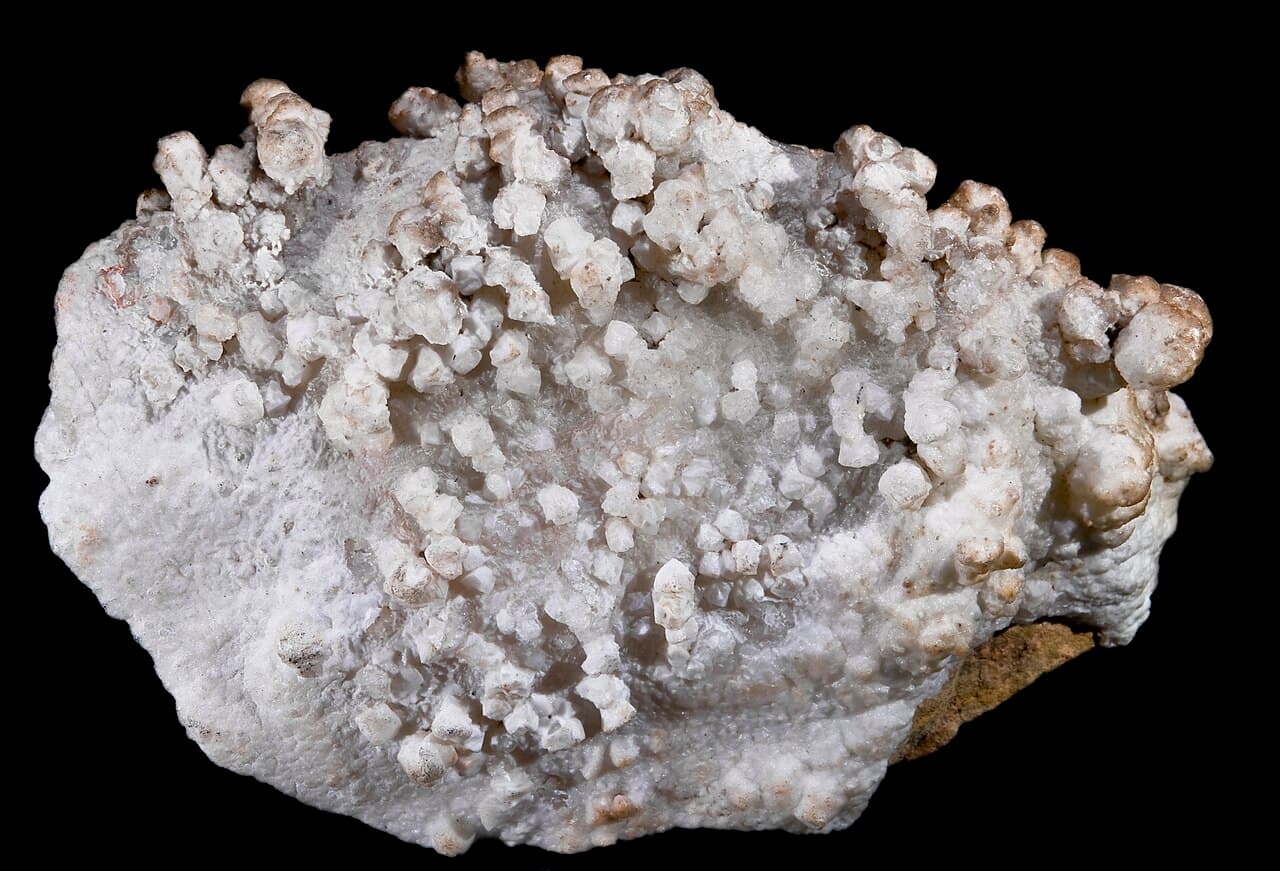
Magnesite is magnesium carbonate, MgCO₃, and in the form most people meet it is an unassuming dull-white to cream-colored stone with a porcelain-like surface, frequently broken up by light gray veining. The massive material that fills bead strands and tumbled bowls often has a knobbly, brain-like or cauliflower texture, and because it is fairly soft — only about 3.5 to 4.5 on the Mohs scale — and quite porous, it is easy to cut, carve and, crucially, to dye. That porosity is the single most important thing to know about magnesite, because it is the reason this otherwise plain white mineral turns up in the crystal trade wearing almost every color of the rainbow.
Like its close cousin howlite, magnesite is the workhorse imitation stone of the bead world. Dyed a bright sky-blue or green, it is sold — sometimes honestly, sometimes not — as imitation turquoise, and tinted other colors it stands in for a range of pricier materials. So identifying magnesite means two things at once: recognizing the natural white, gray-veined, porcelain-textured stone, and recognizing when colored magnesite is being passed off as something more valuable. Both rest on the same handful of simple checks: its softness, its porous texture, its veining, and a weak, slow reaction to acid.
Magnesite at a glance
- Classification
- Mineral — carbonate (magnesium carbonate)
- Composition
- MgCO₃
- Hardness
- About 3.5–4.5 (Mohs)
- Luster
- Dull to earthy in massive form; vitreous in rare crystals
- Streak
- White
- Colors
- White, gray and cream with gray veining (very commonly dyed any color)
- Crystal system
- Trigonal (hexagonal)
- Transparency
- Opaque in massive form (translucent in rare crystals)
- Magnetic
- No
How to identify it
Natural magnesite is recognized by its look and feel before any test: a dull, chalky-to-porcelain white or cream body, often patterned with fine light-gray veins and a lumpy, brain-like or cauliflower surface in the massive material that dominates the market. It feels light and slightly porous rather than glassy, and it is soft — about 3.5 to 4.5 on the Mohs scale — so a steel knife scratches it easily and it leaves a white streak. Most magnesite reaches buyers as round white beads, cabochons or tumbled stones cut from these veined nodules.
Two confirming checks separate it from its look-alikes. First, because it is a carbonate, magnesite reacts to acid — but only weakly and slowly: a drop of dilute acid (or strong vinegar) typically fizzes faintly, often needing scratching or powdering of the spot to bubble, in clear contrast to calcite, which fizzes vigorously and immediately. Second, the dye test: since so much magnesite is colored, a cotton swab dipped in acetone (nail-polish remover) rubbed on a hidden spot will often lift surface dye and reveal the natural white underneath. Magnesite is not magnetic, so magnetism plays no part in identifying it.
Colors and varieties
In its natural state magnesite is essentially a white mineral: chalky white, cream or pale gray, marbled with the lighter gray veining that runs through the massive material. That neutral, porous, even-toned canvas is precisely why magnesite is dyed so heavily — it accepts color uniformly while the veins remain visible, allowing it to mimic the matrix patterns of more expensive stones. Rare, well-formed magnesite crystals also exist and can be glassy and colorless to white, but they are seldom what shoppers encounter.
The popular 'varieties' of magnesite are therefore almost all the work of dye. Blue- and green-dyed magnesite is the most common, sold as imitation turquoise (sometimes mislabeled magnesite turquoise) with the natural gray veins standing in for turquoise's matrix — exactly the role howlite also plays. Magnesite is further tinted purple, pink, red, yellow and black for inexpensive jewelry. The essential identification point is that these vivid stones are colored magnesite, not distinct minerals; underneath the dye sits the same soft, porous, white-and-gray carbonate.
Meaning and properties
In modern crystal-working traditions, white magnesite is associated with calm, relaxation and meditation, its quiet white color naturally linking it in these practices to stillness and a settled mind. People describe it as a soothing stone used to ease tension and support reflective or meditative states. Because it is inexpensive and takes dye so readily, a great deal of colorful jewelry sold under various metaphysical labels is in fact dyed magnesite rather than the costlier stone it resembles.
These associations are cultural and spiritual, not scientifically established medical effects. Magnesite is an affordable, pleasant stone to collect and wear, but it is not a treatment for anxiety, stress or any other physical or emotional health condition and should never replace advice or care from a qualified medical professional. Enjoy it for its calm appearance and its versatility as a decorative material rather than as medicine.
What it's worth
Magnesite is an abundant, inexpensive mineral, and that low cost is central to its identity — it is precisely why magnesite is used so widely as a dyed imitation of pricier stones. Natural white magnesite beads, cabochons and tumbled pieces are budget-friendly, and even attractive well-veined or neatly carved pieces stay affordable. Within natural magnesite, value comes from the usual factors: even color, a pleasing veining pattern, good polish, and clean, undamaged material — but the ceiling is modest.
As with howlite, the real money question is usually not what magnesite costs but what it is being sold as. Blue- or green-dyed magnesite has legitimate value as magnesite, yet it is worth a small fraction of genuine turquoise, so the hazard is paying turquoise prices for dyed magnesite. Honestly labeled, dyed magnesite is a perfectly respectable, low-cost decorative stone; the problem appears only when it is presented as turquoise or another more valuable material. Value tracks honest identity — know what you are actually buying and the fair price follows.
Real vs. fake
Magnesite sits, alongside howlite, at the heart of the turquoise-imitation trade, and the deception runs two ways. First, dyed-blue magnesite is one of the most common stand-ins for turquoise: it is sold as magnesite turquoise, white turquoise or simply as turquoise, and it fools many buyers. The tells are price (real turquoise costs far more), hardness (turquoise is harder, around 5 to 6, while magnesite is a soft 3.5 to 4.5 and scratches easily), and the dye itself — an acetone swab or even water rubbed on a hidden spot often lifts the blue and exposes white magnesite, and dye tends to pool darker inside veins, drill holes and surface pits. A suspiciously cheap, soft blue stone whose color rubs off is almost certainly dyed magnesite, not turquoise.
Second, even genuine magnesite is frequently dyed and sold without disclosure, so identifying natural magnesite means confirming the color is its own. Natural magnesite is white to cream with gray veining; any vivid blue, green, purple or red magnesite has been colored. To verify, inspect the back and the inside of drill holes (dye penetrates unevenly and looks blotchy there), do the acetone-swab test, and use the softness check. The weak, slow acid fizz also distinguishes magnesite from harder, non-reactive look-alikes. When in doubt, buy from a seller who clearly labels dyed and imitation material.
Care
Magnesite needs gentle handling because it is both soft and, very often, dyed. At about 3.5 to 4.5 on the Mohs scale it scratches easily, so store it away from harder stones and from metal, and treat magnesite jewelry as occasional rather than rough everyday wear. Being porous, it readily absorbs oils, perfumes and lotions, which can stain it or, on dyed pieces, mar the color over time, so put magnesite jewelry on after applying cosmetics and wipe it down after wear.
Clean magnesite only with a soft, barely damp cloth and dry it promptly; avoid soaking, since prolonged water exposure seeps into the porous body, and as a carbonate it can be etched by acids, so keep it well away from vinegar and household cleaners. With dyed magnesite this matters even more — water, heat, solvents and strong sunlight can all make the color fade, bleed or rub off, so keep dyed pieces out of prolonged sun and away from chemicals. Skip ultrasonic and steam cleaners entirely, as they can damage the soft stone and drive out dye. Treated kindly, magnesite holds up well as an inexpensive, attractive stone.
Magnesite look-alikes
Frequently asked questions
Is magnesite the same as turquoise?
No. Magnesite is a soft white-and-gray carbonate mineral that is very commonly dyed blue or green to imitate turquoise and then sold as magnesite turquoise or white turquoise. Real turquoise is a different, harder and far more valuable stone. You can tell them apart by hardness (turquoise resists a steel knife; magnesite scratches easily), by price, and by the acetone-swab test, which lifts dye from magnesite but not the natural color of genuine turquoise.
How can I tell if magnesite has been dyed?
Natural magnesite is white to cream with light gray veining, so any vivid color means it has been dyed. To confirm, rub an inconspicuous spot or the inside of a drill hole with a cotton swab dipped in acetone (nail-polish remover) — dye often transfers to the swab. Dye also tends to look blotchy or to pool inside veins and bead holes. If the color comes off or looks uneven, the piece has been dyed.
What is the difference between magnesite and howlite?
They are very close look-alikes: both are soft, white, gray-veined, porous minerals that are routinely dyed blue to imitate turquoise, and they are hard to distinguish by eye. The clearest difference is chemistry — magnesite is a carbonate and gives a weak, slow fizz in acid, while howlite is a borate and does not react. Howlite's veins also tend to be darker, more spiderweb-like gray-to-black, versus magnesite's lighter gray veining.
Does magnesite fizz in acid?
Yes, but only weakly and slowly, which is itself a useful identification clue. As a magnesium carbonate, magnesite reacts to dilute acid (or strong vinegar), but the fizz is faint and often appears only when the spot is scratched or powdered — quite unlike calcite, which fizzes briskly and immediately. This sluggish reaction helps separate magnesite from calcite and from non-carbonate white stones like howlite.
Is yours magnesite? Find out from a photo
Photograph your mineral in good light and get an identification with an honest confidence level, the look-alikes to rule out and the at-home tests that confirm it.
Identify my mineral freeOn Android? Get the free rock identifier app
Related
More minerals in the field guide
Keep exploring
More on minerals: how to identify a mineral, the streak test and the full list of crystal types.
Last updated 2026-06-25. Identification guidance is educational — confirm important results with the diagnostic tests described or a qualified expert.