Epidote
Also known as: Pistacite, Pistachio Stone
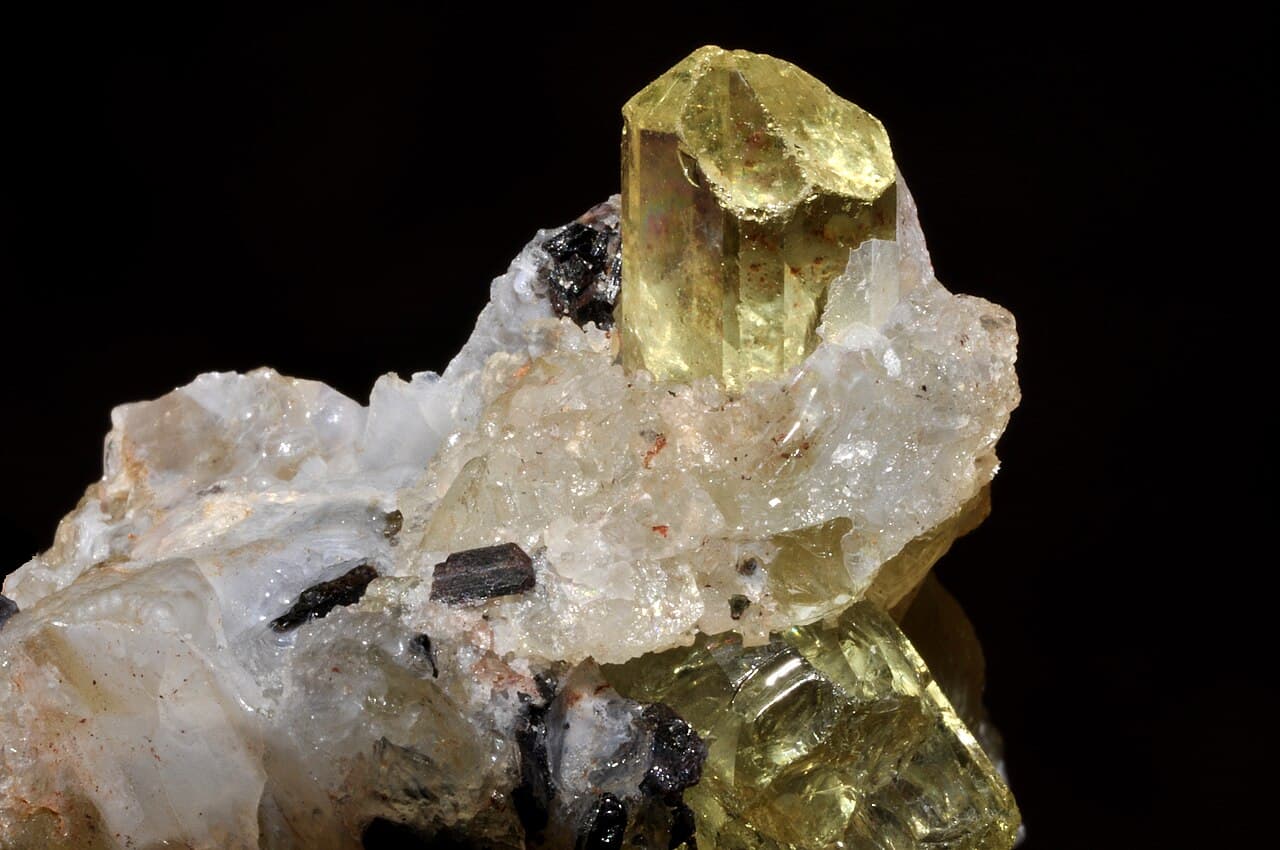
Epidote is a calcium-aluminum-iron sorosilicate best known for one of the most recognizable colors in the mineral world: a distinctive pistachio green that often carries a yellowish or olive cast. That unusual yellow-green shade is so characteristic that an old name for the mineral, pistacite, comes straight from the word pistachio. Epidote grows in slender, elongated prismatic crystals that are typically grooved with fine lengthwise striations, and it forms in a wide range of settings, most commonly in metamorphosed rocks and in the altered margins of igneous bodies. Rockhounds encounter it as sprays of bladed green crystals, as crusts lining cavities, and as the green mineral threaded through veins.
For most people, the first place they meet epidote is inside unakite, the popular green-and-pink rock used for beads and tumbled stones, where epidote supplies the green and pink feldspar supplies the salmon color. Beyond that, epidote is mainly a collector's and geologist's mineral rather than a mainstream gemstone, though clear crystals are occasionally faceted. What makes it genuinely useful to identify is that its color and crystal habit do much of the work: the combination of yellow-green to pistachio color, glassy luster, hardness around 6 to 7, and striated elongated prisms is a strong signature once you have seen it a few times.
Epidote at a glance
- Classification
- Sorosilicate mineral (calcium aluminum iron silicate)
- Composition
- Ca2(Al,Fe)3(SiO4)3(OH)
- Hardness
- 6 to 7 (Mohs)
- Luster
- Vitreous (glassy)
- Streak
- Grayish white to colorless
- Colors
- Pistachio green to yellowish green, olive, and dark green to nearly black in iron-rich material
- Crystal system
- Monoclinic
- Transparency
- Transparent to opaque
How to identify it
Color is the strongest opening clue. Epidote shows a characteristic pistachio to yellowish green, an olive-tinged shade that few other common minerals match, and seeing that color in a glassy, elongated crystal should put epidote near the top of your list. Next, look at the crystal habit: epidote typically forms slender prismatic crystals that are elongated in one direction and grooved with fine parallel striations running along their length. The crystals often occur as radiating sprays or bundles of green blades, and the mineral has a bright vitreous luster on fresh faces. Hardness is a useful check too, at roughly 6 to 7 epidote will scratch glass and resist a steel knife.
Two further traits help confirm it. Epidote is strongly pleochroic, meaning a transparent crystal can appear different colors, often shifting between green, yellow, and brown, when you rotate it and view it from different directions in good light. It also has one direction of perfect cleavage along the length of the prism, so broken crystals tend to split cleanly in that direction. Put the package together, pistachio-green color, striated elongated prisms, glassy luster, hardness near 6 to 7, strong pleochroism, and that one good cleavage, and the identification is well supported. No single property is conclusive on its own, but this cluster reliably separates epidote from other green minerals.
Colors and varieties
Epidote's color range is built around green, with iron content driving how dark and how yellow the stone appears. The classic look is pistachio green to yellowish green, but specimens run from pale olive and grass green to deep, almost blackish green when iron is abundant. The yellow-green tones are the most diagnostic and the reason for the old name pistacite. Crystals are often darker and more saturated where they are thick and brighter, more transparent where they are thin, and the same spray of crystals can show a pleasing gradient of green shades.
Several related forms and rock types are worth knowing. The most familiar is unakite, an altered granite in which green epidote grows together with pink orthoclase feldspar and quartz to make the well-known green-and-pink ornamental stone. Epidote also belongs to a larger mineral group: clinozoisite is a closely related, paler, iron-poor cousin, and the gem-quality green-to-brown variety sometimes faceted by collectors is simply transparent epidote. Because so many green minerals share similar colors, treat color as a starting point and confirm with crystal habit, striations, luster, and hardness rather than relying on the green shade alone.
Meaning and properties
Epidote is primarily a collector's and geologist's mineral, but it does appear in crystal-healing and metaphysical writing, where it is often described as a stone associated with growth, renewal, and releasing old patterns. Some practitioners pair it with its host stone unakite and use it as a symbolic focus during reflection or goal-setting. These associations come from spiritual, cultural, and personal belief systems rather than from scientific evidence, and epidote should not be relied upon to treat, diagnose, or cure any physical or mental health condition.
If you enjoy the symbolic side of minerals, epidote is reasonably durable for handling and display, but it is best treated as a contemplation and collection stone rather than a medical tool. Its real interest for most people is mineralogical: it is a clear indicator of certain metamorphic and hydrothermal conditions, so finding epidote tells a geologist something about how a rock formed. For any genuine health concern, consult a qualified healthcare professional rather than depending on a crystal of any kind.
Value and what affects price
Most epidote is inexpensive because it is a common, widespread mineral. Value rises with crystal quality, color, and aesthetics: sharp, lustrous, well-terminated green prisms, especially attractive radiating sprays or crystals perched on a contrasting matrix, are what collectors seek, while dull massive green material and epidote-bearing rock are common and modestly priced. Specimens that combine good color, clean glassy faces, and an undamaged crystal group are far more desirable than crumbly or coated pieces.
Transparent, gem-quality epidote that can be faceted is much rarer and commands more interest among gem collectors, prized for its deep green color and strong pleochroism. Unakite, the green-and-pink rock colored partly by epidote, is sold cheaply as beads, tumbled stones, and carvings and is valued mainly for its pattern and polish rather than for the epidote itself. As with any specimen, judge a piece on its actual color, crystal quality, luster, and condition rather than on a name, and remember that thin green coatings on host rock are far less valuable than solid, well-formed crystals.
Real vs. fake: avoiding misidentification
Outright fakes of epidote are uncommon because the mineral itself is not expensive, so the real risk is honest misidentification rather than deliberate counterfeiting. The minerals most often confused with epidote are other green species: green tourmaline, actinolite, and peridot can all look superficially similar. Your best tools are the diagnostic traits. Epidote's pistachio to yellowish green color, its striated elongated prisms, its single perfect cleavage along the crystal length, and its strong pleochroism together form a signature that most look-alikes do not fully share.
Watch a few specific points. Green tourmaline crystals are typically more rounded in cross-section with a different striation pattern and no good cleavage, and tourmaline is harder. Actinolite tends to form more fibrous, needle-like or felted masses rather than blocky striated prisms. Peridot, the gem olivine, is usually a cleaner, more uniform yellow-green, lacks the grooved prismatic habit, and shows poor cleavage with a tendency to conchoidal fracture. When unsure, lean on hardness (epidote near 6 to 7), the lengthwise striations, the one good cleavage, and the color shift under rotation rather than on the green color by itself.
Care and cleaning
Epidote is fairly hard at 6 to 7, which makes it more durable than many showy minerals, but it does have one direction of perfect cleavage, so a sharp knock along that plane can split or chip a crystal. Store specimens where their slender prisms will not be crushed or jostled against harder stones, and handle crystal sprays gently because individual blades can snap at their bases. For cleaning, a soft brush with lukewarm water and a little mild soap is usually all that is needed; rinse and let the piece air dry.
Avoid harsh chemicals and strong acids, and skip ultrasonic and steam cleaners for fine crystal groups, since vibration and heat can exploit the cleavage and loosen delicate crystals from their matrix. Epidote's color is generally stable in normal light, so display is straightforward, though as with any specimen it is sensible to avoid prolonged extreme heat. With gentle washing, careful storage, and respect for the single cleavage direction, epidote keeps its glassy faces and pistachio color for a long time.
Epidote look-alikes
Frequently asked questions
What is the easiest way to recognize epidote?
Look for the distinctive pistachio to yellowish green color in glassy, elongated crystals that are grooved with fine lengthwise striations, often grouped in radiating sprays. Add a hardness near 6 to 7 (it scratches glass and resists a knife), strong pleochroism so the crystal shifts color as you rotate it, and one direction of perfect cleavage along the prism. That combination is a reliable signature for epidote.
Is epidote the green in unakite?
Yes. Unakite is an altered granite made mostly of green epidote together with pink orthoclase feldspar and quartz, so the green you see in unakite beads and tumbled stones is epidote and the salmon-pink is feldspar. If you like unakite, you are already familiar with epidote's color, just mixed with pink feldspar and polished into an ornamental rock.
How do I tell epidote from peridot?
Peridot (gem olivine) is usually a cleaner, more uniform yellow-green, lacks epidote's striated elongated prisms, has poor cleavage, and breaks with a curved conchoidal fracture. Epidote is more olive or pistachio toned, forms grooved bladed crystals often in sprays, shows strong pleochroism, and has one perfect cleavage along its length. The crystal habit and that lengthwise cleavage are the clearest tells.
Is epidote valuable?
Most epidote is common and inexpensive, with value driven by crystal quality, color, and how aesthetic and undamaged a specimen is. Sharp, lustrous green crystal sprays on contrasting matrix are the most collectible, and rare transparent gem-quality epidote that can be faceted is worth considerably more. Unakite, colored partly by epidote, is sold cheaply for beads and tumbled stones based on its pattern rather than the epidote content.
Is yours epidote? Find out from a photo
Photograph your mineral in good light and get an identification with an honest confidence level, the look-alikes to rule out and the at-home tests that confirm it.
Identify my mineral freeOn Android? Get the free rock identifier app
Related
More minerals in the field guide
Keep exploring
More on minerals: how to identify a mineral, the streak test and the full list of crystal types.
Last updated 2026-06-25. Identification guidance is educational — confirm important results with the diagnostic tests described or a qualified expert.