Dolostone
Also known as: Dolomite rock, Dolomitic limestone (when partly dolomitized)
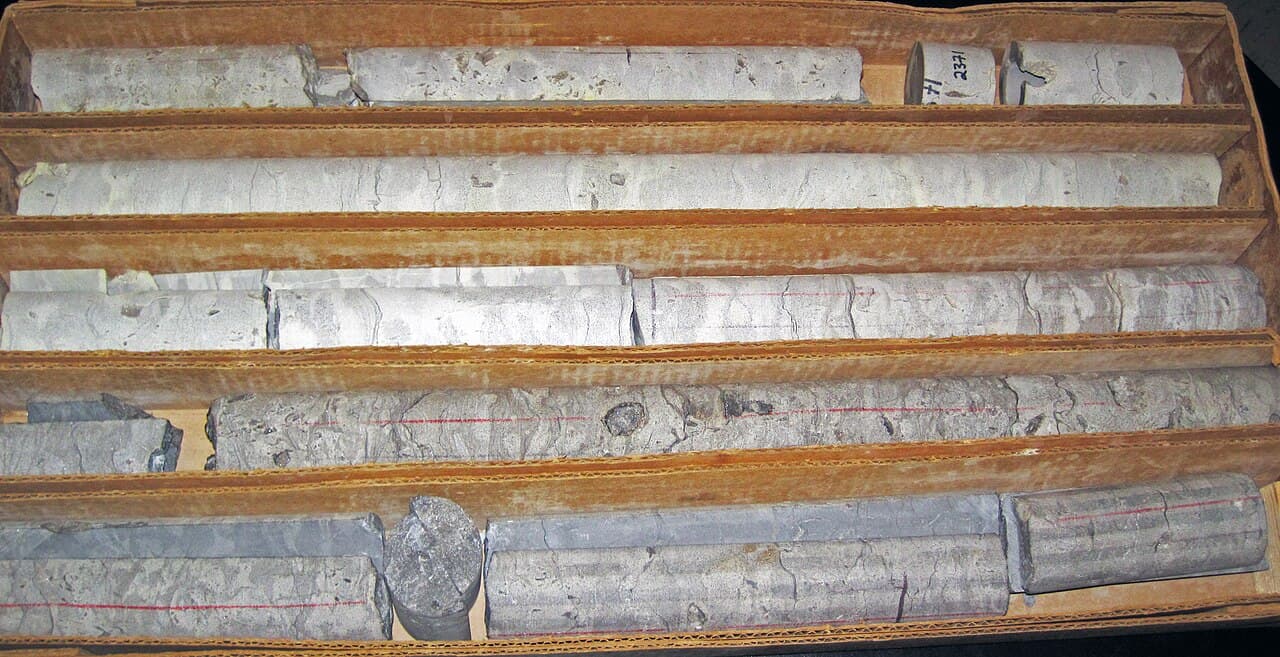
Dolostone is a sedimentary carbonate rock composed mostly of the mineral dolomite, calcium-magnesium carbonate with the formula CaMg(CO₃)₂. It looks remarkably like limestone — both are pale, dense carbonate rocks in shades of cream, gray, and buff — and the two are so closely related that geologists often find them interlayered in the same rock sequence. The crucial chemical difference is the magnesium: where limestone is essentially pure calcium carbonate (calcite), dolostone has had much of that calcium replaced by magnesium, turning it into the tougher, less acid-reactive mineral dolomite.
That difference shows up in the single most useful field test for telling the two rocks apart. A drop of cold dilute hydrochloric acid placed on limestone fizzes briskly, but on fresh dolostone it reacts only weakly and slowly — often you have to scratch the rock to a fine powder before you see any noticeable effervescence at all. Dolostone is also slightly harder than limestone, holds up better to weathering, and frequently has a sugary, granular look on broken surfaces. It is an important building stone and aggregate, and it is also a commercial source of magnesium.
Dolostone at a glance
- Classification
- Sedimentary rock — carbonate (chemical/diagenetic)
- Rock type
- Sedimentary (carbonate/chemical)
- Composition
- Mainly dolomite, CaMg(CO₃)₂ (calcium-magnesium carbonate)
- Hardness
- Dolomite is ~3.5–4 (Mohs) — slightly harder than limestone's calcite
- Luster
- Dull to earthy; broken faces can look faintly sugary
- Streak
- White
- Colors
- Cream, gray, buff, and tan; sometimes pinkish or pale brown
- Texture
- Fine- to medium-grained and often sugary/granular; commonly more crystalline-looking than limestone
What type of rock is dolostone?
Dolostone is a sedimentary rock, and within the sedimentary family it belongs to the carbonate group alongside limestone. It is built overwhelmingly from the mineral dolomite, CaMg(CO₃)₂, which is why the rock is also commonly called dolomite rock — though geologists increasingly use 'dolostone' for the rock and reserve 'dolomite' for the mineral, to avoid confusion. Unlike clastic sedimentary rocks such as sandstone, which are made of broken mineral grains, dolostone is a chemically and biochemically derived carbonate rock.
It is not igneous and, in its ordinary form, not metamorphic. Most dolostone is best described as a diagenetic rock: it begins as a calcium-carbonate sediment or limestone and is chemically altered after deposition. Its metamorphic counterpart does exist, however — when dolostone is subjected to heat and pressure it recrystallizes into a coarse, interlocking, crystalline rock known as dolomitic marble, just as ordinary limestone metamorphoses into marble.
How dolostone forms
Most dolostone is not deposited directly as dolomite but forms through a process called dolomitization, in which an existing limestone (or lime-rich carbonate sediment) is chemically altered after it has been laid down. Magnesium-bearing waters percolate through the porous carbonate, and magnesium ions progressively replace some of the calcium in the calcite, converting it to the mineral dolomite. This commonly happens in shallow, warm marine and coastal settings — tidal flats, lagoons, and evaporative basins where seawater becomes enriched in magnesium — and it can take place soon after deposition or much later during deep burial.
Because dolomitization is a replacement process, it often partially overprints a rock, producing a continuum from pure limestone through dolomitic limestone to fully converted dolostone. The recrystallization that accompanies the change tends to give dolostone its characteristic sugary, granular texture and can blur or destroy original fossils and sedimentary structures that were present in the parent limestone. The exact chemistry of natural dolomite formation has long been studied because dolomite is difficult to precipitate directly in the laboratory at ordinary conditions — the so-called 'dolomite problem' — which is part of why most dolostone is understood as an altered limestone rather than a primary deposit.
How to identify dolostone
The defining field test is the acid reaction. Place a drop of cold dilute hydrochloric acid on a fresh surface: limestone fizzes vigorously and immediately, but dolostone reacts only weakly and slowly, often with little or no visible effervescence on a solid face. The classic trick is to scratch the rock to a fine powder first and then apply the acid to the powder — dolostone will usually fizz noticeably once it is powdered, because the greater surface area speeds the reaction, whereas a solid surface barely responds. A sluggish or powder-only reaction is the single strongest indicator that you are looking at dolostone rather than limestone.
Back up the acid test with hardness and texture. Dolostone's dolomite is about 3.5 to 4 on the Mohs scale — a touch harder than limestone's calcite (about 3) — so it resists a steel knife slightly more and tends to weather into more rounded, resistant outcrops. Look at the broken surface as well: dolostone is frequently fine- to medium-grained with a faintly sugary, crystalline sparkle, and it is often more uniformly cream, buff, or gray than fossil-rich limestone. Fossils, if present at all, are commonly faint or partly destroyed because dolomitization recrystallizes the rock. Taken together, a weak or powder-only acid reaction, slightly greater hardness, and a sugary carbonate texture confirm dolostone.
What dolostone is used for
Dolostone is a widely used construction material. Crushed, it makes a durable aggregate for road base, concrete, and railway ballast, and its slightly greater hardness and resistance to weathering than limestone make it valued where toughness matters. Cut and dressed, it serves as building and dimension stone for walls, facing, and flooring, and it has long been quarried as an attractive, hard-wearing stone — the Dolomite mountains of the Alps, after which the mineral is named, are built largely of it.
Its magnesium content gives dolostone several uses that limestone cannot fill. It is an important raw material for producing magnesium metal and magnesium compounds, and calcined dolostone yields dolomitic lime used in refractory bricks and linings that must withstand high furnace temperatures. In steelmaking it serves as a flux and as a source of magnesia for furnace linings, and in agriculture dolomitic lime is spread to neutralize acidic soils while supplying both calcium and magnesium as plant nutrients. Ground dolostone is also used as a filler and as a soil and water conditioner.
Dolostone look-alikes
Frequently asked questions
What type of rock is dolostone?
Dolostone is a sedimentary carbonate rock made mostly of the mineral dolomite, CaMg(CO₃)₂. It sits alongside limestone in the carbonate group and is most often a diagenetic rock — a former limestone whose calcium has been partly replaced by magnesium. It is not igneous, and only becomes metamorphic when heat and pressure turn it into dolomitic marble.
How do I tell dolostone from limestone?
Use the acid test. A drop of cold dilute hydrochloric acid makes limestone fizz briskly on a solid surface, but dolostone reacts only weakly and slowly — frequently you have to scratch the rock to a powder before it visibly effervesces. Dolostone is also slightly harder and tends to have a more uniform, sugary texture with fewer well-preserved fossils.
Why does dolostone barely react with acid?
Dolostone is made of dolomite, a calcium-magnesium carbonate that dissolves in dilute acid much more slowly than the calcite in limestone. On a solid surface the reaction is sluggish or invisible, but crushing the rock to a powder exposes far more surface area, which is why powdered dolostone will usually fizz when the same acid is applied.
What is dolostone used for?
Dolostone is crushed for durable road and construction aggregate and cut as a hard-wearing building and dimension stone. Its magnesium makes it valuable as a source of magnesium metal and compounds, as dolomitic lime for high-temperature refractory bricks and as a steelmaking flux, and as agricultural lime that neutralizes acidic soils while supplying calcium and magnesium.
Is yours dolostone? Find out from a photo
Photograph your rock in good light and get an identification with an honest confidence level, the look-alikes to rule out and the at-home tests that confirm it.
Identify my rock freeOn Android? Get the free rock identifier app
Related
More rocks in the field guide
Keep exploring
More on rocks: how to identify a rock, what kind of rock is this and the Mohs hardness scale.
Last updated 2026-06-25. Identification guidance is educational — confirm important results with the diagnostic tests described or a qualified expert.