Gneiss
Also known as: Gneissic rock, Orthogneiss / paragneiss
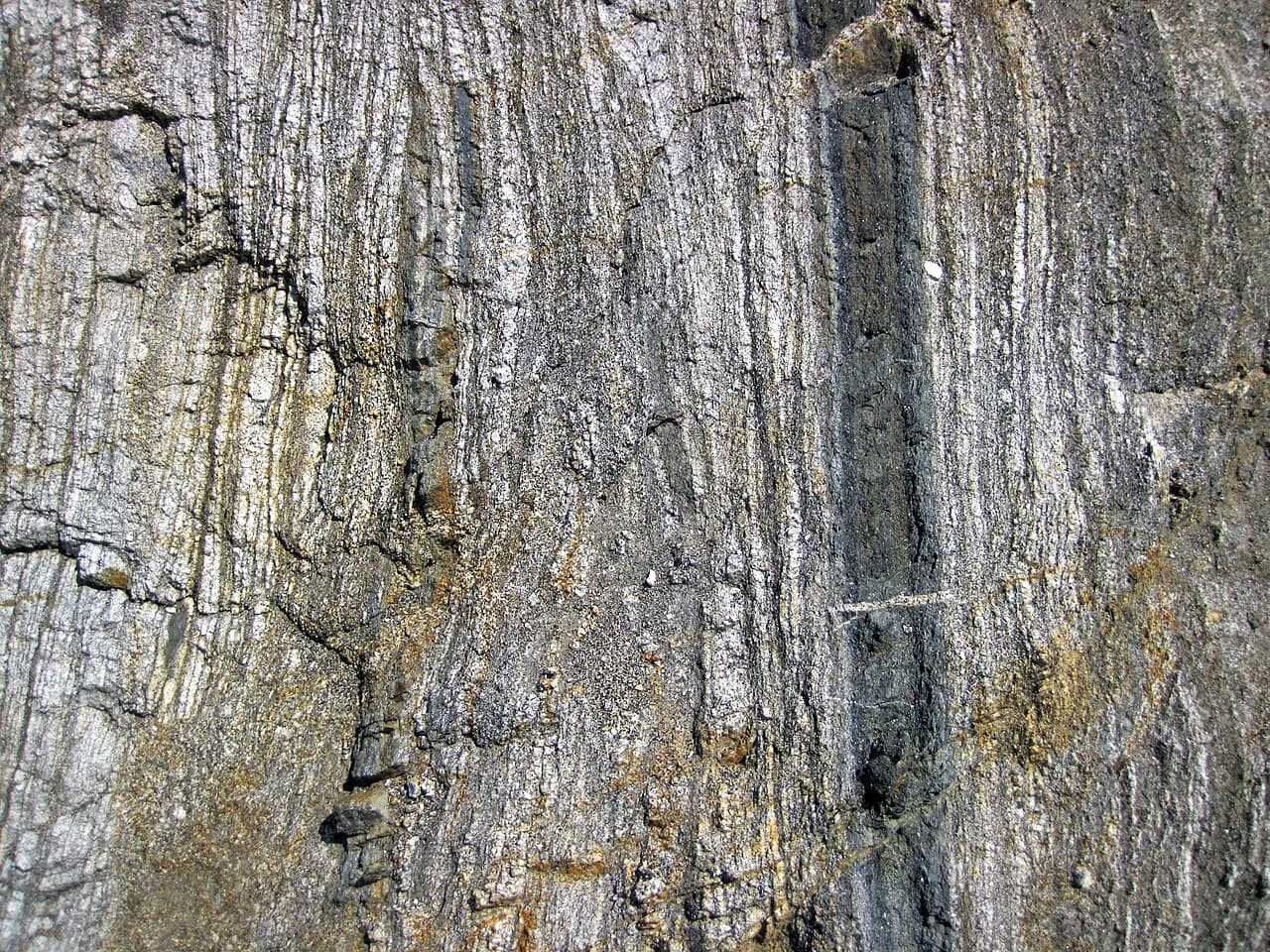
Gneiss (pronounced "nice") is a coarse-grained, high-grade metamorphic rock instantly recognized by its banding: alternating light and dark stripes that sweep across the rock in roughly parallel layers. The pale bands are rich in quartz and feldspar, while the dark bands concentrate platy or needle-like minerals such as biotite mica and amphibole. This segregation into color bands, known as gneissic banding, is the single most reliable field clue — if a hard, grainy rock is striped with light and dark layers, gneiss should be your first guess.
What makes gneiss distinct from other striped metamorphic rocks is that the banding is the result of intense heat and pressure deep in the crust, not of easy splitting. Although its minerals are sorted into layers, gneiss does not flake or peel apart along those bands the way a mica-rich schist does; a struck piece tends to break across the layering into blocky fragments. That combination — obvious light-and-dark banding plus a tough, non-splitting rock with coarse, visible grains — is the signature of one of the most common rocks in the deep continental crust and in the ancient cores of the continents.
Gneiss at a glance
- Classification
- Metamorphic rock — high-grade, foliated
- Rock type
- Metamorphic
- Composition
- Quartz, feldspar, mica (biotite/muscovite) ± amphibole
- Hardness
- About 6–7 overall, governed by its quartz and feldspar
- Colors
- Banded light and dark — gray, white or pink stripes with darker layers
- Texture
- Foliated (gneissic banding); coarse-grained with segregated light and dark bands
What type of rock is gneiss?
Gneiss is a metamorphic rock — it is not igneous and not sedimentary. It forms when a pre-existing rock is transformed in the solid state by high temperature and pressure, deep within the Earth's crust, until its minerals recrystallize and reorganize into bands. The original rock is not melted; instead, its grains grow larger and migrate into light and dark layers while remaining solid. That makes gneiss the product of metamorphism, the third great rock-forming process alongside igneous (crystallized from melt) and sedimentary (deposited and cemented) processes.
Gneiss can be born from more than one kind of parent. When a granite or other igneous rock is metamorphosed, the result is called orthogneiss; when a sedimentary rock such as shale or sandstone is the starting material, the result is a paragneiss. Either way, the rock you end up with is metamorphic. The most common confusion is with granite, an igneous rock that contains almost identical minerals — but granite's crystals are arranged randomly with no banding, whereas gneiss has clearly segregated light and dark layers.
How gneiss forms
Gneiss forms under high-grade metamorphic conditions — broadly higher temperatures and pressures than those that produce slate, phyllite or schist. As a parent rock is buried deep beneath mountain belts and heated, its minerals begin to recrystallize and the elements within them migrate over short distances. Light-colored, felsic minerals (quartz and feldspar) and dark-colored, mafic minerals (biotite, amphibole) gradually separate into distinct bands. This sorting, called metamorphic differentiation, produces the characteristic gneissic banding.
Because these conditions occur where continents collide and crust is thickened, gneiss is typical of the deep roots of mountain ranges and of ancient continental shields. With continued metamorphism a schist can be converted into a gneiss as its grains coarsen and its minerals segregate; pushed even further, toward the point where the rock begins to partially melt, gneiss grades into migmatite, a "mixed" rock of swirled metamorphic and once-molten material. Gneiss thus sits near the high-temperature end of the foliated metamorphic sequence, just short of melting.
How to identify gneiss
The defining feature is banding. Look for alternating light and dark stripes — pale layers of quartz and feldspar separated by darker layers of biotite or amphibole — running in roughly parallel bands across the rock. The grains should be coarse enough to see with the naked eye, giving the rock a grainy rather than smooth feel, and the overall stone is hard: the quartz and feldspar will scratch glass. The bands may be straight, wavy or folded, but they are always present and visible.
The most important test is how the rock breaks. Unlike schist, gneiss does not split readily along its bands. Despite the layering, a hammer blow tends to fracture it across the banding into blocky chunks rather than peeling it into sheets, and the dark bands lack the strong satiny or sparkly sheen of a mica-rich schist. Use the contrasts to confirm: granite has the same minerals but no banding at all; schist is finer, far more micaceous, splits easily and glitters; and a rock with chaotic, swirled, partly fused-looking layers is more likely migmatite. Coarse grain plus segregated bands plus a tough, non-splitting body equals gneiss.
What gneiss is used for
Gneiss is hard, dense and resistant to weathering, so its main uses overlap with those of granite. Cut and polished, its sweeping bands make an attractive, durable dimension stone for countertops, floor and wall tiles, facing slabs and cladding; in the stone trade some banded gneisses are even sold under the broad label of "granite." Blocks of gneiss are used for facing and building stone where a striking layered pattern is desirable.
Crushed gneiss also serves as a sturdy construction aggregate for concrete, road base and fill, much like other hard crystalline rocks. One practical caution distinguishes it from granite: because its minerals are arranged in layers, gneiss can be slightly weaker along the banding and may split or wear preferentially in that direction, so it is selected and oriented with that grain in mind when used as load-bearing or heavily trafficked stone.
Gneiss look-alikes
Frequently asked questions
What type of rock is gneiss?
Gneiss is a metamorphic rock — neither igneous nor sedimentary. It forms when a pre-existing rock, such as granite (orthogneiss) or shale (paragneiss), is recrystallized in the solid state under high temperature and pressure, sorting its minerals into light and dark bands.
How can I identify gneiss?
Look for a hard, coarse-grained rock with alternating light and dark bands — pale quartz-and-feldspar layers between darker biotite or amphibole layers. The grains are visible, the rock scratches glass, and crucially it breaks across the banding rather than splitting into sheets the way schist does.
What is the difference between gneiss and granite?
They share nearly the same minerals, but granite is igneous with randomly arranged, unbanded crystals, while gneiss is metamorphic and shows distinct light-and-dark banding. If the grainy rock is striped, it is gneiss; if it is evenly speckled with no bands, it is granite.
What is gneiss used for?
Gneiss is used as a durable, decorative dimension stone for countertops, tiles, cladding and building stone, where its banding is attractive, and it is crushed for aggregate in concrete and road base. Because its minerals are layered, it can split slightly more easily along the banding than granite does.
Is yours gneiss? Find out from a photo
Photograph your rock in good light and get an identification with an honest confidence level, the look-alikes to rule out and the at-home tests that confirm it.
Identify my rock freeOn Android? Get the free rock identifier app
Related
More rocks in the field guide
Keep exploring
More on rocks: how to identify a rock, what kind of rock is this and the Mohs hardness scale.
Last updated 2026-06-24. Identification guidance is educational — confirm important results with the diagnostic tests described or a qualified expert.