Marble
Also known as: Metamorphosed limestone, Crystalline limestone
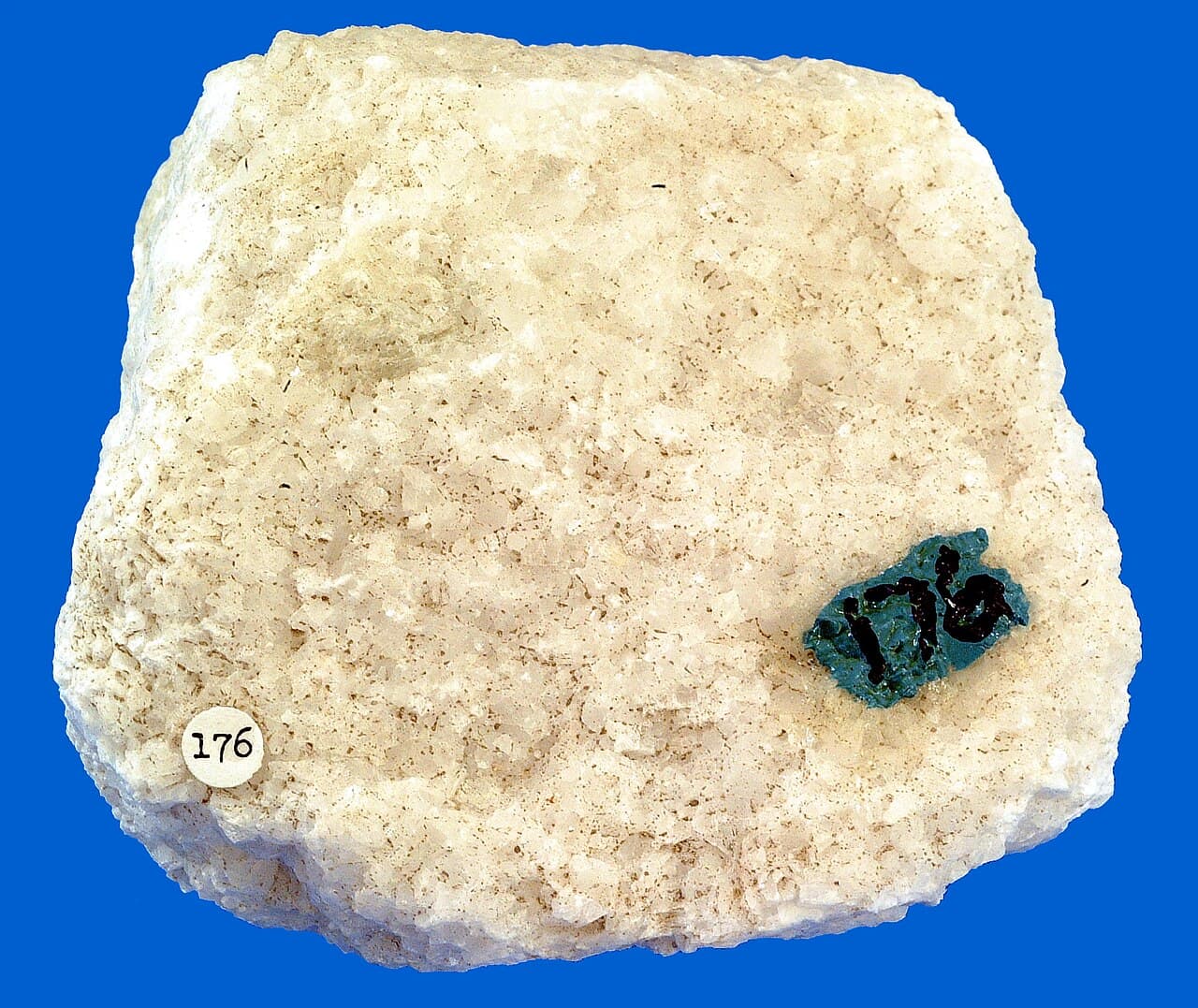
Marble is a metamorphic rock made of tightly interlocking calcite (or dolomite) crystals, formed when limestone or dolostone is recrystallized by heat and pressure deep inside the Earth. The transformation erases most of the original sedimentary features and packs the carbonate grains together into a dense, even mosaic, which is why a freshly broken surface often has a faint sparkle and a slightly sugary, granular look. The most famous marble is the pure white Carrara stone of Italy used by classical sculptors, but marble occurs in a wide range of colors and is frequently shot through with colored veins.
What makes marble instantly recognizable in the field is the combination of softness and chemistry. Because it is built almost entirely from calcite, marble is soft enough to be scratched by a steel knife or even a copper coin, and it reacts with acid: a drop of dilute hydrochloric acid (or, more weakly, household vinegar) will fizz on its surface as carbon dioxide gas bubbles off. That fizz is the single most decisive clue separating marble from harder, quartz-rich look-alikes such as quartzite. The smooth, cool feel and the swirling veins that decorators prize are simply the visible side of a rock that is chemically just recrystallized limestone.
Marble at a glance
- Classification
- Metamorphic rock — non-foliated, carbonate (metacarbonate)
- Rock type
- Metamorphic
- Composition
- Mostly calcite (CaCO₃); dolomitic marble contains dolomite, CaMg(CO₃)₂
- Hardness
- About 3 on the Mohs scale — soft; scratched by a steel knife
- Luster
- Dull to sugary on broken surfaces; takes a high polish
- Colors
- Often pure white; also gray, pink, green, black and tan, commonly veined
- Transparency
- Opaque to faintly translucent in thin, pale pieces
- Texture
- Granular, interlocking carbonate crystals (granoblastic); typically non-foliated
- Magnetic
- Not magnetic
What type of rock is marble?
Marble is a metamorphic rock. The three great rock families are igneous (cooled from molten rock), sedimentary (built from cemented grains, fragments or shells) and metamorphic (an existing rock recrystallized by heat and pressure), and marble belongs firmly in the third group. It is not igneous, because it never melted, and although its parent material is sedimentary, marble itself is what that sediment became after metamorphism rewrote its texture. So when someone asks whether marble is igneous, sedimentary or metamorphic, the answer is metamorphic.
The parent rock of marble is limestone, or its magnesium-rich cousin dolostone. Limestone is a sedimentary rock made of calcite, often from the shells and skeletons of marine organisms. When a body of limestone is buried deeply or caught up in mountain-building, the rising temperature and pressure cause its calcite to recrystallize into larger, interlocking grains, destroying the original fossils and bedding and producing the compact crystalline rock we call marble. Because the chemistry barely changes, marble keeps limestone's defining property of fizzing in acid even though its texture is completely transformed.
How marble forms
Marble forms through the metamorphism of limestone or dolostone, most often where rocks are squeezed and heated during the collision of tectonic plates. As a region is buried beneath kilometers of overlying rock, or intruded by hot magma, temperatures climb high enough for solid calcite to recrystallize without melting. The tiny carbonate grains and any fossil fragments dissolve and regrow into a tight, interlocking framework of new calcite crystals, a process geologists call recrystallization. The result is a denser, harder-to-fracture rock with a uniform, sparkly grain in place of the original muddy or fossil-rich limestone.
Two settings dominate. In regional metamorphism, broad belts of limestone are transformed over large areas as mountain ranges form, producing extensive marble deposits. In contact metamorphism, a body of magma bakes the limestone immediately around it, creating marble in a narrower zone and sometimes introducing new minerals from circulating hot fluids. Those extra minerals are responsible for much of marble's color and veining: pure calcite is white, but traces of iron, clays, graphite or serpentine swept in during metamorphism tint the rock pink, gray, black or green and create the contrasting veins that run through many decorative slabs.
How to identify marble
The two most reliable field tests for marble are hardness and the acid reaction. Marble is soft, only about 3 on the Mohs scale, so a steel knife blade will scratch it easily and you can often mark it with a copper coin; this immediately rules out hard, glassy rocks. Then apply the acid test: a drop of dilute hydrochloric acid placed on marble will fizz vigorously as it releases carbon dioxide, because the rock is made of calcite. (Dolomitic marble reacts more sluggishly and may need a scratched or powdered surface to fizz noticeably.) A rock that is soft and fizzes in acid is almost certainly a carbonate rock such as marble or limestone.
Texture then separates marble from its sedimentary parent. Look closely, ideally with a hand lens, at a freshly broken surface: marble shows a mass of interlocking, sugary calcite crystals that catch the light, and it generally lacks fossils, bedding layers or visible cemented grains. Many marbles are also veined, with contrasting swirls or threads of color cutting across the stone. By contrast, limestone tends to look more uniform, earthy or fossil-bearing and is not recrystallized. If the rock is soft, fizzes, and shows a crystalline rather than grainy-sedimentary or layered fabric, you are looking at marble.
What marble is used for
Marble's combination of fine, even grain, softness enough to carve, and the ability to take a brilliant polish has made it a premier sculptural and architectural stone for thousands of years. Sculptors have long prized white statuary marble because it can be worked into smooth, detailed figures and has a soft translucency that mimics skin. As dimension stone it is cut into slabs and tiles for flooring, wall cladding, columns, staircases and the facades and interiors of monumental buildings, where its veined patterns are valued as decoration.
In the home, polished marble is a popular choice for countertops, vanities, fireplace surrounds and tabletops, although its softness and acid sensitivity mean these surfaces scratch and etch more easily than harder stones and need sealing and care. Beyond ornamental uses, marble is also quarried and crushed for industrial purposes: as construction aggregate, as a source of calcium carbonate for products such as paints, paper and antacids, and, when crushed fine, as agricultural lime to reduce soil acidity. The same chemistry that makes marble fizz in the field is what gives it value as an industrial carbonate.
Marble look-alikes
Frequently asked questions
What type of rock is marble?
Marble is a metamorphic rock. It forms when limestone or dolostone is recrystallized by heat and pressure, so it is not igneous or sedimentary itself, even though its parent rock (limestone) is sedimentary. The metamorphism turns the original carbonate grains into interlocking calcite crystals.
How can I identify marble?
Test hardness and acid reaction. Marble is soft (about 3 on the Mohs scale), so a steel knife scratches it, and a drop of dilute acid fizzes on it because it is made of calcite. On a fresh break it shows interlocking, sugary crystals and often colored veins, with no fossils or bedding layers.
What is the difference between marble and quartzite?
Both can be pale and sugary, but quartzite is made of quartz and is very hard (about 7), scratching glass and steel and not reacting with acid, while marble is soft (about 3), is scratched by a knife, and fizzes in acid. The acid test is the quickest way to tell them apart.
What is marble used for?
Marble is used for sculpture, building and dimension stone, flooring, wall cladding, and countertops because it carves well and takes a high polish, though it scratches and etches relatively easily. Crushed marble is also used as aggregate, as a source of calcium carbonate, and as agricultural lime.
Is yours marble? Find out from a photo
Photograph your rock in good light and get an identification with an honest confidence level, the look-alikes to rule out and the at-home tests that confirm it.
Identify my rock freeOn Android? Get the free rock identifier app
Related
More rocks in the field guide
Keep exploring
More on rocks: how to identify a rock, what kind of rock is this and the Mohs hardness scale.
Last updated 2026-06-24. Identification guidance is educational — confirm important results with the diagnostic tests described or a qualified expert.