Granite
Also known as: Granitic rock, Plutonic granite
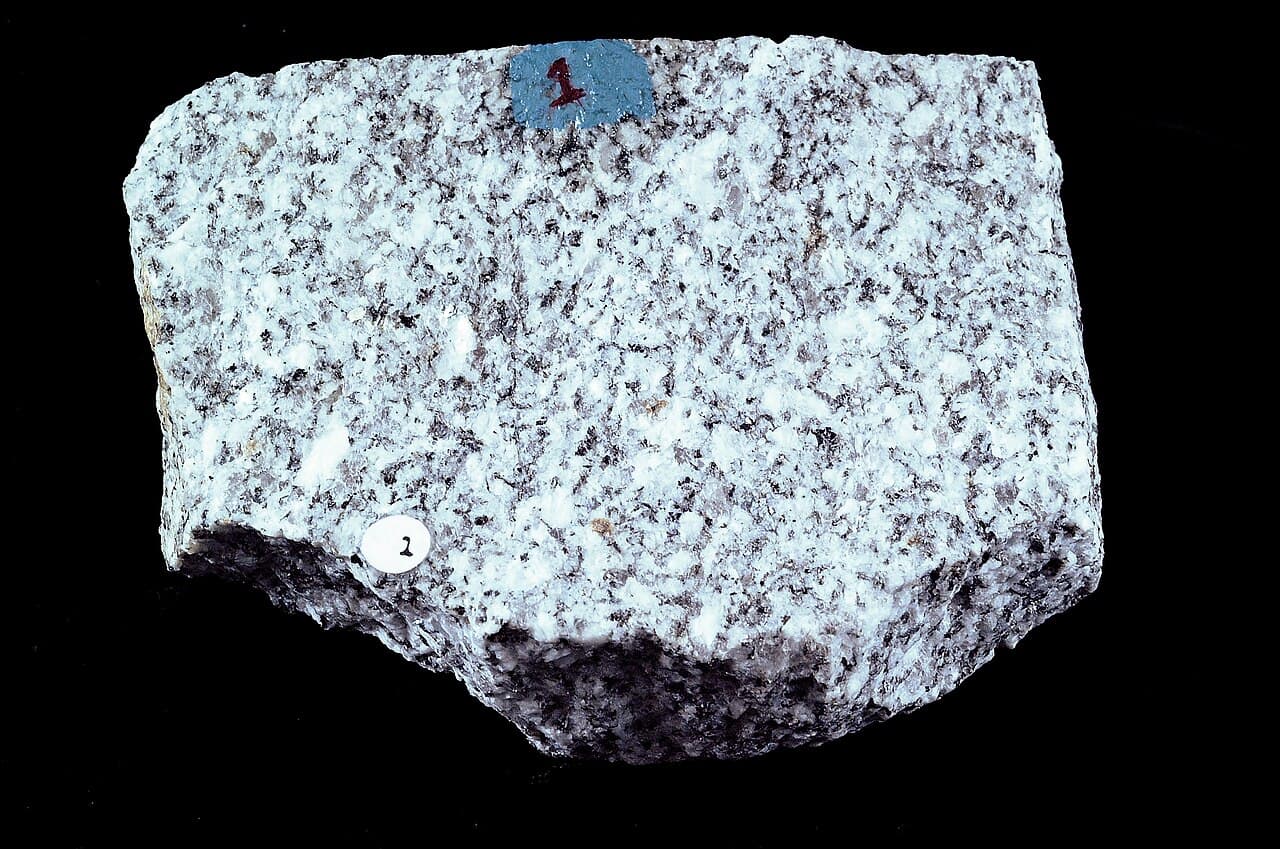
Granite is a coarse-grained igneous rock made largely of quartz and feldspar, with smaller amounts of mica and sometimes a dark amphibole. It is the classic "speckled" stone of countertops, curbs and mountain cliffs: look closely and you can see a mosaic of interlocking mineral grains, typically a mix of glassy gray quartz, blocky pink or white feldspar, and flecks of shiny black mica. That visible, salt-and-pepper crystalline texture is the single most useful clue that a rock is granite rather than a fine-grained volcanic rock or a layered sedimentary one.
Because its crystals grew slowly from molten rock cooling deep inside the Earth, granite is hard, dense and durable, which is exactly why it has been used for building stone and monuments for thousands of years. Geologists use the word "granite" fairly strictly for a rock rich in quartz and alkali feldspar, but in everyday and commercial use the term is stretched to cover almost any hard, grainy, light-colored igneous rock — so a slab sold as "granite" at a stone yard may technically be a diorite or gabbro.
Granite at a glance
- Classification
- Igneous rock — felsic, intrusive (plutonic)
- Rock type
- Igneous
- Composition
- Quartz, alkali feldspar, plagioclase, mica (± amphibole)
- Hardness
- About 6–7, set by its quartz and feldspar
- Colors
- Pink, gray or white, peppered with black mineral specks
- Texture
- Coarse-grained (phaneritic) — interlocking crystals visible to the naked eye
What type of rock is granite?
Granite is an igneous rock — it crystallized from molten rock (magma). More specifically it is an intrusive or plutonic igneous rock, meaning the magma cooled slowly while still trapped underground rather than erupting onto the surface. That slow cooling gave the crystals time to grow large enough to see, which is why granite has its characteristic coarse, grainy texture.
A common point of confusion is whether granite could be sedimentary or metamorphic. It is neither: it is not built from cemented grains or layers (sedimentary), and it is not a pre-existing rock recrystallized by heat and pressure (metamorphic). The closest source of mix-ups is gneiss, a metamorphic rock with a very similar mineral makeup. The difference is fabric — granite's crystals are arranged randomly with no preferred direction, while gneiss shows distinct light and dark banding or stripes. If you see banding, you are looking at gneiss, not granite.
How granite forms
Granite forms when a large body of silica-rich (felsic) magma becomes trapped within the Earth's crust and cools over thousands to millions of years. Because the surrounding rock insulates the magma, it loses heat extremely slowly, and individual minerals have ample time to grow into interlocking crystals millimeters to centimeters across. As the melt cools, minerals crystallize in sequence and lock together, leaving little to no empty space — which is why granite is so dense and strong.
These cooled magma bodies, called plutons or batholiths, can be enormous, forming the cores of entire mountain ranges. The granite we see at the surface today was originally emplaced kilometers underground; it becomes exposed only after the overlying rock is slowly stripped away by uplift and erosion. That is why granite so often crops out in eroded mountain landscapes and along scoured river valleys and coastlines.
How to identify granite
Start with grain size. Granite is coarse-grained: you should be able to pick out individual mineral crystals with the naked eye, giving the rock a grainy, speckled appearance rather than a smooth or glassy one. Then look at the minerals themselves. Granite is dominated by light-colored grains — milky or pink blocky feldspar and glassy gray, slightly translucent quartz — peppered with darker flecks of black or brown mica and sometimes needle-like dark amphibole. The overall color reads as pink, gray or white, never uniformly dark.
A few simple field tests confirm it. Granite is hard: the quartz in it will scratch glass and a steel knife blade will not scratch the quartz grains. The grains are randomly oriented with no layering, banding or alignment — if you see stripes or a tendency to split along flat planes, suspect gneiss or schist instead. Quartz is the clincher: its glassy, colorless-to-gray grains with no flat cleavage faces (it breaks with curved, shell-like surfaces) distinguish true granite from darker, quartz-poor relatives like diorite and gabbro.
Colors and varieties
Granite's color is controlled mainly by its feldspar. Pink and reddish granites owe their hue to abundant alkali feldspar (orthoclase or microcline), while gray and white granites contain more pale plagioclase and quartz. The dark speckling comes from biotite mica and amphibole; the more of these dark minerals present, the darker and "peppered" the rock looks, grading toward relatives such as diorite. Texture also varies: some granites are evenly grained, while porphyritic granites contain large, blocky feldspar crystals set in a finer-grained groundmass.
Be aware that the commercial stone trade uses "granite" very loosely. Many polished slabs marketed as granite — including some jet-black or richly colored ones — are technically gabbro, diorite, anorthosite or other igneous rocks. For a buyer the label rarely matters, but for identification the geological definition (quartz plus alkali feldspar, light overall color) is what counts.
What granite is used for
Granite's hardness, density and resistance to weathering make it one of the most widely used building and ornamental stones. Polished granite is a popular choice for kitchen countertops, flooring and cladding because it resists scratching and wear and takes a durable high polish. Cut into blocks, it serves as dimension stone for buildings, bridges, curbstones, paving and steps, and its longevity makes it a traditional material for monuments, statues and headstones.
Crushed granite is also used as a construction aggregate in concrete, road base and railway ballast, where its strength and angularity are valuable. The combination of structural toughness and an attractive crystalline appearance is what lets a single rock type serve both as heavy-duty aggregate and as a premium decorative surface.
Granite look-alikes
Frequently asked questions
What type of rock is granite?
Granite is an igneous rock — specifically an intrusive (plutonic) one that crystallized slowly from magma deep underground. It is not sedimentary or metamorphic. The slow cooling produced its coarse, visibly crystalline texture.
How can I identify granite?
Look for a hard, coarse-grained rock with visible interlocking crystals: glassy gray quartz, blocky pink or white feldspar and black mica flecks, with no layering or banding. It scratches glass, and its quartz grains break with curved surfaces rather than flat cleavage faces.
What is the difference between granite and gneiss?
They share nearly the same minerals, but gneiss is metamorphic and shows distinct light-and-dark banding, while granite is igneous with randomly arranged, unbanded crystals. If you see stripes or layers, it is gneiss.
What is granite used for?
Granite is used for countertops, flooring, building and paving stone, monuments and headstones because it is hard, durable and polishes well. Crushed granite is also used as aggregate in concrete, road base and railway ballast.
Is yours granite? Find out from a photo
Photograph your rock in good light and get an identification with an honest confidence level, the look-alikes to rule out and the at-home tests that confirm it.
Identify my rock freeOn Android? Get the free rock identifier app
Related
More rocks in the field guide
Keep exploring
More on rocks: how to identify a rock, what kind of rock is this and the Mohs hardness scale.
Last updated 2026-06-24. Identification guidance is educational — confirm important results with the diagnostic tests described or a qualified expert.