Mudstone
Also known as: Mudrock, Argillite (when hardened)
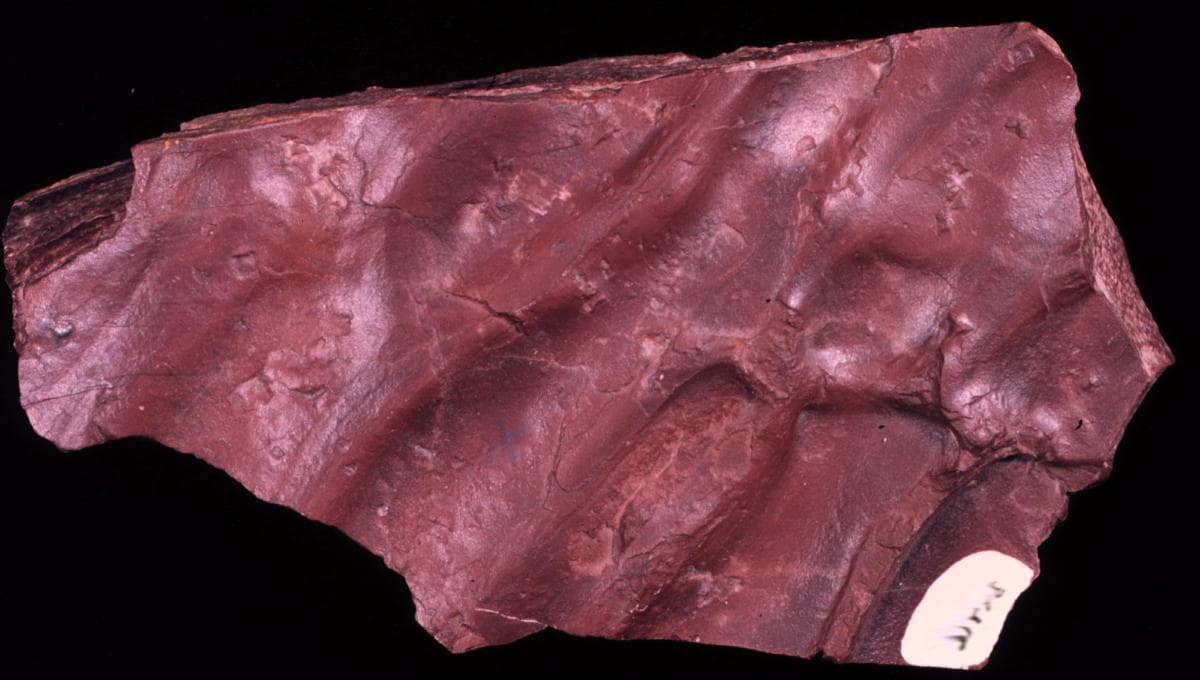
Mudstone is a fine-grained clastic sedimentary rock built almost entirely from clay- and silt-sized particles — grains so small that they feel smooth or slightly floury rather than gritty between your fingers. It belongs to the broad family of "mudrocks," which together make up the most abundant sedimentary rocks on Earth, formed wherever fine mud settles out of still water: on lake bottoms, across river floodplains, and on the quiet floors of deep oceans. Most mudstone is dull and earthy in appearance, breaking into blocky, angular chunks rather than smooth slabs, and it usually shows up in muted grays, browns, reds, and blacks.
The single most important thing to know about mudstone is what separates it from its close cousin, shale: mudstone is not fissile. Fissility is the tendency to split into thin, paper-like sheets along closely spaced parallel planes — and shale does exactly that. Mudstone, made of the same mud-sized ingredients, instead breaks in a blocky, massive way with no preferred splitting direction. Both rocks are essentially lithified mud; the difference lies in their internal structure. If a fine-grained, smooth rock cleaves into flat layers it is shale, and if it fractures into irregular blocks it is mudstone.
Mudstone at a glance
- Classification
- Sedimentary rock — clastic (fine-grained mudrock)
- Rock type
- Sedimentary (clastic)
- Composition
- Mostly clay minerals (e.g., illite, kaolinite) plus fine quartz silt; minor feldspar, mica, and organic matter
- Hardness
- Soft overall — roughly 2–3; easily scratched and can crumble, though the constituent quartz silt is harder
- Luster
- Dull, earthy
- Colors
- Gray, brown, red, and black; tints depend on iron content and organic matter
- Texture
- Very fine-grained; clay- and silt-sized particles too small to see individually; smooth to slightly floury feel; blocky, massive, non-fissile fracture
What type of rock is mudstone?
Mudstone is a sedimentary rock, and within that group it is a clastic rock — one assembled from broken, transported particles rather than from chemical precipitation or organic accumulation. Specifically it is the finest of the clastic rocks, made of clay- and silt-sized grains, which puts it alongside siltstone, claystone, and shale in the "mudrock" category. It is not igneous (it never melted) and it is not metamorphic (it has not been recrystallized by heat and pressure), though if mudstone is buried deeply and squeezed and heated, it can harden into argillite and eventually metamorphose into slate.
The most useful way to place mudstone among its relatives is by grain size and structure. Claystone is dominated by the very finest clay particles; siltstone is built from coarser, gritty silt; and mudstone sits in between, mixing clay and silt. Shale shares mudstone's fine grain size but is fissile, splitting into thin sheets, whereas mudstone is massive and blocky. So mudstone is best defined as a fine-grained, mud-sized clastic sedimentary rock that does not split into layers.
How mudstone forms
Mudstone forms from mud — the suspension of fine clay and silt particles that water carries when rivers, lakes, and oceans are calm enough to let the smallest grains settle. Because clay and silt stay suspended in moving water and drop out only where currents slow to a near standstill, mudstone accumulates in quiet, low-energy environments: deep lake basins, sheltered lagoons, river floodplains that flood and then still, and the deep, undisturbed parts of the seafloor far from wave action. Layer upon layer of mud builds up over long stretches of time.
As more sediment piles on top, the buried mud is compacted: the weight squeezes water out of the pore spaces and presses the platy clay grains together, while dissolved minerals cement them into solid rock. Whether the resulting rock becomes mudstone or shale depends largely on how the clay particles end up arranged and on later compaction. When the clay flakes are randomly oriented or the mud is churned by burrowing organisms before it hardens, the rock lacks a preferred splitting direction and becomes blocky mudstone; when the flakes settle into a strong parallel alignment, the rock splits readily and becomes fissile shale.
How to identify mudstone
Start with the feel and the grain size. Mudstone is so fine-grained that you cannot pick out individual particles with the naked eye, and a clean surface feels smooth or only slightly floury — never gritty or sandy. That smoothness rules out sandstone (which feels like sandpaper) and even siltstone (which feels faintly gritty when rubbed or scraped against your teeth). The rock is also soft and dull: a knife scratches it easily, and a corner may crumble or powder, in contrast to hard, glassy quartz-rich rocks.
The decisive test is how it breaks. Strike or split a piece and watch the fracture: mudstone breaks into blocky, irregular, angular chunks with no preferred direction, while shale cleaves into thin, flat, parallel sheets. This non-fissile, massive fracture is the defining feature of mudstone and the cleanest way to tell it from shale. Two more checks help confirm: mudstone does not fizz when a drop of dilute acid is applied (which separates it from carbonate rocks like limestone, unless it happens to be limy), and it is often, but not always, structureless rather than finely banded. Color — gray, brown, red, or black — is a clue to its makeup but not to its identity, since all of these shades occur in mudstone depending on iron and organic content.
What mudstone is used for
Mudstone's most important roles come from its very fine grain and its clay content. The same clay minerals that make it smooth and soft also make mudrocks a key raw material for the ceramics and brick industries: crushed and fired, clay-rich mudstone is used to manufacture bricks, tiles, and pottery, and it is a component of the materials that go into cement. Because it is weak and breaks down readily, it is generally not valued as building or dimension stone the way harder rocks are.
Mudstone is also significant in the energy and engineering worlds, though largely for how it behaves underground. Organic-rich mudstones and shales can act as the source rocks that generate petroleum and natural gas, and their low permeability lets them serve as seals and barriers that trap fluids in the rocks below — the same low permeability that makes them important in groundwater studies and in the design of waste-containment sites. That weakness and water-sensitivity cuts the other way in construction: mudstone can soften, swell, and slump when wet, so it is treated as a problem material to be evaluated carefully in foundations, road cuts, and slopes.
Mudstone look-alikes
Frequently asked questions
What type of rock is mudstone?
Mudstone is a fine-grained clastic sedimentary rock made of clay- and silt-sized particles. It belongs to the mudrock family alongside siltstone, claystone, and shale. It is not igneous or metamorphic, though deep burial can harden it into argillite and ultimately metamorphose it into slate.
What is the difference between mudstone and shale?
Both are made of the same clay- and silt-sized mud, but shale is fissile — it splits into thin, flat, parallel sheets — while mudstone is massive and breaks into blocky, irregular chunks with no preferred splitting direction. That layered splitting (or lack of it) is the key distinction between the two.
How can I identify mudstone?
Look for a dull, soft, very fine-grained rock that feels smooth rather than gritty and that breaks into blocky, angular pieces instead of thin sheets. It is easily scratched by a knife, usually gray, brown, red, or black, and does not fizz in dilute acid (which would indicate limestone instead).
What is mudstone used for?
Clay-rich mudstone is used as a raw material for bricks, tiles, pottery, and cement. Underground, organic-rich mudstones can act as petroleum and gas source rocks and as low-permeability seals. Because it is weak and softens when wet, it is rarely used as building stone and is treated as a problem material in construction.
Is yours mudstone? Find out from a photo
Photograph your rock in good light and get an identification with an honest confidence level, the look-alikes to rule out and the at-home tests that confirm it.
Identify my rock freeOn Android? Get the free rock identifier app
Related
More rocks in the field guide
Keep exploring
More on rocks: how to identify a rock, what kind of rock is this and the Mohs hardness scale.
Last updated 2026-06-25. Identification guidance is educational — confirm important results with the diagnostic tests described or a qualified expert.