Shungite
Also known as: Noble shungite, Elite shungite, Karelian stone
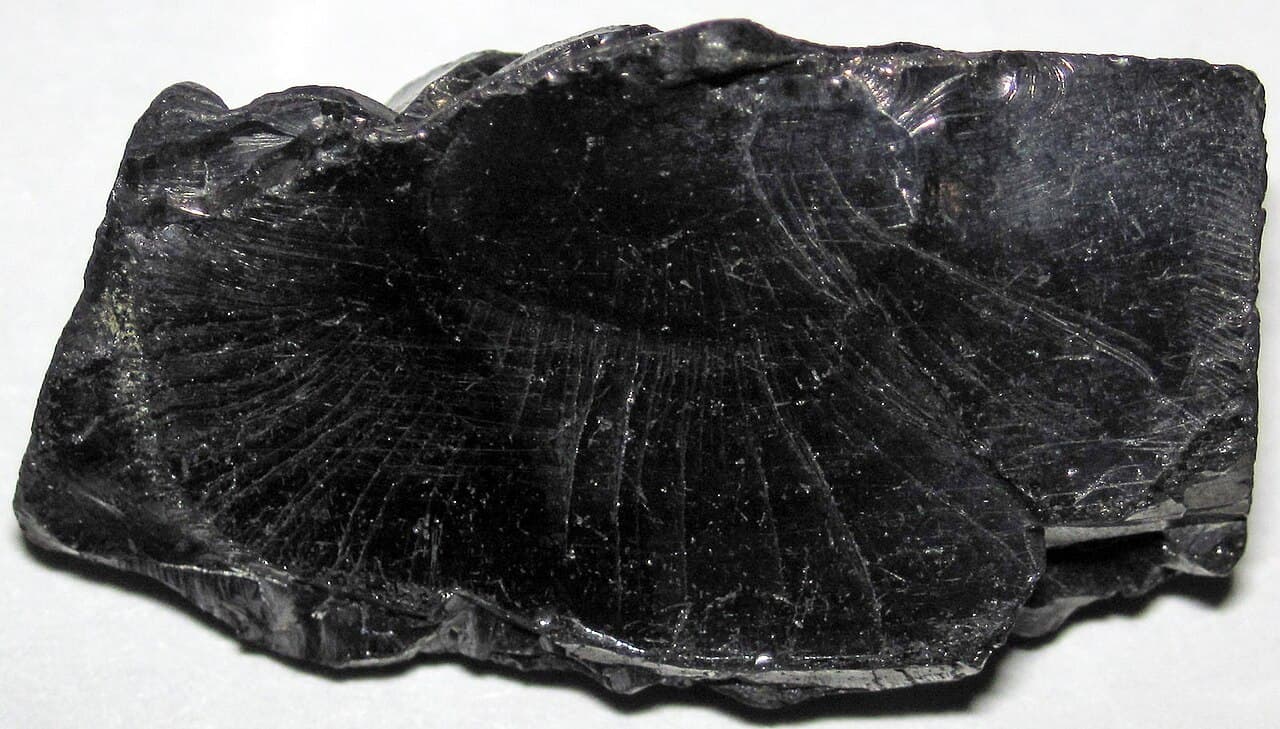
Shungite is an unusual black, carbon-rich material from the village of Shunga in the Karelia region of northwestern Russia, and it sits in a category of its own. Strictly speaking it is not a true mineral with an orderly crystal structure but a mineraloid — and in many forms a rock — composed largely of non-crystalline carbon, often mixed with silicate minerals like quartz. What makes it scientifically interesting is that it contains fullerenes, the spherical carbon molecules famously nicknamed 'buckyballs,' which is part of why this otherwise plain-looking black stone has attracted so much attention.
There are two main grades you will meet. 'Elite' or 'noble' shungite is the rare, high-carbon form — up to roughly 98% carbon — with a bright, silvery-metallic, almost mirror-like shine; it is brittle, comes in small irregular pieces and is the premium material. Far more common is 'regular' shungite, a matte-to-semi-glossy black rock with a lower carbon content, lighter in the hand than it looks, that can be carved and polished into spheres, pyramids, pendants and tumbled stones. A notable physical quirk of carbon-rich shungite is that it can conduct electricity, which is unusual for something sold as a 'stone' and is a handy clue to its identity.
Shungite at a glance
- Classification
- Carbon-rich mineraloid / rock (non-crystalline carbon ± quartz and silicates)
- Composition
- Largely C (carbon), with variable SiO₂ and other silicate/mineral content; not a fixed formula
- Hardness
- About 3.5–4 (Mohs) — fairly soft, scratched by a steel knife
- Luster
- Metallic and silvery in 'elite/noble' grade; matte to semi-glossy in 'regular' shungite
- Streak
- Black (can leave a sooty mark and dirty the hands)
- Colors
- Black to grayish-black; silvery sheen in high-carbon elite grade
- Crystal system
- None — amorphous (non-crystalline)
- Magnetic
- Not magnetic, but carbon-rich shungite can conduct electricity
How to identify it
Start with color, weight and luster. Shungite is always black to grayish-black, and a key tell is that it usually feels surprisingly light for its size — much less dense than metallic-looking minerals like hematite. 'Elite' or noble shungite has a striking bright, silvery, almost mirror-like metallic shine on fresh surfaces and comes as small, brittle, irregular nuggets, while 'regular' shungite is a more ordinary matte-to-semi-glossy black that takes a smooth polish on carved spheres and pyramids. Many pieces will leave a faint sooty black mark on your fingers or on paper, reflecting their high carbon content.
Two simple checks help confirm it. First, hardness: shungite is fairly soft at about Mohs 3.5 to 4, so a steel knife scratches it and it is clearly softer than quartz, glass or obsidian. Second — the standout test — carbon-rich shungite can conduct electricity, so a genuine high-carbon piece can complete a simple circuit and light a small bulb or register on a multimeter, something almost no ordinary black stone will do. A lightweight, soft, sooty black stone that also conducts electricity is very likely real shungite; a hard, glassy black piece with conchoidal fracture is more likely obsidian, and a heavy, metallic, gray-streaked one is more likely hematite.
Colors and varieties
Shungite is essentially a one-color stone — black — but its surface character varies a lot with carbon content. The premium 'elite' (also called 'noble') grade is the highest-carbon form, up to about 98% carbon, and is recognized by its bright silvery, metallic, lustrous sheen and small, brittle, naturally faceted-looking fragments; it is not usually carved, but kept as raw nuggets. Mid- and lower-grade material shades from a semi-glossy charcoal to a flatter matte black.
The far more common 'regular' or 'classic' shungite has a lower (but still substantial) carbon content mixed with quartz and other silicate minerals, giving a denser, more workable black rock. This is the material you usually see shaped into polished spheres, pyramids, cubes, pendants, beads and tumbled stones, and used to make water 'infusion' chips and even tiles. So while there are no colorful varieties, the practical distinction in the market is grade and finish: rare silvery elite nuggets versus the everyday matte-to-glossy carved black shungite.
Meaning and properties
Shungite is one of the most heavily marketed 'protective' stones, and in popular crystal lore it is promoted above all as an EMF-protection and purification stone — sold to shield people from the electromagnetic fields of phones, Wi-Fi and computers, to 'cleanse' water, and as a grounding stone for the root chakra associated with safety and detox. Many people keep shungite pyramids or plates near electronics, wear shungite pendants, or place shungite chips in water bottles because of these traditional and commercial beliefs.
It is important to be clear and honest about these claims: they are traditional and marketed beliefs, not scientifically established facts. There is no reliable scientific evidence that shungite blocks or neutralizes EMF in any way that benefits health, and it should not be relied upon as protection from radiation or as a medical treatment, water purifier or remedy for any condition. (Because raw shungite is dusty and may carry impurities, it is also not a substitute for proper water filtration.) Enjoy shungite for its genuinely interesting carbon-and-fullerene mineralogy and the grounding associations people attach to it — and rely on qualified professionals and tested products for actual health, safety and water-quality needs.
Value
Regular carved shungite is abundant and generally inexpensive, so most of its value comes from craftsmanship and grade rather than rarity: a cleanly polished, well-proportioned sphere, pyramid or pendant in solid matte-to-glossy black is worth more than a dull, chipped or low-carbon piece. Because it is a soft, common rock, ordinary shungite items are priced as affordable decorative and metaphysical pieces.
The premium of the market is 'elite' or noble shungite — the rare, silvery, very high-carbon nuggets — which is scarcer and commands noticeably higher prices per gram than regular grade, with brighter metallic sheen and higher carbon content being the main drivers. Larger, cleaner elite pieces are the most sought after. There is no single fixed price, and because the desirable health 'benefits' are not scientifically supported, it is wise not to overpay on marketing claims; judge value the honest way, by comparing grade, carbon content, size and quality of finish between similar pieces.
Real vs. fake
Because shungite is sold for its supposed properties, imitations are common — often plain black stone, black glass, resin, or even painted or pressed material passed off as shungite, and lower-carbon rock sold at premium 'elite' prices. Warning signs include a piece that is too heavy and dense (suggesting another rock or glass), a glassy conchoidal fracture (pointing to obsidian or glass), trapped round bubbles or mold seams (plastic or glass), and a stone that is suspiciously hard or leaves no sooty mark at all.
The most decisive test exploits shungite's real physics: genuine carbon-rich shungite conducts electricity, so a true high-carbon piece can complete a simple battery-and-bulb circuit or register continuity on a multimeter, whereas glass, plastic, obsidian and most look-alike rocks do not conduct. Back this up with the basics — real shungite is fairly soft (Mohs ~3.5–4, scratched by a knife), feels light for its size, is matte-to-metallic black (silvery in elite grade), and often dirties the fingers slightly. A hard, glassy, non-conductive 'shungite' is almost certainly something else; for important purchases, buy from reputable sellers who can confirm Karelian origin.
Care
Shungite is fairly soft (about Mohs 3.5–4) and, in the elite grade, quite brittle, so handle it gently: keep it away from harder stones that can scratch it, store carved pieces separately or wrapped in soft cloth, and protect fragile silvery nuggets from knocks and drops that can chip or shatter them. Fresh or low-grade pieces can also shed a little fine black dust, so a tray or cloth underneath keeps surfaces clean.
Clean shungite with lukewarm water and a soft cloth or brush, and dry it well; a quick rinse is fine, but avoid prolonged soaking of porous or raw material, and skip harsh chemicals, acids, ultrasonic and steam cleaners, which can damage the soft, sometimes flaky surface. Because raw shungite can carry dust and impurities, do not treat casual rinse water as drinkable or purified. Kept dry, stored carefully and cleaned gently, both regular and elite shungite will hold their black (or silvery) finish for a long time.
Shungite look-alikes
Frequently asked questions
What is shungite?
Shungite is a black, carbon-rich mineraloid (and often a rock) from the Shunga area of Karelia, Russia. It is made largely of non-crystalline carbon — sometimes mixed with quartz and other minerals — and contains fullerenes ('buckyballs'). 'Elite' or noble grade is rare, silvery and up to about 98% carbon; 'regular' shungite is matte black, lighter than it looks, and often carved into spheres, pyramids and pendants.
Does shungite really block EMF or protect your health?
No. The claims that shungite blocks EMF, neutralizes phone or Wi-Fi radiation, purifies water, or treats medical conditions are traditional and marketed beliefs, not scientifically established facts. There is no reliable evidence that it protects health in these ways, and it should not be used as EMF protection, a medical remedy, or a substitute for proper water filtration. Enjoy it for its mineralogy and rely on tested products and professionals for real needs.
How can I tell real shungite from a fake?
The strongest test is electrical: genuine carbon-rich shungite conducts electricity, so it can complete a simple battery-and-bulb circuit or register on a multimeter, while glass, plastic and obsidian do not. Real shungite is also fairly soft (Mohs ~3.5–4), feels light for its size, is matte-to-metallic black, and often leaves a faint sooty mark. A hard, glassy, non-conductive 'shungite' is almost certainly something else.
What is the difference between elite and regular shungite?
Elite (or 'noble') shungite is the rare, premium grade — up to roughly 98% carbon — with a bright silvery metallic sheen; it comes as small brittle nuggets and is more expensive per gram. Regular shungite has a lower (but still high) carbon content mixed with quartz and other minerals, is matte-to-glossy black, more durable, and is the material usually carved into spheres, pyramids, beads and tumbled stones.
Is yours shungite? Find out from a photo
Photograph your crystal in good light and get an identification with an honest confidence level, the look-alikes to rule out and the at-home tests that confirm it.
Identify my crystal freeOn Android? Get the free rock identifier app
Related
More crystals in the field guide
Keep exploring
More on crystals: the full list of crystal types, how to identify a crystal and crystals by color.
Last updated 2026-06-25. Identification guidance is educational — confirm important results with the diagnostic tests described or a qualified expert.