Septarian
Also known as: Dragon Stone, Dragon's Egg, Septarian Nodule, Septarian Concretion
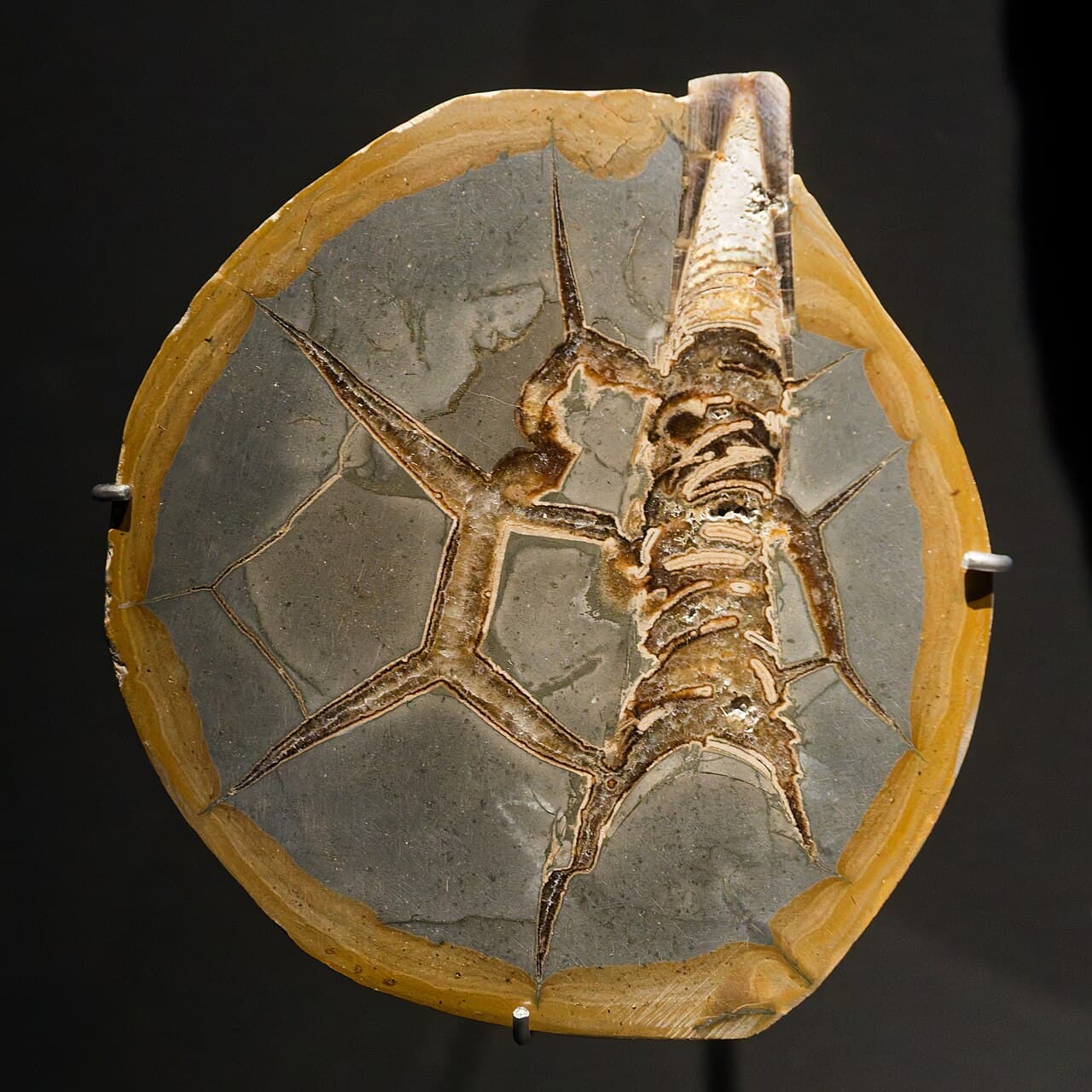
Septarian is not a single mineral but a concretion: a rounded nodule of sedimentary mud that hardened, dried, cracked from the inside, and then had its internal cracks slowly filled with crystal. The result is a stone with one of the most recognizable interiors in the rock world. Cut or split open, a septarian nodule reveals a web of golden-yellow calcite veins and bands of brown to honey-colored aragonite snaking through a gray-brown limestone or mud body, often with hollow pockets lined in sparkling crystal. Those branching cracks, called septa, give the stone its name and its nickname dragon stone, since the pattern can look like the scaly skin or cracked shell of a dragon's egg.
Because each nodule formed and cracked individually, no two septarian stones are identical, which is a large part of their appeal as decorative and display pieces. They are relatively soft (the calcite and aragonite fillings sit around 3.5 to 4 on the Mohs scale, with the surrounding limestone often softer still), so septarian is admired and polished rather than used in rugged jewelry. Knowing how septarian forms is the key to identifying it: the combination of a concretion body, radiating internal cracks, and contrasting yellow and brown carbonate infill is a signature that few other stones can fake.
Septarian at a glance
- Classification
- Sedimentary concretion (nodule of limestone/mudstone with calcite and aragonite infill)
- Composition
- Mixed: CaCO3 (calcite and aragonite) with limestone/clay matrix
- Hardness
- About 3.5 to 4 (Mohs), softer in the muddy matrix
- Luster
- Vitreous on the crystalline veins, dull to earthy on the matrix
- Streak
- White (from the carbonate components)
- Colors
- Golden yellow veins, brown to honey aragonite bands, gray to brown matrix; sometimes white or reddish accents
- Crystal system
- Not applicable as a whole (an aggregate); calcite is trigonal, aragonite orthorhombic
- Transparency
- Opaque overall, with translucent crystal in vein pockets
How to identify it
The defining feature of septarian is its interior, so the most reliable identification comes from a cut, polished, or broken surface rather than the rough outside. Look for a network of cracks radiating and branching through the stone, filled with bright golden-yellow calcite and bordered by darker brown to honey-colored aragonite, all set in a gray-brown limestone or mud matrix. The cracks typically widen toward the center and narrow toward the edges, sometimes opening into small hollow cavities lined with tiny calcite crystals. This combination of branching septa plus two-tone carbonate infill in a sedimentary body is the single best diagnostic for septarian.
Supporting tests confirm it quickly. Septarian is soft: the calcite and aragonite veins are only about 3.5 to 4 on the Mohs scale, so a steel knife scratches them, and the muddy matrix is softer still. Because the bright veins are carbonate, a drop of dilute acid or even household vinegar will fizz on them as carbon dioxide is released, which separates the yellow calcite and brown aragonite from any non-carbonate look-alike. The outside of an uncut nodule is usually a rounded, lumpy gray-brown ball that gives little away, so when in doubt, judge septarian by what is inside, not by its weathered shell.
Colors and varieties
Septarian's classic palette comes straight from its mineral makeup. The vivid golden-yellow veins are calcite, the warm brown to caramel bands are aragonite, and the surrounding gray to gray-brown body is limestone or hardened mud, sometimes with a chalcedony-rich rind. Many pieces also show thin white seams, occasional reddish or orange tones where iron has stained the matrix, and dark outlines where the aragonite borders the calcite. The strong contrast between the bright yellow centers and the muted brown surround is what makes polished septarian so striking and easy to recognize.
Most of the septarian on the market is sold as polished slabs, spheres, eggs, hearts, towers, and freeform display pieces that show off the cracked interior, and the trade names dragon stone and dragon's egg are used for exactly this material. Variation between specimens is the norm: some nodules are dominated by wide yellow calcite veins, others by tight brown aragonite webbing or by open crystal-lined pockets. The amount of yellow, the boldness of the pattern, and the presence of sparkling cavities all change from nodule to nodule, so collectors often choose septarian piece by piece for its individual pattern.
Meaning and properties
In crystal and metaphysical traditions, septarian is often described as a grounding and nurturing stone, with its blend of calcite, aragonite, and earthy limestone said by practitioners to bring a feeling of calm, patience, and connection to the earth. Some people keep it for meditation or display as a reminder of slow, natural cycles, given how long the nodule took to form and fill. These associations come from spiritual and cultural belief systems and personal practice, not from scientific evidence, and septarian should not be used to diagnose, treat, or cure any physical or emotional condition.
If you enjoy the symbolic side of stones, septarian's warm colors and dramatic patterning make it a popular meditation and decor piece, and you can treat those uses as a personal or spiritual practice rather than a remedy. Keep the practical limits in mind: it is soft and partly made of mud-like matrix, so it is better suited to careful handling and display than to everyday wear. For any genuine health or wellbeing concern, consult a qualified healthcare professional instead of relying on a crystal.
Value and what affects price
Septarian is an affordable, widely available decorative stone rather than a precious one, so price is driven mostly by size, pattern, and finish rather than rarity. The most desirable pieces show bold, high-contrast golden-yellow calcite against well-defined brown aragonite, attractive symmetrical cracking, and clean, glossy polishing with no major chips. Specimens that open into sparkling crystal-lined pockets, or large carved forms like spheres and eggs that display the pattern from every angle, command more than plain or muddy-looking slabs.
Workmanship and condition matter because septarian is soft and partly porous. A high-quality polish that brings out the yellow veins, even cutting that centers the most dramatic pattern, and a piece free of cracks across the matrix all add value, while dull surfaces, dominant gray mud, or fracture damage reduce it. Because the material is common and inexpensive at the low end, judge a septarian piece on the strength of its pattern, the quality of its finish, and its overall condition rather than on any marketing name.
Real vs. fake
Outright fakes of septarian are uncommon because the natural material is cheap, so the main issues are dyeing and misidentification rather than counterfeiting. The most reliable authenticity check is the carbonate reaction: real septarian's yellow calcite and brown aragonite veins fizz when touched with a drop of dilute acid or household vinegar, while a resin or plastic imitation will not react. Genuine septarian is also soft, so a steel knife scratches the veins easily; a piece that resists scratching and has unnaturally perfect, repeating patterns may be a molded or composite imitation rather than a natural nodule.
Be aware that some septarian is color-enhanced to make the yellow more vivid, so suspiciously bright, uniform, or oddly tinted color (especially unnatural blues or greens) can indicate dye rather than natural calcite; a hidden or freshly cut surface sometimes reveals paler material underneath. Natural septarian also shows genuine variation, with cracks that widen toward the center, irregular vein widths, and a real sedimentary matrix, whereas printed or cast fakes tend to look too even. Combining the acid test, the low hardness, and a look for honest, irregular internal structure makes confident identification straightforward.
Care
Septarian needs gentler care than most popular crystals because it is soft and chemically reactive. At roughly Mohs 3.5 to 4 in the veins and softer in the matrix, it scratches easily, so store it apart from harder stones and avoid stacking pieces against one another. Clean it only with a soft, dry or barely damp cloth, or a soft brush to lift dust; avoid prolonged soaking, since the porous limestone matrix can absorb water and the polish can dull. Support larger spheres and carvings from underneath, as a knock can chip an edge or crack the matrix.
The most important rule is to keep septarian away from acids of any kind, because the same carbonate reaction that helps identify it will etch and dissolve the yellow and brown veins. That means no vinegar, no acidic cleaners, and care around acidic household products. Keep it out of prolonged direct sunlight, which can fade enhanced color over time, and avoid sudden temperature changes. Treated with this gentle routine, a polished septarian piece keeps its glossy surface and the bright contrast between its calcite and aragonite for years.
Septarian look-alikes
Frequently asked questions
What is septarian made of?
Septarian is a concretion rather than a single mineral. It has a body of gray-brown limestone or hardened mud that cracked from the inside as it dried, and those internal cracks were later filled with golden-yellow calcite and bands of brown aragonite. Some nodules also have hollow pockets lined with small crystals. The mix of a sedimentary matrix and carbonate vein infill is what gives septarian its distinctive look.
Why is septarian called dragon stone?
The nickname dragon stone, or dragon's egg, comes from its appearance. The branching network of cracks across the surface and through the interior resembles scaly dragon skin or the cracked shell of an egg, and the warm yellow and brown colors add to the effect. The names are trade terms for the same natural septarian nodule, not a separate material.
How can I tell if septarian is real?
Use two quick checks. First, put a drop of vinegar or dilute acid on a yellow or brown vein; real septarian is carbonate and will fizz as carbon dioxide bubbles off, while resin or plastic imitations will not. Second, try to scratch it: genuine septarian is soft (about Mohs 3.5 to 4), so a steel knife marks it easily. Natural pieces also show irregular cracks that widen toward the center rather than a too-perfect repeating pattern.
Can septarian get wet or be worn as jewelry?
Limit water exposure and clean it only briefly with a soft, barely damp cloth, since the porous limestone matrix can absorb water and dull the polish, and never use acids, which dissolve the carbonate veins. Because it is soft and partly made of mud-like matrix, septarian also makes fragile jewelry that scratches and chips; it is best suited to display pieces, spheres, and carvings rather than everyday rings or bracelets.
Is yours septarian? Find out from a photo
Photograph your crystal in good light and get an identification with an honest confidence level, the look-alikes to rule out and the at-home tests that confirm it.
Identify my crystal freeOn Android? Get the free rock identifier app
Related
More crystals in the field guide
Keep exploring
More on crystals: the full list of crystal types, how to identify a crystal and crystals by color.
Last updated 2026-06-25. Identification guidance is educational — confirm important results with the diagnostic tests described or a qualified expert.