Rose Quartz
Also known as: Pink quartz, Hyaline quartz (older usage)
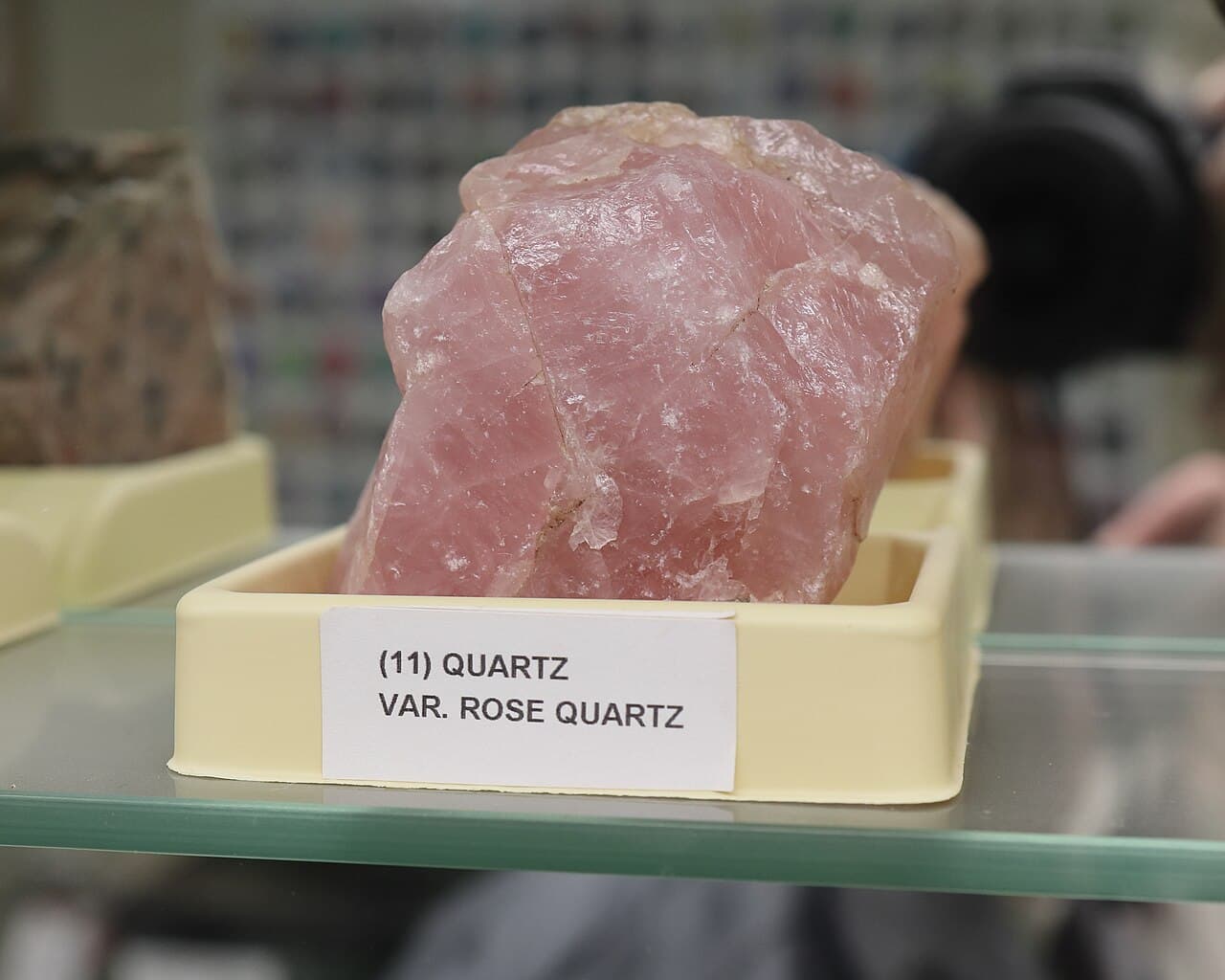
Rose quartz is the soft pink variety of quartz (SiO₂), sharing the same core properties as clear quartz, amethyst and citrine: a Mohs hardness of 7, a white streak and a trigonal crystal structure. What sets it apart is both its gentle rose color and the way it grows. Unlike amethyst or citrine, rose quartz almost always occurs in massive form — cloudy, glassy chunks with no flat crystal faces — rather than as the sharp six-sided points people associate with quartz. Most pieces are hazy and translucent rather than clear, with a milky, slightly cloudy interior.
The pink color is delicate and comes from trace elements such as titanium and iron, and in much material from microscopic mineral fibers distributed through the stone. Those same tiny inclusions are responsible for one of rose quartz's most prized effects: when a clean piece is cut into a rounded cabochon, light scattering off the fibers can produce asterism, a soft six-rayed star floating across the surface. From pale, barely-there blush to a deeper rosy pink, this is among the most recognizable and beloved of all the quartz varieties.
Rose Quartz at a glance
- Classification
- Mineral — macrocrystalline quartz (pink variety)
- Composition
- SiO₂ (silica, colored by trace titanium/iron and microscopic inclusions)
- Hardness
- 7 (Mohs)
- Luster
- Vitreous (glassy)
- Streak
- White
- Colors
- Pale pink to rosy pink, often cloudy
- Crystal system
- Trigonal
- Transparency
- Translucent to nearly transparent (usually hazy)
How to identify rose quartz
The first clues are color and texture together: rose quartz is a soft, slightly cloudy pink, and it almost always appears as a solid massive lump with no crystal faces rather than as distinct points. Hold a piece up to the light and it is typically translucent and hazy, glowing gently rather than being either glass-clear or fully opaque. As quartz, it has a hardness of 7, so it will scratch glass, a steel knife will not scratch it, and a broken surface shows a curved, shell-like (conchoidal) fracture instead of flat cleavage planes.
Confirm the basics with simple tests: a white streak and that hardness of 7 immediately separate rose quartz from softer pink minerals. The color should be a muted, even-to-cloudy pink — natural rose quartz is rarely a vivid, candy-bright pink, and it is rarely transparent and flawless. If a tumbled or carved piece is cut as a smooth dome, tilt it under a single light source and look for a faint star; the presence of weak asterism is a helpful confirmation that you are dealing with genuine rose quartz.
Color and varieties
Rose quartz ranges from the faintest pale blush through to a fuller rosy pink, and the tone is almost always soft rather than intense. Most material is cloudy and translucent because of the microscopic inclusions that also give the stone its color and its capacity for asterism; perfectly clear pink quartz crystals do exist but are rare and are sometimes distinguished as "pink quartz" separate from common massive rose quartz. The best-known special variety is star rose quartz, in which a cabochon shows a soft six-rayed star.
Color can vary noticeably from piece to piece and even within a single specimen, and it tends to be on the gentle side. Because the hue is naturally pale and uneven, an extremely saturated, perfectly uniform hot-pink stone should raise suspicion of dye rather than being taken as premium natural color.
Meaning and properties
Rose quartz is famous in crystal traditions as the "love stone," associated with gentleness, compassion, emotional warmth and self-care, and in chakra-based practice it is most often linked with the heart. Its soft pink color has long made it a symbol of tenderness and affection, and it is a popular gift stone for exactly that reason.
These associations are cultural and spiritual rather than scientifically established medical effects. Rose quartz is best enjoyed for its beauty and symbolism; it is not a substitute for medical, emotional or psychological care.
Value: what rose quartz is worth
Rose quartz is abundant and generally inexpensive, and most tumbled stones, beads and small carvings cost only a few dollars. Value rises with a clean, attractive even pink color, good translucency, and freedom from cracks, gray patches or muddy zones, so well-colored translucent material is worth more than pale, heavily clouded or fractured pieces.
The clearest premiums go to special material: transparent pink quartz crystals are scarce and prized by collectors, and finely cut star rose quartz cabochons with a sharp, well-centered star command more than ordinary massive stone. As always, natural untreated color is preferred over dyed material.
Real vs. fake rose quartz
The most common deceptions are dyed quartz and glass posing as rose quartz. The biggest red flag is the color itself: genuine rose quartz is a soft, often uneven pink that is rarely vivid, so an intensely bright, perfectly uniform hot-pink stone is a warning sign of dye. Dyed pieces may also show color concentrated along cracks. Glass imitations frequently contain tiny round bubbles, can feel warmer to the touch than cool quartz, and may be softer, so a knife test that leaves a scratch points away from genuine quartz, which has a hardness of 7.
Several natural pink minerals are also mistaken for rose quartz, and a few quick checks separate them. Morganite is pink beryl, harder than quartz (about Mohs 7.5–8) and denser, so rose quartz cannot scratch it. Rhodochrosite is a soft pink mineral (only about 3.5–4 on the Mohs scale), is usually banded in lighter and darker pink, and will effervesce (fizz) in contact with acid — none of which is true of quartz. Pink calcite is likewise much softer and also fizzes in acid. Confirming a hardness of 7, a white streak, no reaction to acid and a glassy conchoidal fracture reliably identifies real rose quartz.
Care
Rose quartz is hard (Mohs 7) and durable, making it safe to clean with warm water and a mild soap and well suited to everyday jewelry and handling. Avoid harsh chemicals and abrupt temperature changes, which can stress any quartz, and treat acid-bearing cleaners as off-limits.
Light is the main thing to manage: rose quartz's gentle pink can fade with prolonged exposure to strong sunlight. Store it out of direct sun for long stretches to keep its color from washing out over time, and it will otherwise hold up well for generations.
Rose Quartz look-alikes
Frequently asked questions
What is rose quartz?
Rose quartz is the soft pink variety of quartz (SiO₂), with a Mohs hardness of 7 and a white streak. It almost always occurs as cloudy, massive chunks rather than as crystals, and its gentle pink comes from trace titanium and iron and from microscopic inclusions, which can also create a six-rayed star when the stone is cut as a cabochon.
How can I tell if rose quartz is real?
Real rose quartz is a soft, often uneven and cloudy pink, has a hardness of 7 (it scratches glass and is not scratched by a knife), shows a white streak, and does not react to acid. Suspect dye if the pink is intensely bright and perfectly uniform, and suspect glass if you see tiny round bubbles or the piece feels warm and scratches easily.
What is the difference between rose quartz and morganite?
Hardness, density and clarity. Morganite is pink beryl, harder than quartz (about Mohs 7.5–8) and denser, so rose quartz cannot scratch it and morganite feels heavier. Morganite is usually clearer and more transparent, while rose quartz is typically cloudy and translucent.
What is rose quartz good for?
Practically, it is a durable, attractive stone for jewelry, beads and carvings. In crystal traditions it is known as the love stone, associated with compassion, emotional warmth and self-care — associations that are spiritual and cultural rather than medically proven, so it is not a substitute for medical or emotional care.
What does rose quartz symbolize?
Rose quartz is best known as the stone of love — self-love, friendship and gentle emotional comfort — an association running back to antiquity, where Greek and Roman myth tied it to Aphrodite and Venus and it was carved into love tokens. In modern crystal practice it is treated as the heart-chakra stone, valued for calm and compassion. These meanings are cultural and spiritual rather than medical: rose quartz is a lovely stone to keep or give, but it does not treat any condition and is no substitute for professional care.
Is desert rose the same as rose quartz?
No — despite the similar name they are completely different minerals. Rose quartz is pink quartz: glassy, translucent and hard (Mohs 7). A 'desert rose' is a rosette-shaped cluster of gypsum or barite crystals that grew around sand grains in arid ground — sandy-brown, opaque and far softer, since gypsum is only 2 on the Mohs scale and a fingernail will scratch it. If your 'rose' is beige, petal-like and crumbles or scratches easily, it is a desert rose, not rose quartz.
Is yours rose quartz? Find out from a photo
Photograph your crystal in good light and get an identification with an honest confidence level, the look-alikes to rule out and the at-home tests that confirm it.
Identify my crystal freeOn Android? Get the free rock identifier app
Related
More crystals in the field guide
Related reading
Keep exploring
More on crystals: the full list of crystal types, how to identify a crystal and crystals by color.
Last updated 2026-07-19. Identification guidance is educational — confirm important results with the diagnostic tests described or a qualified expert.