Brachiopod
Also known as: Brachiopod fossil, Lamp shell
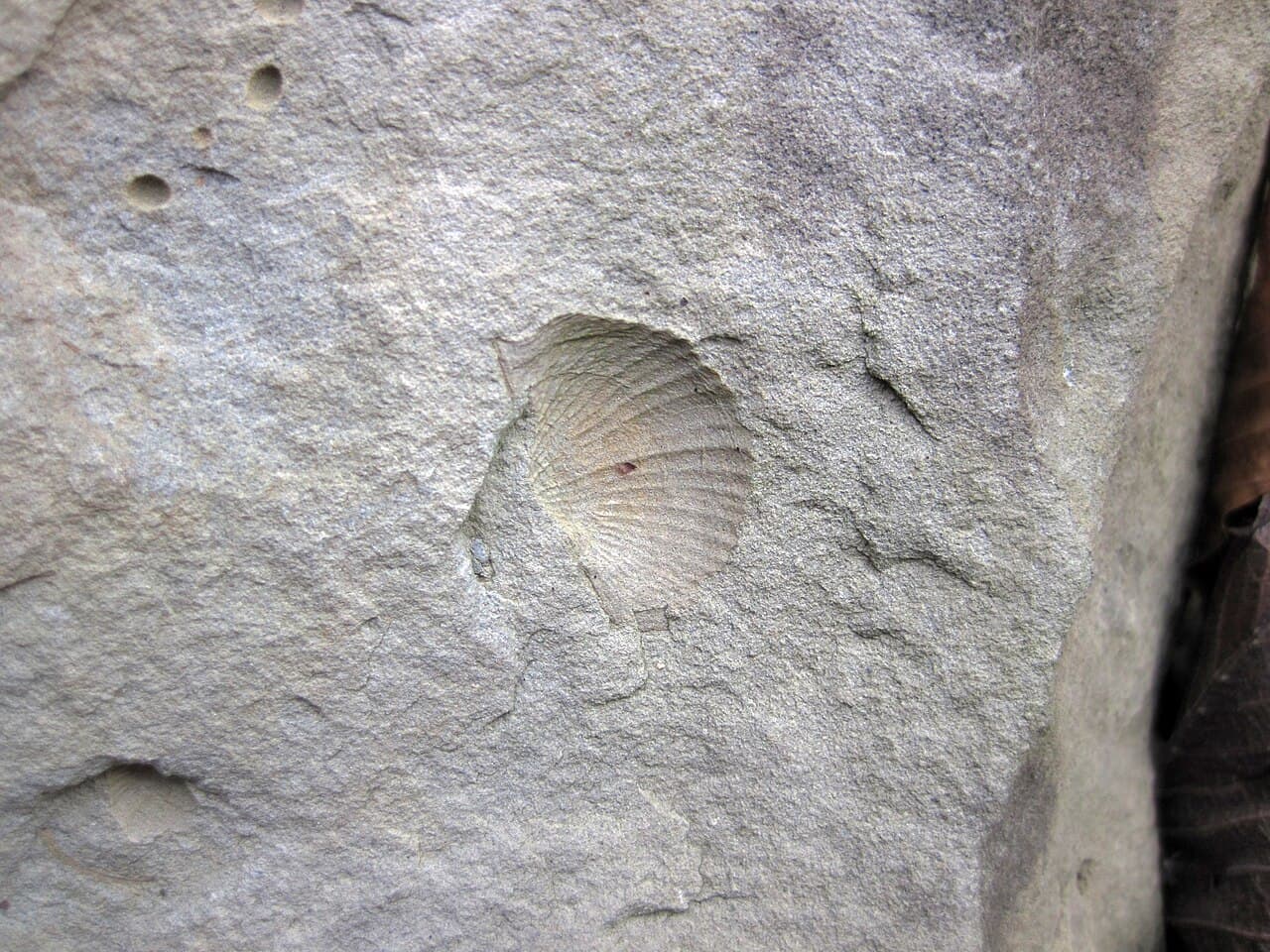
A brachiopod is the fossilized shell of a marine animal that, at a glance, looks much like a clam but in fact belongs to an entirely separate branch of the animal kingdom — its own phylum, Brachiopoda. Often called "lamp shells" because some kinds resemble an ancient Roman oil lamp, brachiopods have two valves that meet to enclose a soft filter-feeding body. They are among the most abundant and important fossils of the Paleozoic seas, so common in some rock layers that a single slab of limestone can be crowded with them, and they are one of the first fossils most rockhounds learn to recognize.
What makes brachiopods worth knowing is that, despite the clam-like first impression, they are built on a completely different plan from clams. They lived anchored to the sea floor, many by a fleshy stalk that emerged through a small hole near the beak of one valve, and they filtered food from the water with a specialized internal organ. Brachiopods first appeared more than half a billion years ago, exploded in diversity through the Paleozoic Era, were hit hard by the great end-Permian extinction, and — unlike trilobites or ammonites — a modest number still survive in today's oceans. So a brachiopod fossil represents a long-running and still-living lineage.
Brachiopod at a glance
- Classification
- Fossil — marine animal of the phylum Brachiopoda ("lamp shell")
- Composition
- Shell typically calcite, CaCO₃; some groups built shells of calcium phosphate
- Hardness
- Varies with the preserving mineral, not the original animal (calcite ~3, silica ~7 if replaced)
- Luster
- Dull to slightly vitreous, depending on preservation
- Colors
- Gray, tan, brown, cream; depends on the rock and preserving minerals
- Texture
- Two-valved shell, often ribbed or with growth lines; commonly preserved in limestone or shale
How to identify it
A brachiopod is a small shell, usually a centimeter or a few centimeters across, made of two valves that fit together — and the way to identify it (and to separate it from a clam) is symmetry. Hold the fossil so you are looking straight down at one valve: a brachiopod's single valve is itself bilaterally symmetric, meaning a mirror line runs down the middle of that one valve, with the left and right halves matching. The two valves, however, are usually different sizes from each other. A clam (a bivalve mollusk) is the reverse: each valve is lopsided on its own, but the two valves mirror each other. Put simply, in a brachiopod the mirror plane runs across the valves; in a clam it runs between them. That single test is the most reliable way to tell the two apart.
Several other clues back it up. Many brachiopods show a small round hole, called the pedicle opening or foramen, at the pointed beak of the larger valve — this is where the anchoring stalk emerged in life, and a clam shell never has such a hole. The beak region of one valve often curls slightly over the other, and the shell surface commonly carries strong ribs that radiate from the beak, or fine concentric growth lines, or both. The overall outline is frequently rounded, fan-shaped or shaped like a little winged shell. A two-valved fossil that is symmetric across a single valve, especially one with a small hole at the beak, is a brachiopod.
How it formed / when it lived
Brachiopods are an ancient group: they first appear in the fossil record in the Cambrian Period, more than 500 million years ago, and they became spectacularly abundant through the rest of the Paleozoic Era — the Ordovician, Silurian, Devonian, Carboniferous and Permian periods. Because they were so numerous and evolved into many readily distinguished forms, they are valuable index fossils for dating Paleozoic marine rocks, and whole limestone and shale beds were built largely from their accumulated shells. In life most were anchored to the sea floor, filtering tiny food particles from seawater, which is why they fossilized so commonly in shallow marine sediments.
The mineral makeup of the shell helped its preservation: most brachiopods grew shells of calcite, a stable form of calcium carbonate, while one group built shells of tough calcium phosphate. After burial, shells were commonly preserved as the original calcite, recrystallized, replaced by silica, or left behind as natural molds and casts in the surrounding rock. The group suffered enormously in the end-Permian mass extinction about 252 million years ago — the largest extinction in Earth's history — which ended their long dominance of the sea floor. Crucially, though, brachiopods did not die out: a reduced number of lineages survived, and lamp shells still live in the oceans today, making the group one of the great survivors of geologic time.
Types and varieties
Thousands of brachiopod species have been described, and collectors usually sort them by overall shape, the strength and style of the ribbing, and the form of the hinge and beak. Some are smooth and shaped like a little Roman lamp; some are strongly winged and almost straight along the hinge line, like tiny outstretched wings; some are fan-shaped with bold radiating ribs; and others are nearly circular or have a folded, zig-zag front margin where the two valves meet. The size and curvature of the beak, and whether a pedicle hole is present, are further features that help narrow a specimen to a particular kind.
Preservation also gives brachiopods different looks. Many are found as solid shells in gray or tan limestone; others appear as internal or external molds — the rock having taken an impression of a shell that later dissolved away — so what you see is a negative imprint or a stone cast of the inside. Silicified brachiopods, in which the shell has been replaced by hard silica, can sometimes be freed whole from limestone by acid and show exquisite detail. Whatever the form, the constant diagnostic feature remains the symmetry: a single valve mirror-imaged down its midline.
Value, and real vs. fake
Brachiopods are among the most affordable of all fossils, precisely because they are so abundant — common species can often be collected by the handful from the right rock layers and sell for very little. Value is modest and rises mainly with exceptional preservation, larger or unusually shaped specimens, complete shells with both valves joined, finely detailed silicified examples, and attractive slabs crowded with shells suitable for display. Specimens with documented species and locality, or those prepared to show fine surface detail, are worth more than loose, weathered fragments.
Outright fakes are essentially a non-issue with brachiopods: the fossils are too common and too inexpensive to be worth faking, so there is little reason to copy them. The real identification challenge is simply telling a brachiopod from a clam, which the symmetry test settles — remember that a brachiopod is symmetric across a single valve and may have a small hole at the beak, while a clam's two valves mirror each other and never have that hole. The other thing to recognize is whether you are looking at an actual shell or a mold and cast of one in the rock, which is normal and authentic rather than any kind of fake. Because genuine specimens are cheap and plentiful, an honest seller stating the species and locality is all the assurance most buyers need.
Brachiopod look-alikes
Frequently asked questions
What is a brachiopod?
A brachiopod is the fossilized two-valved shell of a marine animal in its own phylum, Brachiopoda, often called a "lamp shell." It looks clam-like but is built on a different plan: it lived anchored to the sea floor, many by a stalk that emerged through a small hole at the beak. Brachiopods are among the most abundant Paleozoic fossils, and a few kinds still live in the oceans today.
How is a brachiopod different from a clam?
The key is symmetry. A brachiopod's single valve is symmetric down its own midline, while its two valves differ in size — the mirror plane runs across the valves. A clam is the reverse: each valve is lopsided on its own, but the two valves mirror each other. Many brachiopods also have a small round hole at the beak for the anchoring stalk; clams never do.
How old are brachiopods and are any still alive?
Brachiopods first appear in the Cambrian, more than 500 million years ago, and were enormously abundant throughout the Paleozoic Era. They were hit hard by the end-Permian mass extinction about 252 million years ago, but unlike trilobites and ammonites they did not die out — a reduced number of brachiopod lineages survive in the oceans today.
Are brachiopod fossils worth money?
Brachiopods are among the most affordable fossils because they are so common; ordinary specimens sell for very little. Value rises mainly with exceptional preservation, complete joined shells, fine silicified detail, unusual shapes, or attractive display slabs packed with shells. Outright fakes are basically unheard of since the real fossils are too cheap and plentiful to be worth copying.
Is yours brachiopod? Find out from a photo
Photograph your fossil in good light and get an identification with an honest confidence level, the look-alikes to rule out and the at-home tests that confirm it.
Identify my fossil freeOn Android? Get the free rock identifier app
Related
More fossils in the field guide
Keep exploring
More on fossils: identify a fossil from a photo, how to identify a rock and the Mohs hardness scale.
Last updated 2026-06-25. Identification guidance is educational — confirm important results with the diagnostic tests described or a qualified expert.