Peridotite
Also known as: Ultramafic rock
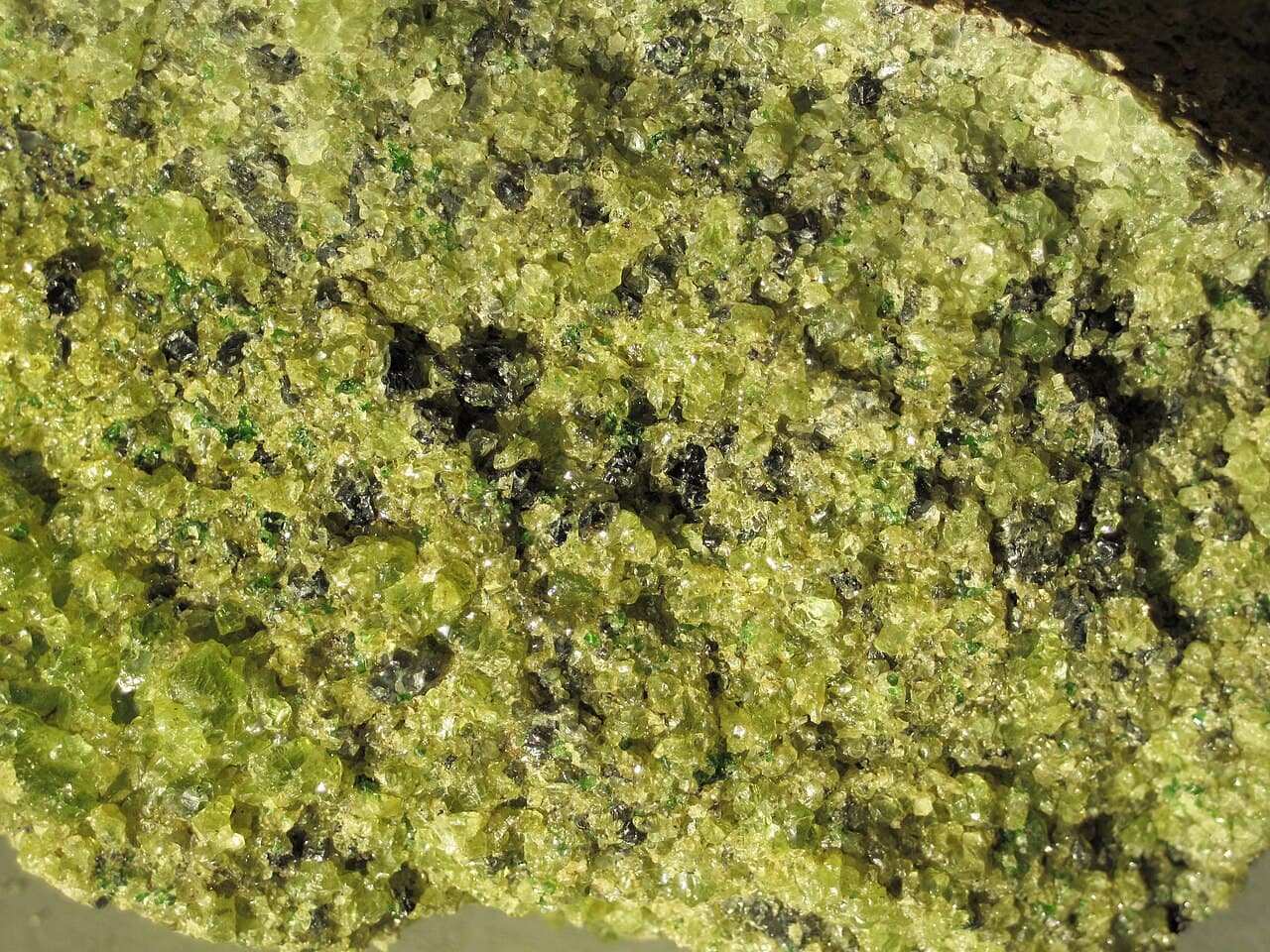
Peridotite is a dense, coarse-grained, dark green to black igneous rock that is far more important than its modest fame suggests: it is the dominant rock of the Earth's upper mantle, the thick layer that lies beneath the crust. Made up largely of the green mineral olivine, usually with some pyroxene, peridotite is classed as an ultramafic rock — extremely rich in magnesium and iron and very poor in silica. It crystallized slowly from molten rock at great depth, which is why its mineral grains are large and interlocking, and its heavy, dark, sugary-green appearance is unlike that of the everyday rocks found at the surface.
What makes peridotite remarkable is both where it comes from and what it carries. It takes its name from peridot, the gem-quality variety of olivine, and weathered or gem-bearing peridotite is the original source of that stone. Peridotite commonly hosts ore minerals such as chromite (the main source of chromium) and nickel-bearing minerals, and when it reacts with water near the surface it alters into the soft, greenish rock serpentinite. Pieces of mantle peridotite are sometimes carried upward as fragments (xenoliths) in volcanic rocks, and a close relative, kimberlite, is the rock that brings most natural diamonds to the surface — so peridotite is, quite literally, a window into the deep Earth.
Peridotite at a glance
- Classification
- Igneous rock — intrusive (plutonic), ultramafic
- Rock type
- Igneous (intrusive/plutonic), ultramafic
- Composition
- Dominated by olivine ((Mg,Fe)2SiO4) with pyroxene; very low in silica, high in Mg and Fe
- Hardness
- About 6.5–7 on the Mohs scale (set by olivine; pyroxene ~5–6)
- Luster
- Dull to glassy on fresh mineral grains; olivine grains are glassy green
- Colors
- Dark green to greenish-black or black; can be yellowish-green when olivine-rich
- Texture
- Coarse-grained (phaneritic), dense and heavy, with interlocking crystals
What type of rock is peridotite?
Peridotite is an igneous rock — one that crystallized from molten or partly molten rock. Within the igneous family it is intrusive (also called plutonic), meaning it solidified slowly at depth rather than erupting and chilling at the surface; that slow cooling is why its crystals are coarse and easily seen. Chemically it is ultramafic, the most magnesium- and iron-rich, silica-poor category of igneous rocks, sitting well beyond even the mafic rocks like basalt and gabbro on the compositional scale.
Peridotite is defined by its minerals: by convention it must be made of at least about 40 percent olivine, with the rest typically pyroxene and minor amounts of minerals such as spinel, chromite or garnet. Varieties are named by their exact mineral mix — for example, dunite is a peridotite composed almost entirely of olivine, while lherzolite and harzburgite contain olivine together with different pyroxenes. Crucially, peridotite is not just a rare surface curiosity: it is the principal rock of the Earth's upper mantle, so most of the rock beneath the thin crust we live on is peridotite of one kind or another.
How peridotite forms
Most peridotite did not form by simple cooling of a magma at the surface; it is mantle rock. The Earth's upper mantle is overwhelmingly peridotite, and when that mantle partially melts, the easily-melted, silica-rich portion drains away to feed basaltic eruptions, leaving behind a residue even richer in olivine — itself a peridotite. Bodies of peridotite also crystallize at the bottom of slowly cooling magma chambers, where dense olivine and pyroxene crystals settle out first and accumulate into ultramafic layers (a process called cumulate formation), often together with valuable chromite.
Peridotite reaches the surface by several routes, none of them ordinary. Slabs of oceanic crust and the underlying mantle can be thrust up onto continents during plate collisions, exposing large masses of peridotite (as part of rock sequences called ophiolites). Rising magmas can rip off and carry up small fragments of mantle peridotite as xenoliths, and the diamond-bearing rock kimberlite is a peridotite relative that blasts up from great depth. Once exposed, peridotite is unstable in the wet, oxygen-rich surface environment: reaction with water readily alters its olivine and pyroxene into serpentine minerals, converting the rock into serpentinite and often giving outcrops a slick, greenish, veined appearance.
How to identify peridotite
Three properties together identify peridotite: it is dark, dense and coarse-grained, with a distinctly green cast. Pick it up and it feels noticeably heavy for its size because olivine and pyroxene are dense, iron-magnesium minerals. A fresh surface is dark green to greenish-black, frequently with a granular, sugary look, and you should be able to see interlocking crystals with the naked eye — the glassy, olive-green grains of olivine are the key, sometimes accompanied by darker, slightly duller pyroxene. The rock is hard (olivine is about 6.5–7 on the Mohs scale) and shows no layering, no banding and no obvious feldspar.
Use the absence of feldspar and the green olivine to separate peridotite from its relatives. Gabbro, the other common coarse, dark intrusive rock, contains abundant pale plagioclase feldspar, so it looks salt-and-pepper rather than uniformly dark green and is somewhat less dense. Basalt has the same dark, iron-rich chemistry but cooled quickly at the surface, so it is fine-grained with no visible crystals. Dunite is a peridotite that is almost pure olivine and so looks paler and more uniformly yellow-green. And if the rock is soft, slick and crisscrossed with greenish veins, it has been altered to serpentinite rather than fresh peridotite. A heavy, hard, coarse, green, feldspar-free rock is peridotite.
What peridotite is used for
Peridotite's greatest value is as a host rock for ore and gems rather than as a building material. It is the principal source of chromite, the ore mined for chromium, and many of the world's nickel and platinum-group-metal deposits are tied to ultramafic rocks of peridotite composition. As the parent rock of olivine, peridotite is also the ultimate source of the gemstone peridot, recovered from gem-quality olivine in and around these rocks. Olivine separated from peridotite is used industrially as a refractory (high-temperature) sand and as a flux and slag conditioner in metal smelting.
Peridotite is increasingly studied for a very modern purpose: carbon storage. Because its magnesium-rich minerals react naturally with carbon dioxide to form solid carbonate minerals, weathering and engineered reactions in peridotite can lock away CO2 permanently as rock, and this is being explored as a way to help offset carbon emissions. The rock is also a prime scientific resource, since mantle peridotite and the xenoliths derived from it offer geologists direct samples of the deep Earth. Its altered form, serpentinite, is quarried and polished as a decorative "green marble," though that is a property of the altered rock rather than of fresh peridotite itself.
Peridotite look-alikes
Frequently asked questions
What type of rock is peridotite?
Peridotite is an intrusive (plutonic) igneous rock and the most important ultramafic rock. It crystallized slowly at depth, so it is coarse-grained, and it is extremely rich in magnesium and iron and poor in silica. It is the dominant rock of the Earth's upper mantle.
How can I identify peridotite?
Look for a rock that is dark green to greenish-black, distinctly heavy for its size, hard, and coarse-grained with visible interlocking crystals — especially glassy, olive-green olivine grains. It has no layering, no banding and no pale feldspar. The combination of high density, green olivine and a coarse, feldspar-free texture is diagnostic.
What is peridotite made of?
Peridotite is made mostly of the green mineral olivine (by definition at least about 40 percent), usually together with pyroxene and minor minerals such as spinel, chromite or garnet. Varieties are named by the mix: dunite is almost pure olivine, while lherzolite and harzburgite combine olivine with different pyroxenes.
Why is peridotite important?
Peridotite is the main rock of the Earth's upper mantle, so it makes up most of the rock just below the crust and gives geologists direct samples of the deep Earth. It is the source rock of the gem peridot, a major host of chromium, nickel and platinum-group ores, alters to serpentinite, and is being studied for permanently storing carbon dioxide as solid carbonate.
Is yours peridotite? Find out from a photo
Photograph your rock in good light and get an identification with an honest confidence level, the look-alikes to rule out and the at-home tests that confirm it.
Identify my rock freeOn Android? Get the free rock identifier app
Related
More rocks in the field guide
Keep exploring
More on rocks: how to identify a rock, what kind of rock is this and the Mohs hardness scale.
Last updated 2026-06-25. Identification guidance is educational — confirm important results with the diagnostic tests described or a qualified expert.