Schist
Also known as: Mica schist, Crystalline schist
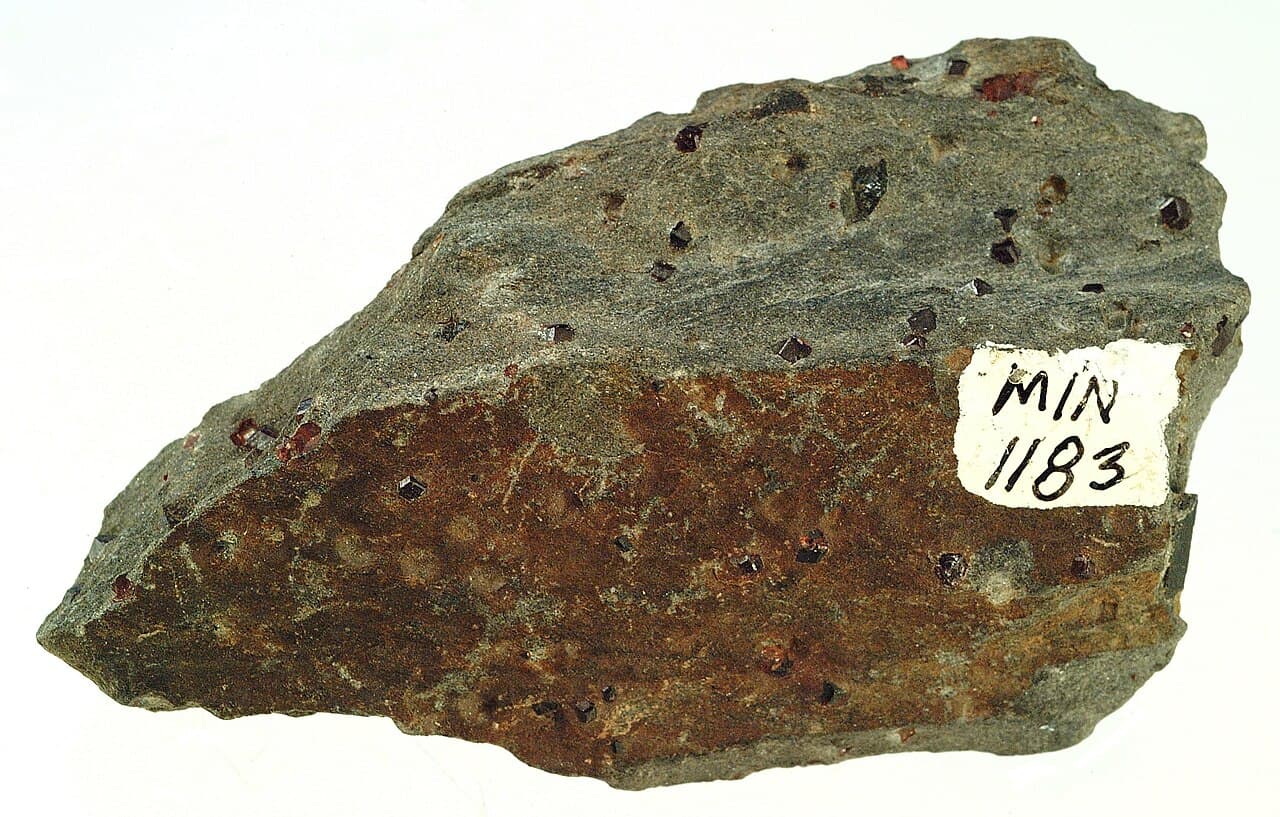
Schist is a medium-grade metamorphic rock defined by schistosity — a strong, sheet-like foliation produced by abundant platy minerals, especially micas, all aligned in the same direction. Because so many flat mica grains lie parallel to one another, the rock splits easily into flakes, slabs and wavy sheets, and its surfaces catch the light with a conspicuous sparkly or satiny sheen. Tilt a piece of schist and the flat faces glitter; that shimmer, combined with a tendency to flake apart, is the quickest way to recognize it in the field.
Unlike a fine, dull slate, schist has grains large enough to see: you can usually pick out individual flakes of silvery muscovite or dark biotite mica, and many schists carry larger "index" crystals such as deep red garnet that grew during metamorphism. Schists are commonly named for their standout minerals — mica schist, garnet schist, talc schist — which makes them a favorite of rock hounds. The combination of visible aligned micas, an easy split into sheets and a sparkling sheen distinguishes schist from the dull, ultra-fine rocks below it and the coarse, banded gneiss above it.
Schist at a glance
- Classification
- Metamorphic rock — medium-grade, foliated
- Rock type
- Metamorphic
- Composition
- Mica (muscovite/biotite), quartz, feldspar ± garnet, chlorite, talc
- Hardness
- Roughly 3–6, varying with mineral content; mica makes it splittable
- Colors
- Silvery gray, brown, green or near-black, often with a sparkly sheen
- Texture
- Foliated (schistose); medium-grained with visible aligned platy minerals that split into sheets
What type of rock is schist?
Schist is a metamorphic rock — not igneous, not sedimentary. It forms in the solid state when an existing rock is altered by heat and pressure until new minerals grow and align, giving the rock its layered, splittable fabric. The parent rock is never melted; instead its minerals recrystallize and reorient under directed pressure. That places schist firmly among the metamorphic rocks, distinct from igneous rocks crystallized from magma and sedimentary rocks built from cemented grains.
Most schist begins as a fine-grained mudrock. With increasing metamorphism a shale or mudstone is first converted to slate, then to phyllite, and then — as its mica grains grow large enough to see and align strongly — to schist. Push the metamorphism further still and schist coarsens and its minerals segregate into bands, grading into gneiss. So schist occupies the middle of the foliated metamorphic series: coarser and far more sparkly than slate or phyllite, but finer-grained and more easily split than the high-grade, banded gneiss.
How schist forms
Schist forms under medium-grade metamorphic conditions — moderate temperatures and pressures, typically in the roots of mountain belts where rocks are squeezed and heated during continental collisions. As a slate or phyllite is buried deeper and warmed, its tiny clay minerals recrystallize into larger flakes of mica. Crucially, the pressure is directed: it squeezes the rock more strongly in one direction, so the growing platy minerals all rotate and grow perpendicular to the squeeze, ending up parallel to one another. This pervasive alignment is what creates schistosity and the rock's tendency to split into sheets.
The specific minerals that grow depend on the starting composition and the exact temperature and pressure, which is why schists come in so many varieties. A typical pelitic (mud-derived) schist is dominated by muscovite and biotite mica with quartz, and as conditions intensify it develops larger "index" minerals — garnet, staurolite, kyanite — that geologists use to gauge metamorphic grade. Other parent rocks yield green chlorite schist or soft, soapy talc schist. With still more heat and pressure, schist transitions toward gneiss as its grains enlarge and segregate into bands.
How to identify schist
Start with the sheen and the split. Schist is strongly foliated: it splits readily into flakes, plates or wavy sheets, and the freshly exposed surfaces sparkle or shine with a satiny luster because they are coated in aligned mica flakes. Run your eye across a tilted piece — if it glitters and wants to flake apart along the foliation, you are very likely looking at schist. The grains should be coarse enough that you can actually see the individual mica flakes, unlike the smooth, featureless surface of a slate.
Then read the minerals and rule out neighbors. Look for visible silvery muscovite, dark biotite, and any standout crystals such as round red garnets — their presence essentially confirms a schist and even hints at its grade. To separate schist from its look-alikes: slate is much finer and dull, splitting into flat, smooth roofing-like sheets without a sparkle; phyllite sits between slate and schist, with a silky sheen but grains still too small to resolve clearly; and gneiss is coarser and banded into light and dark layers, and it does not split easily along those bands the way schist flakes apart. Visible aligned micas, an easy flaky split and a glittering sheen point to schist.
What schist is used for
Schist is a more limited building material than granite or gneiss because its strong foliation makes it relatively weak — it tends to split along the mica layers, so it is generally not used where high structural strength or load-bearing capacity is required, and it makes poor concrete aggregate. Its most common practical uses play to its layered character: as a decorative landscaping and veneer stone, as flagging and paving where flat slabs are wanted, and as a regional building and walling stone in areas where it is the local rock.
Schist is also valued more for what it contains and reveals than for bulk construction. Some varieties are quarried for specific minerals — talc schist is a source of soft, workable soapstone and talc, and garnet schist can yield abrasive-grade garnet — while well-formed garnet, staurolite and kyanite crystals from schists are collected as mineral specimens. For geologists, schist is an important field indicator: the index minerals it grows make it a key record of how deep and how hot a region's rocks were once buried.
Schist look-alikes
Frequently asked questions
What type of rock is schist?
Schist is a metamorphic rock — neither igneous nor sedimentary. It forms when a fine-grained rock such as slate or phyllite is further altered by heat and directed pressure, growing aligned mica flakes that give it its splittable, sparkly foliation.
How can I identify schist?
Look for a medium-grained rock that splits easily into flakes or sheets and sparkles with a satiny sheen from aligned mica flakes. Visible silvery muscovite or dark biotite, and especially standout crystals such as red garnet, confirm it. Slate is finer and dull; gneiss is coarser and banded and does not flake apart.
What is the difference between schist and gneiss?
Both are foliated metamorphic rocks, but schist is medium-grade, rich in aligned mica, sparkly, and splits readily into sheets, while gneiss is higher-grade, coarser, segregated into light and dark bands, and breaks across the banding instead of flaking. More mica and an easy flaky split mean schist.
What is schist used for?
Schist is used mainly as a decorative landscaping, veneer and paving stone and as a local walling and building stone, since its foliation makes it too weak for high-strength construction or concrete aggregate. Some varieties are sources of talc, soapstone or abrasive garnet, and its crystals are collected as mineral specimens.
Is yours schist? Find out from a photo
Photograph your rock in good light and get an identification with an honest confidence level, the look-alikes to rule out and the at-home tests that confirm it.
Identify my rock freeOn Android? Get the free rock identifier app
Related
More rocks in the field guide
Keep exploring
More on rocks: how to identify a rock, what kind of rock is this and the Mohs hardness scale.
Last updated 2026-06-24. Identification guidance is educational — confirm important results with the diagnostic tests described or a qualified expert.