Phyllite
Also known as: Phyllitic schist
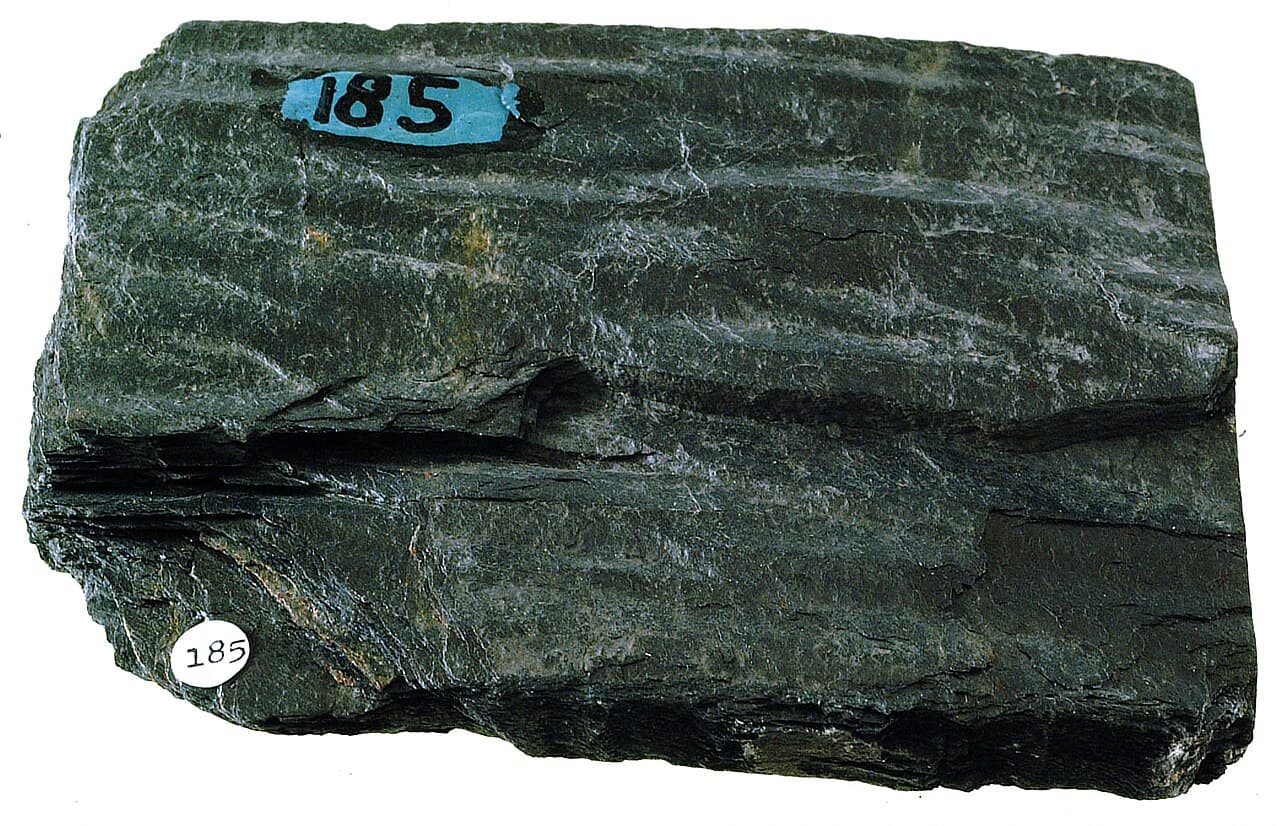
Phyllite is a fine-grained, foliated metamorphic rock that sits squarely between slate and schist in the metamorphic family. Its single most distinctive feature is a soft, silvery, satin-like sheen — often called a "phyllitic luster" — that plays across its surface as you tilt it to the light. That shimmer comes from countless microscopic mica grains (mostly sericite and chlorite) that have grown large enough to reflect light in unison but are still too small to pick out as individual flakes. The rock is typically silver-gray, greenish-gray or pale green, and its layering is frequently crinkled, wavy or gently puckered rather than dead flat.
Phyllite forms one rung up the metamorphic ladder from slate. The full sequence runs shale, then slate, then phyllite, then schist, and finally gneiss, with each step recording slightly higher heat and pressure and slightly coarser mineral growth. Compared with slate, phyllite has been cooked a little more, so its micas have grown and turned the dull slaty surface into a satiny one; compared with schist, it has been cooked a little less, so its individual mica flakes are not yet big enough to see clearly. This in-between character is exactly what makes phyllite recognizable: too shiny to be slate, too fine-grained to be schist.
Phyllite at a glance
- Classification
- Metamorphic rock — foliated, intermediate grade (between slate and schist)
- Rock type
- Metamorphic (foliated)
- Composition
- Mainly fine-grained mica (sericite/muscovite) and chlorite, with quartz and feldspar
- Hardness
- About 1.5–3 on the Mohs scale — soft, scratched by the soft micas on its surface
- Luster
- Distinctive silky to satiny (phyllitic) sheen on foliation surfaces
- Colors
- Silver-gray, greenish-gray, silvery green; also bronze or reddish where iron-rich
- Texture
- Very fine-grained; foliated with a satiny sheen and often crinkled or wavy surfaces
What type of rock is phyllite?
Phyllite is a metamorphic rock — an existing rock that has been changed in the solid state by heat and pressure. Of the three great rock families (igneous from cooled melt, sedimentary from cemented grains, and metamorphic from altered rock), phyllite belongs firmly to the metamorphic group. More precisely, it is a foliated metamorphic rock, meaning its platy minerals are aligned into parallel layers, and it is of intermediate metamorphic grade: hotter and more recrystallized than slate, but cooler and finer-grained than schist.
Phyllite occupies a clearly defined slot in the classic metamorphic sequence of fine-grained, clay-rich rocks. Begin with shale, a sedimentary mudrock. Gentle metamorphism turns it into slate, with its smooth slaty cleavage. A little more heat and pressure recrystallizes the clays into slightly larger micas, producing phyllite with its satiny sheen. Still more, and the micas grow visible to the eye, giving schist; more again, and the minerals segregate into light and dark bands, giving gneiss. Phyllite is the third step in that chain — the bridge between the dull, flat slate and the sparkly, coarse schist.
How phyllite forms
Phyllite forms by the regional metamorphism of slate, or directly from shale and mudstone, at temperatures and pressures somewhat higher than those that make slate. The setting is typically the interior of a mountain belt, where thick piles of clay-rich sedimentary rock are buried, folded and squeezed during continental collision. Under this directed pressure the tiny clay minerals recrystallize into fine micas — chiefly sericite (a fine white mica) and chlorite — and those new flakes grow with their flat faces aligned perpendicular to the squeezing force. Because the flakes are now slightly larger than in slate, their aligned surfaces catch and reflect light together, producing the characteristic satiny phyllitic sheen.
The crinkled, wavy foliation that phyllite so often shows is a record of more than one episode of deformation. After the first foliation forms, continued squeezing from a new direction can microscopically fold the mica layers, puckering the surface into small wrinkles and corrugations (a fabric geologists call crenulation). This is why phyllite frequently looks gently rumpled rather than flat. As metamorphism continues past the phyllite stage, the micas keep growing until they are individually visible and the rock becomes a schist, so phyllite marks a transitional window in which the micas are grown enough to shine but not yet enough to see.
How to identify phyllite
The defining clue to phyllite is its sheen. Tilt a fresh foliation surface in the light and look for a soft, silvery, satin-like luster that shifts as you move the rock — this phyllitic sheen is the single most reliable identifier. The rock is very fine-grained, so you should not be able to pick out individual mineral flakes even with a hand lens, yet the surface plainly shimmers. It is soft (the surface micas are easily scratched), commonly silver-gray to greenish-gray, and its layering is often crinkled, wavy or puckered rather than perfectly flat. Phyllite splits along its foliation, but the split faces tend to be slightly uneven and lustrous rather than the smooth, dull sheets of slate.
Place a suspect specimen in the metamorphic sequence to confirm it. Slate, one grade lower, splits into smooth, flat, dull sheets and lacks the satin shimmer. Schist, one grade higher, has clearly visible, sparkly mica flakes and a coarser, flakier texture you can see without magnification. Gneiss, higher still, shows alternating light and dark mineral bands rather than a continuous micaceous sheen. If your rock is too shiny and silvery to be slate but too fine-grained to show individual flakes like schist, it is phyllite. The combination of a satiny surface, no visible grains, softness and crinkled foliation is diagnostic.
What phyllite is used for
Phyllite's uses follow directly from its makeup: it is decorative and workable but relatively soft and splits along its foliation, so it is favored where appearance matters more than heavy structural loads. Its silvery, satiny surfaces make it a popular dimension and cladding stone for wall facing, decorative veneers, paving and flagstones, fireplace surrounds and garden landscaping, where the shimmering, sometimes greenish color is the main attraction. Split into thin slabs, it serves as an ornamental flooring and walkway stone, and tumbled or shaped pieces appear in countertops and tile work marketed for their natural sheen.
Because phyllite is softer and more easily split than many building stones, it is generally not chosen for high-strength structural roles or heavy load-bearing work, and its foliation can make it prone to splitting along the layers under stress. In practice it is used as crushed stone and fill, as a rustic roofing and paving material in regions where it is abundant, and as an attractive natural facing stone. Some varieties have been carved into small ornamental objects. Across all of these the value comes from the same traits: a fine-grained, layered rock with a distinctive satin luster that takes a handsome natural finish.
Phyllite look-alikes
Frequently asked questions
What type of rock is phyllite?
Phyllite is a foliated metamorphic rock of intermediate grade. It forms by the metamorphism of slate (or directly from shale) and sits between slate and schist in the sequence shale to slate to phyllite to schist to gneiss. It is not igneous or sedimentary, though its ultimate parent, shale, is sedimentary.
How can I identify phyllite?
Look for a soft, silvery, satin-like sheen on the foliation surfaces that shifts as you tilt the rock — this phyllitic luster is the key clue. Phyllite is very fine-grained (no individual flakes visible even with a lens), soft, usually silver-gray to greenish-gray, and often has crinkled or wavy layering. It splits along its foliation into slightly uneven, lustrous sheets.
What is the difference between phyllite and slate?
Slate is one metamorphic grade lower. Its micas are smaller, so it splits into smooth, flat, dull sheets and has no shine. Phyllite has been heated a little more, so its micas have grown enough to give a distinct silvery, satiny sheen and often a crinkled surface. In short: dull and flat is slate; satiny and shimmering is phyllite.
What is the difference between phyllite and schist?
Phyllite is finer-grained and lower-grade than schist. In phyllite the micas are too small to see individually and blur into a continuous satin sheen, while in schist the mica flakes are large enough to see clearly and sparkle separately. If you can pick out individual glittering flakes, it is schist; if the rock shimmers all over but shows no distinct grains, it is phyllite.
Is yours phyllite? Find out from a photo
Photograph your rock in good light and get an identification with an honest confidence level, the look-alikes to rule out and the at-home tests that confirm it.
Identify my rock freeOn Android? Get the free rock identifier app
Related
More rocks in the field guide
Keep exploring
More on rocks: how to identify a rock, what kind of rock is this and the Mohs hardness scale.
Last updated 2026-06-25. Identification guidance is educational — confirm important results with the diagnostic tests described or a qualified expert.