Larimar
Also known as: Blue pectolite, Dolphin stone, Stefilia's Stone, Atlantis stone
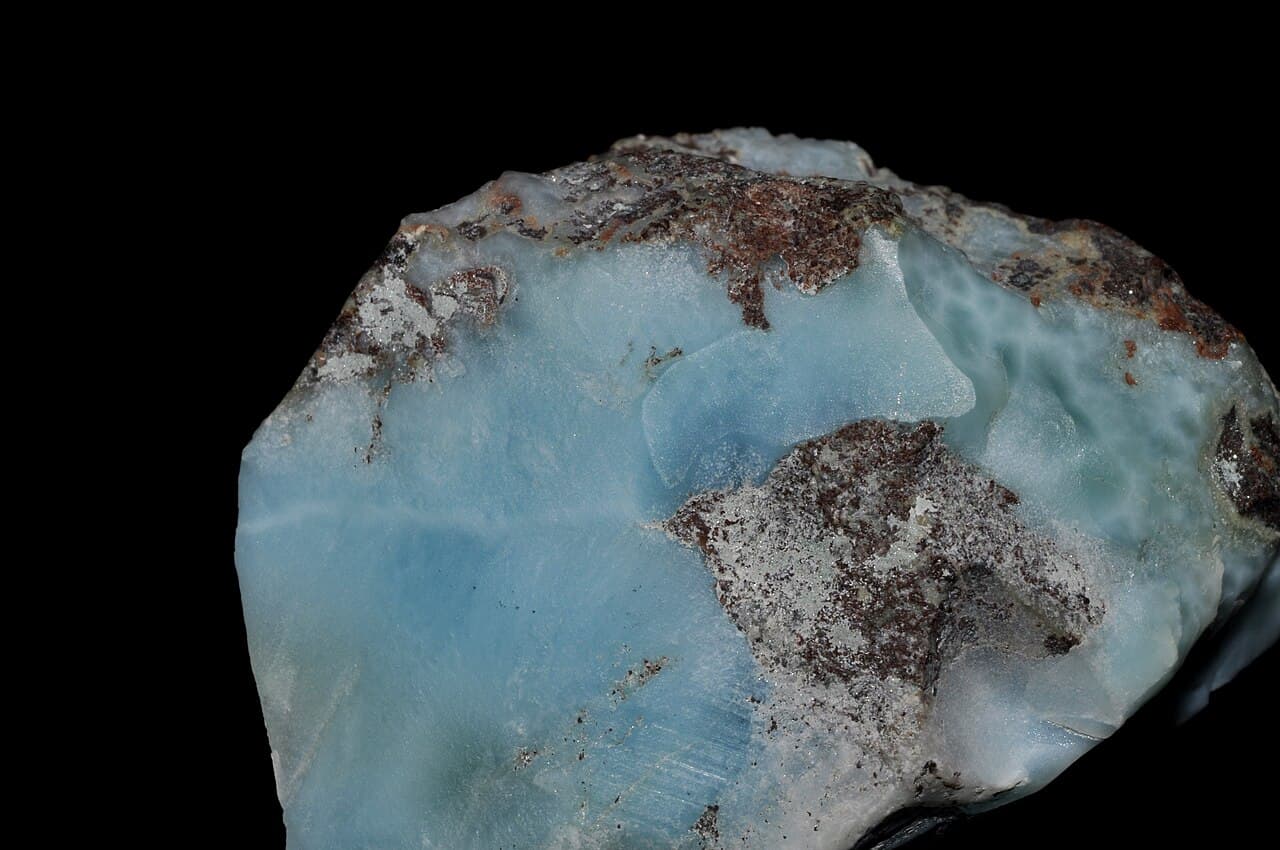
Larimar is a rare, sky-blue to green-blue gem variety of the mineral pectolite, a calcium sodium silicate. While ordinary pectolite is a common, colorless-to-white mineral found in many parts of the world, the blue form prized as larimar is found in only one place on Earth: a small mining area in the Barahona Province of the Dominican Republic. Its serene color — ranging from pale, almost milky blue to a deep volcanic blue-green — is caused by copper substituting for calcium in the mineral's structure, and that single, geographically restricted source is what makes the gem genuinely scarce. Discovered and named in the 1970s, larimar combines a local girl's name, Larissa, with the Spanish word for sea, mar, capturing the oceanic look that has made it famous.
What sets larimar apart visually is its patterning. The blue rarely appears as a flat, even color; instead it is broken up by white lines, swirls, and cell-like networks often described as a "turtleback" or "stormy" pattern, where pale blue and white interweave like sunlight on shallow water. This comes from the fibrous, radiating way pectolite crystallizes. Because larimar is relatively soft — about 4.5 to 5 on the Mohs scale — and comes from a single deposit, it is treated as a collector's and designer's gem rather than an everyday hard-wearing stone, and recognizing it depends as much on that watery blue-and-white pattern as on the color itself.
Larimar at a glance
- Classification
- Mineral (gem variety of pectolite) — a calcium sodium silicate
- Composition
- NaCa₂Si₃O₈(OH)
- Hardness
- About 4.5–5
- Luster
- Vitreous to silky or pearly, owing to the fibrous structure
- Streak
- White
- Colors
- Sky blue, green-blue, volcanic blue, sometimes nearly white, with white veining
- Crystal system
- Triclinic (occurs as compact, fibrous, radiating masses rather than visible crystals)
- Transparency
- Translucent to opaque
How to identify it
The clearest identifying feature of larimar is its combination of color and pattern. Genuine larimar is a soft sky blue to green-blue, often uneven across a single stone, broken up by white veins, blotches, and a distinctive cell-like or "turtleback" network where blue and white interlace. Unlike a flatly dyed blue stone, real larimar shows a watery, mottled depth, and the blue commonly grades from pale to more intense across the cabochon. Held to the light it is translucent to opaque, with a slightly silky or pearly sheen on polished surfaces that comes from its fibrous internal structure.
Beyond appearance, two physical traits help confirm it. Larimar is relatively soft — about 4.5 to 5 on the Mohs scale — so it will not scratch glass the way a quartz-family stone (about 7) will; a stone sold as larimar that easily scratches glass is suspect. It is also a pectolite, so under magnification you can often see the fine, radiating, fibrous texture rather than the granular or banded look of its imitators. Because virtually all genuine larimar comes from one deposit in the Dominican Republic, locality is itself a clue: reputable larimar is Dominican, and any other claimed source should raise a flag.
Colors and varieties
Larimar's color comes from copper substituting for calcium, and it spans a range from pale, milky, almost whitish blue through bright sky blue to deeper green-blue and the prized intense "volcanic" blue. The most valued material is a vivid, saturated blue, sometimes nearly turquoise in tone, while paler and greener stones are more common and more affordable. Within a single piece the color is usually uneven, mingling with white in swirls and networks, and that interplay of blue and white is part of larimar's charm rather than a flaw. Some stones also carry faint reddish or brownish flecks from associated minerals such as hematite.
There are no separate mineral varieties of larimar — it is all blue pectolite from the same Dominican source — but the trade grades it informally by color depth and pattern. Stones are often described from lighter grades up to the most prized deep-blue, high-contrast material, and the so-called turtleback pattern, with crisp blue cells outlined by white, is especially sought after. You will also see the marketing names "dolphin stone" and "Atlantis stone" attached to larimar, which reflect its oceanic look and folklore rather than any difference in the stone itself.
Meaning and properties
In modern crystal-working and metaphysical traditions, larimar is often described as a calming, soothing stone, with its sea-and-sky color associated with tranquility, clear communication, and a sense of peace. It is sometimes called the "dolphin stone" or the "Atlantis stone" and is linked in folklore to the ocean and to gentle emotional release, which is why it is a popular choice for meditation pieces and for jewelry meant to feel serene. These associations are cultural and spiritual, drawing on the stone's tropical origin and watery appearance rather than on any property of the mineral itself.
These meanings are personal and spiritual, not scientifically established medical effects. Larimar does not diagnose, treat, cure, or prevent any physical or emotional health condition, and it is not a substitute for professional medical or mental-health care. It can be a beautiful, meaningful stone to wear and to keep for reflection, but any sense of calm it brings comes from personal and aesthetic experience rather than from a demonstrated physical mechanism. As with all ornamental stones, enjoy it for its beauty without relying on it for healing.
Value
Larimar's value rests on two pillars: its single-source rarity and the quality of an individual stone's color and pattern. Because it is mined in only one small area of the Dominican Republic, supply is genuinely limited, and fine material is treated as a collector's and designer's gem. Within that supply, the strongest driver of value is color — deep, vivid, even sky-to-volcanic blue is the most prized, while pale, washed-out, or heavily white-dominated stones are more affordable. A crisp, attractive "turtleback" pattern with high contrast between blue and white also adds desirability.
Other practical factors are size, clarity of pattern, freedom from cracks, and quality of cut and polish, since larimar is almost always cut as cabochons or beads rather than faceted. Clean, well-polished stones with rich color and no distracting fractures sit at the top; cloudy, cracked, or muddy material sits lower. Because the gem is soft and single-source, buyers should weigh both rarity and condition, and should be aware that the same scarcity that gives larimar its value also makes convincing imitations worth a seller's effort — so price that seems far below the going rate for vivid blue material deserves scrutiny.
Real vs. fake
Because genuine larimar is scarce and desirable, imitations are common, and they fall into a few groups: dyed stones (such as dyed howlite or magnesite colored blue), blue glass and plastic, and other natural blue minerals like chrysocolla, amazonite, or turquoise sold under the larimar name. The first goal is to confirm the stone is really blue pectolite from the Dominican Republic rather than a colored substitute. Reputable larimar is always Dominican; a confident claim of any other origin is a warning sign in itself.
Several checks help. Real larimar shows uneven, naturally graded blue with a fibrous, watery turtleback pattern, whereas dyed imitations often have unnaturally even color or dye pooling in cracks — an acetone-dampened swab on a hidden spot can lift such dye, which natural larimar will not release. Larimar's softness (about 4.5 to 5) means it should not scratch glass; a "larimar" that scratches glass easily is more likely a harder substitute like amazonite or chalcedony. Glass imitations may show swirl marks, bubbles, or a too-perfect blue and feel warmer and lighter, while a hot-pin test can reveal plastic by its acrid smell. For a significant purchase, buying from a reputable seller and, when in doubt, seeking expert gemological testing is the safest route.
Care
Larimar is a relatively soft and somewhat delicate gem, so it needs gentler handling than harder stones. Clean it only with lukewarm water and a little mild soap, using a soft cloth or very soft brush, and dry it promptly; avoid harsh detergents and abrasive cleaners. Keep larimar away from chemicals such as perfume, hairspray, lotions, and household cleaners, and remove larimar jewelry before swimming, showering, or using cleaning products, since prolonged exposure to chemicals can dull its surface over time.
Never put larimar in an ultrasonic or steam cleaner — vibration and heat can damage the stone and any fractures it contains. Its color can also fade with very prolonged, intense sunlight or heat, so store it out of constant direct sun and away from sources of strong heat. Because it is soft (about 4.5 to 5 on the Mohs scale), store larimar separately from harder gems like quartz and topaz that could scratch it, ideally wrapped in a soft pouch or a lined box, and protect it from knocks and from being worn in rough, everyday situations where it could chip.
Larimar look-alikes
Frequently asked questions
What exactly is larimar?
Larimar is a rare blue-to-green-blue gem variety of the mineral pectolite, a calcium sodium silicate. Ordinary pectolite is white and common, but the blue form prized as larimar gets its color from copper substituting for calcium, and it is found in only one place on Earth — a small mining area in the Dominican Republic.
Where is larimar found?
Larimar comes from a single source: a restricted mining area in the Barahona Province of the Dominican Republic. That one-deposit origin is the main reason it is genuinely rare. Any larimar claimed to come from another country should be treated with caution, as reputable larimar is Dominican.
Is larimar a hard or durable stone?
Larimar is relatively soft, about 4.5 to 5 on the Mohs scale, which makes it more delicate than most everyday gems. It can scratch and chip more easily than quartz or harder stones, so it is best worn carefully, kept away from chemicals and hard knocks, and treated as a collector's and designer's gem rather than a rugged daily-wear stone.
How can I tell real larimar from a fake?
Look for an uneven sky-to-green-blue color with a fibrous, watery white turtleback pattern, translucency, and a softness that will not scratch glass. Imitations include dyed howlite, blue glass, and other minerals like amazonite or turquoise. An acetone swab can lift added dye, glass may show bubbles or swirls, and a confident non-Dominican origin claim is a warning sign.
Is yours larimar? Find out from a photo
Photograph your gemstone in good light and get an identification with an honest confidence level, the look-alikes to rule out and the at-home tests that confirm it.
Identify my gemstone freeOn Android? Get the free rock identifier app
Related
More gemstones in the field guide
Keep exploring
More on gemstones: the full list of crystal and gem types, how to identify gemstones and the polished-stone identifier.
Last updated 2026-06-25. Identification guidance is educational — confirm important results with the diagnostic tests described or a qualified expert.