Siltstone
Also known as: Silt rock
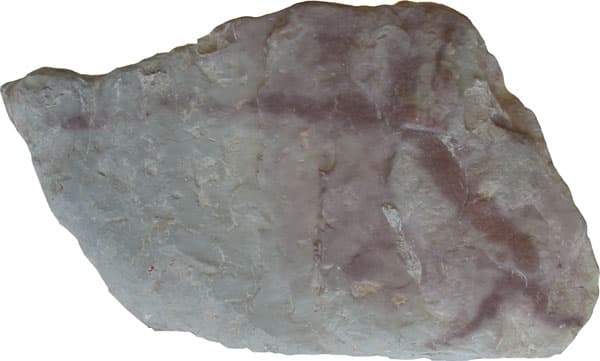
Siltstone is a fine-grained clastic sedimentary rock built mostly from silt — mineral particles that are finer than sand but coarser than clay. That middle position is the key to recognizing it: siltstone sits squarely between sandstone, whose individual sand grains you can usually see and feel, and the smooth claystones and shales made of even finer clay. The grains in siltstone are too small to pick out clearly with the naked eye, yet they are coarse enough to give the rock a faintly gritty feel when rubbed or scraped, often noticeable against the teeth. It typically appears in shades of gray, brown, tan or reddish, depending on the minerals and cements binding it together.
Like all clastic sedimentary rocks, siltstone is made of broken fragments of older rocks that were weathered, transported by water or wind, and eventually deposited and cemented into solid stone. Silt-sized particles settle out where currents are gentle but not entirely still — on river floodplains, in lakes, on deltas and across quiet parts of the seafloor — so siltstone often forms in thin, even beds or appears massive with little internal structure. Recognizing it comes down to grain size and feel: finer and grittier than sandstone, coarser and less smooth than mudstone or shale.
Siltstone at a glance
- Classification
- Sedimentary rock — clastic (detrital), fine-grained
- Rock type
- Sedimentary (clastic)
- Composition
- Quartz and feldspar silt with clay and mineral cements
- Hardness
- Variable, roughly 3–6 depending on cement and composition
- Colors
- Gray, brown, tan or reddish
- Texture
- Fine-grained — silt particles, too small to see clearly but faintly gritty to the touch
What type of rock is siltstone?
Siltstone is a sedimentary rock, and more specifically a clastic (or detrital) one, meaning it is made of solid fragments of pre-existing rocks rather than crystallized from magma or precipitated from solution. It is not igneous and not metamorphic; there are no interlocking crystals grown from a melt, only grains that were transported, deposited and then cemented together. Clastic sedimentary rocks are classified by the size of their grains, and siltstone is defined by being dominated by silt-sized particles.
On the grain-size scale, siltstone occupies the step between sandstone and mudstone. Sandstone is built from larger sand grains you can typically see; siltstone is made of finer silt grains that are hard to distinguish individually; and claystone, mudstone and shale are made of still-finer clay particles that feel smooth. Because silt sits in the middle, siltstone shares features with both neighbors, which is why grain size and texture — rather than color alone — are what pin down the identification.
How siltstone forms
Siltstone forms through the familiar sedimentary cycle: older rocks are broken down by weathering into small particles, those particles are carried away by water or wind, and they are eventually deposited where the moving medium slows enough to drop them. Silt-sized grains are intermediate in weight, so they settle where currents are gentle but still moving — environments such as river floodplains, deltas, lake bottoms and the quieter reaches of the seafloor. As successive layers accumulate, the weight of overlying sediment compacts the deposit and mineral cements precipitate between the grains, gradually turning loose silt into solid rock.
Because silt settles in calm, low-energy settings, siltstone commonly forms in thin, regular beds or appears as a fairly massive, structureless rock. It frequently occurs interlayered with sandstone and shale, recording shifts in current strength over time: coarser sand where flow was stronger, finer clay where it was weakest, and silt in between. These transitions are why siltstone is often found sandwiched between its coarser and finer relatives in the same outcrop.
How to identify siltstone
The defining test for siltstone is grain size and feel. Its particles are too small to make out clearly with the naked eye, so the rock does not look obviously grainy like sandstone, yet it is coarse enough to feel faintly gritty when you rub it between your fingers or scrape it — a classic field trick is to gently bite a clean piece, where silt grates against the teeth while smooth clay does not. The rock is usually a fairly even gray, brown, tan or reddish color and may show thin bedding or appear massive.
Use its neighbors to confirm. Sandstone is coarser and visibly grainy, with individual sand grains you can see and feel as sandpaper-like roughness — if you can clearly pick out grains, it is sandstone, not siltstone. Shale, mudstone and claystone are finer and feel smooth or soapy rather than gritty, and shale in particular tends to be laminated and fissile, splitting into thin sheets. Siltstone sits between these: grittier than mudstone, smoother than sandstone, and generally more blocky and less fissile than shale.
What siltstone is used for
Siltstone is not a premium building stone, but its uses follow from its abundance and modest strength. Crushed siltstone is used as fill and as low-grade aggregate in construction and road base, and well-cemented varieties have been used locally as rough building and paving stone where harder rock was not readily available. Its value is largely practical rather than ornamental, since it lacks the durability and polish of rocks like granite or sandstone.
Siltstone is more significant in geology and energy than in the building trade. Layers of siltstone act as reservoir and seal rocks in the subsurface, influencing how groundwater, oil and natural gas move and accumulate, and the rock's fine grain size and bedding make it a useful recorder of past depositional environments. Geologists study siltstone beds to reconstruct ancient rivers, lakes and shorelines and to interpret the energy of the currents that laid the sediment down.
Siltstone look-alikes
Frequently asked questions
What type of rock is siltstone?
Siltstone is a sedimentary rock, specifically a fine-grained clastic (detrital) one made of cemented silt particles. It is not igneous or metamorphic — it forms from fragments of older rocks that were deposited and compacted rather than crystallized from a melt.
What is the difference between siltstone and sandstone?
Both are clastic sedimentary rocks, but they differ in grain size. Sandstone is made of coarser sand grains you can usually see and feel as roughness, while siltstone is made of finer silt grains that are too small to pick out clearly and feel only faintly gritty.
How can I identify siltstone?
Check grain size and feel: siltstone's grains are too fine to see clearly but coarse enough to feel slightly gritty when rubbed or bitten. It is grittier than smooth mudstone and shale but lacks the visible sand grains of sandstone, and it is usually gray, brown, tan or reddish.
What is siltstone used for?
Siltstone is used as fill and low-grade aggregate in construction and road base, and as rough local building stone where well cemented. In geology and energy it is important as a reservoir and seal rock and as a recorder of ancient rivers, lakes and shorelines.
Is yours siltstone? Find out from a photo
Photograph your rock in good light and get an identification with an honest confidence level, the look-alikes to rule out and the at-home tests that confirm it.
Identify my rock freeOn Android? Get the free rock identifier app
Related
More rocks in the field guide
Keep exploring
More on rocks: how to identify a rock, what kind of rock is this and the Mohs hardness scale.
Last updated 2026-06-25. Identification guidance is educational — confirm important results with the diagnostic tests described or a qualified expert.