Quartzite
Also known as: Metaquartzite, Metamorphosed sandstone
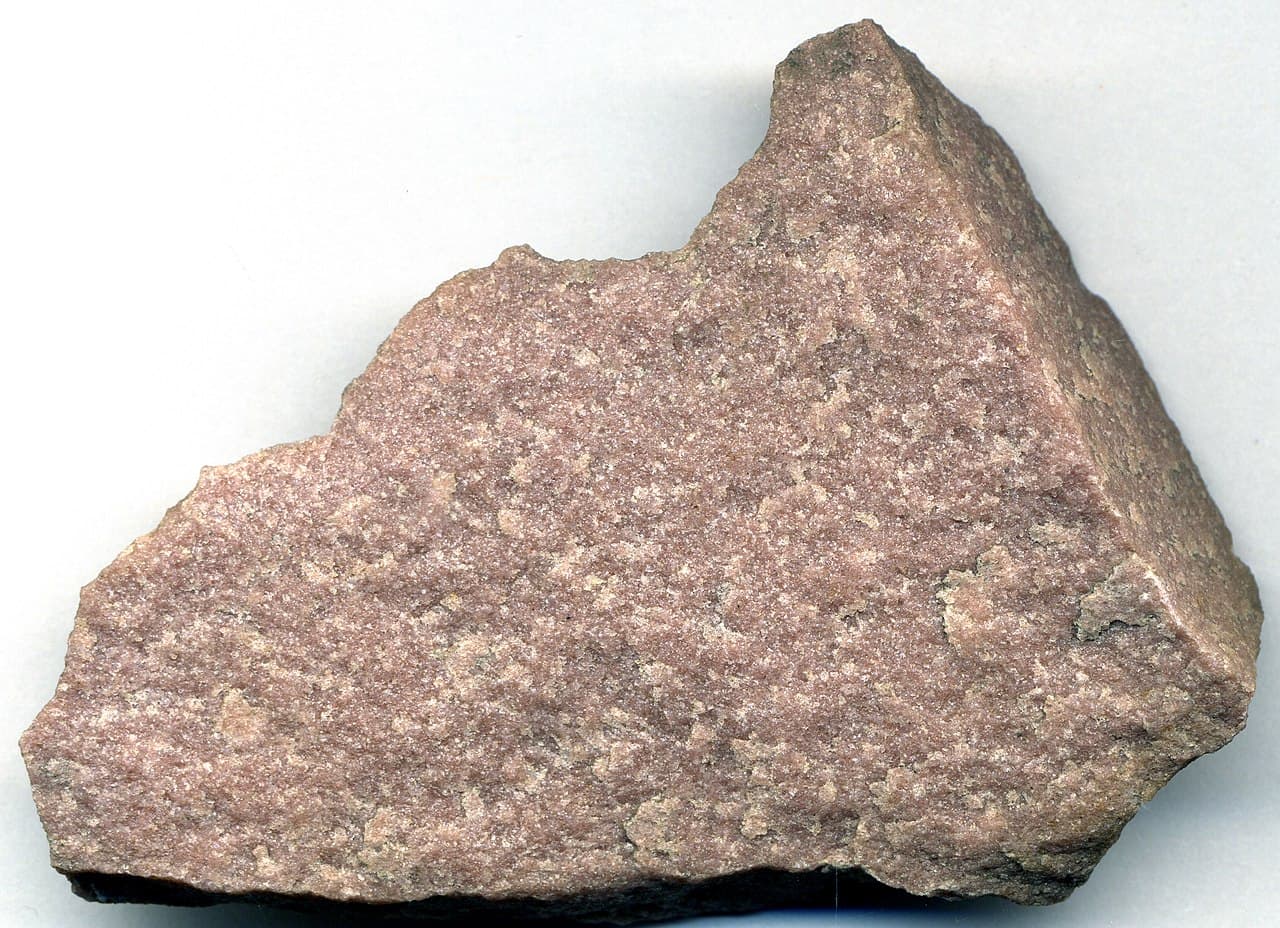
Quartzite is a hard, dense metamorphic rock made almost entirely of quartz, formed when quartz-rich sandstone is fused together by heat and pressure deep in the Earth. During metamorphism the original sand grains and the silica cement between them recrystallize into a single interlocking mass, so the boundaries between grains largely disappear. The result is one of the toughest common rocks: a pale, often glassy or sugary stone that usually rings white, gray or pink and breaks cleanly across its grains rather than crumbling apart like loose sand.
The defining feature of quartzite is sheer hardness. Because it is essentially solid quartz, it sits around 7 on the Mohs scale and will scratch glass and a steel knife blade with ease, while almost nothing in a typical field kit can scratch it. That hardness, combined with the fact that a fresh break cuts straight through the grains and leaves a smooth, sometimes shiny surface, is what separates true quartzite from its softer sedimentary parent, sandstone, in which individual grains rub off and the rock fractures around them. Quartzite also does not react with acid, which distinguishes it from pale carbonate rocks such as marble.
Quartzite at a glance
- Classification
- Metamorphic rock — non-foliated, silica-rich (metasandstone)
- Rock type
- Metamorphic
- Composition
- Almost entirely quartz (SiO₂)
- Hardness
- About 7 on the Mohs scale — very hard; scratches glass and steel
- Luster
- Glassy to sugary or greasy on a fresh break; can be waxy when polished
- Colors
- Usually white or gray; also pink, red, yellow and tan from impurities
- Transparency
- Opaque, though individual quartz grains may look glassy
- Texture
- Granular, interlocking quartz grains (granoblastic); typically non-foliated
- Magnetic
- Not magnetic
What type of rock is quartzite?
Quartzite is a metamorphic rock. Of the three rock families — igneous (cooled from melt), sedimentary (built from cemented grains or fragments) and metamorphic (an existing rock recrystallized by heat and pressure) — quartzite belongs to the metamorphic group. It did not crystallize from magma and it is not a freshly cemented sediment; it is what a particular sediment turned into after being subjected to intense heat and pressure. So to the common question of whether quartzite is igneous, sedimentary or metamorphic, the answer is metamorphic.
The parent rock of quartzite is quartz sandstone. Sandstone is a sedimentary rock made of sand-sized quartz grains held together by a natural cement. When that sandstone is deeply buried or caught up in mountain-building, rising temperature and pressure cause the quartz grains and their silica cement to recrystallize and fuse into a continuous, interlocking framework. The grain boundaries that were obvious in the sandstone become welded shut, which is exactly why quartzite breaks through its grains while sandstone breaks around them. Chemically little changes — both are dominated by quartz — but the texture and strength are transformed.
How quartzite forms
Quartzite forms by the metamorphism of quartz sandstone, typically where rocks are heated and compressed during the burial of thick sedimentary piles or the collision of tectonic plates. As temperature and pressure rise, the rounded quartz sand grains and the silica that cemented them begin to recrystallize. Silica is redeposited in the spaces between grains and the grains grow together until the original pore space is gone and the boundaries are fused. This welding of grain to grain is what converts a relatively weak, porous sandstone into a hard, non-porous rock in which the quartz forms one continuous interlocking mass.
Because quartz is chemically stable and extremely durable, quartzite resists weathering far better than most surrounding rocks. Over long spans of time the softer rocks around a quartzite body erode away faster, so quartzite frequently stands out as ridges, hilltops and prominent outcrops in the landscape. The color of the finished rock depends on what impurities were present: clean quartzite is white or gray, while traces of iron oxide can tint it pink or red and other minerals can add yellow or tan hues. Sometimes faint relict bedding from the original sandstone survives metamorphism and can still be seen as subtle banding.
How to identify quartzite
The first and best test is hardness. Quartzite is made of quartz, so it is very hard, around 7 on the Mohs scale: it will readily scratch glass and a steel knife blade, and a knife will not scratch it. This high hardness rules out softer pale rocks. Next, check the acid reaction — there should be none. Unlike marble and limestone, quartzite does not fizz when dilute acid is applied, because it contains no carbonate. A pale rock that scratches glass and does not react with acid is a strong candidate for quartzite.
Then examine how the rock breaks, which is the key to separating quartzite from its sandstone parent. Run a thumbnail or fingertip over a broken surface: quartzite feels solid and the grains do not rub off, and a fresh fracture cuts straight through the grains, leaving a smooth, glassy or sugary surface that may glint in the light. Sandstone, by contrast, sheds loose sand grains and fractures around them, leaving a rougher, more granular face. Quartzite is also typically denser and more compact, with little or no visible pore space. If the rock is hard, acid-inert, and breaks through rather than around its grains, it is quartzite.
What quartzite is used for
Quartzite's extreme hardness and resistance to scratching, heat and weathering make it a sought-after stone for surfaces that must endure heavy use. Polished quartzite slabs are popular for kitchen countertops, where the rock's durability and resistance to etching give it an advantage over softer stones like marble. As dimension stone it is cut for flooring, wall cladding, stair treads and paving, and its toughness suits it to high-traffic and exterior applications where a long-lasting, low-maintenance surface is wanted.
In construction and industry, crushed quartzite is widely used as a hard, durable aggregate in concrete, asphalt, road base and railway ballast, where its strength and angularity are valuable. Its very high silica content also makes certain quartzites a raw material for products that require pure silica, and broken quartzite has long served as a rugged building and walling stone. Across all these uses, the same property — a fused, all-quartz framework that is hard and chemically inert — is what gives quartzite its value.
Quartzite look-alikes
Frequently asked questions
What type of rock is quartzite?
Quartzite is a metamorphic rock. It forms when quartz sandstone is recrystallized by heat and pressure, fusing the sand grains into a solid quartz mass, so it is not igneous and not a sedimentary rock itself, even though its parent rock (sandstone) is sedimentary.
How can I identify quartzite?
Check hardness, acid reaction and how it breaks. Quartzite is very hard (about 7), so it scratches glass and steel; it does not fizz in acid; and a fresh break cuts straight through the grains, leaving a smooth, glassy or sugary surface with no loose grains rubbing off.
What is the difference between quartzite and sandstone?
Sandstone is the soft, porous sedimentary parent, in which grains rub off and the rock breaks around its grains. Quartzite is the metamorphosed version: its grains are fused so it is much harder, feels solid, and breaks straight through the grains, leaving a smooth surface.
What is quartzite used for?
Quartzite is used for countertops, flooring, cladding, paving and other dimension stone because it is extremely hard, durable and resistant to etching. Crushed quartzite is also widely used as a tough aggregate in concrete, asphalt, road base and railway ballast.
Is yours quartzite? Find out from a photo
Photograph your rock in good light and get an identification with an honest confidence level, the look-alikes to rule out and the at-home tests that confirm it.
Identify my rock freeOn Android? Get the free rock identifier app
Related
More rocks in the field guide
Keep exploring
More on rocks: how to identify a rock, what kind of rock is this and the Mohs hardness scale.
Last updated 2026-06-24. Identification guidance is educational — confirm important results with the diagnostic tests described or a qualified expert.