Sandstone
Also known as: Arenite, Sandrock
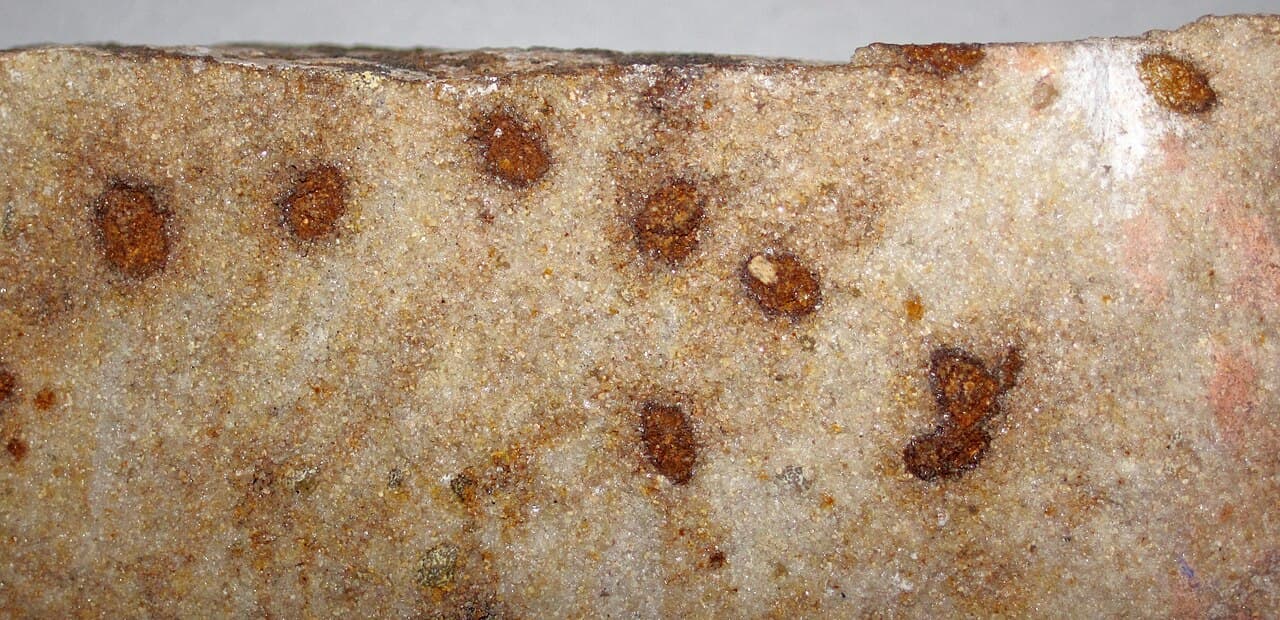
Sandstone is a clastic sedimentary rock built from sand-sized grains — particles between roughly 0.06 and 2 millimeters across, the same size range as the sand you would feel between your fingers at a beach. Those grains are most often quartz, because quartz is hard and chemically stable enough to survive being weathered, washed, and tumbled across long distances, but they can also include feldspar or small fragments of older rock. After the sand is deposited and buried, groundwater carrying dissolved minerals seeps through the pore spaces and precipitates a natural cement — usually silica, calcite, or iron oxide — that glues the loose grains into solid stone.
Because it is essentially cemented sand, sandstone has a characteristically gritty, granular feel: run a fingertip across a broken surface and it rasps like fine sandpaper, and on poorly cemented pieces you can often rub or flick individual grains loose. This grain-by-grain construction also makes sandstone one of the easiest rocks for a beginner to recognize and one of the most useful to people — it has been quarried as building stone, ground into glass sand, and shaped into millstones for thousands of years.
Sandstone at a glance
- Classification
- Sedimentary rock — clastic
- Rock type
- Sedimentary
- Composition
- Dominantly quartz (SiO₂) grains; may include feldspar and rock fragments, bound by silica, calcite (CaCO₃), or iron-oxide cement
- Hardness
- Variable, ~2–7 depending on cement — quartz grains are 7, but weakly cemented rock crumbles far more easily
- Luster
- Dull to earthy
- Colors
- Tan, buff, yellow, red, brown, white, and gray
- Texture
- Clastic; sand-sized grains (0.06–2 mm), ranging from well-sorted and rounded to poorly sorted and angular
What type of rock is sandstone?
Sandstone is a sedimentary rock — specifically a clastic (or detrital) sedimentary rock, meaning it is made from the broken-down fragments of pre-existing rocks rather than from molten material or from minerals recrystallized by heat and pressure. So in the classic three-way split of igneous, sedimentary, and metamorphic rocks, sandstone sits firmly in the sedimentary group, alongside relatives such as siltstone, shale, and conglomerate that differ mainly in grain size.
It is not igneous: igneous rocks like granite and basalt crystallize from cooling magma or lava and are made of interlocking mineral crystals, not loose grains stuck together by cement. It is also not metamorphic — though it has a metamorphic cousin worth knowing. When sandstone is subjected to enough heat and pressure, the quartz grains recrystallize and fuse together into quartzite, a much harder metamorphic rock. Sandstone is the unaltered, sedimentary starting point; quartzite is what it becomes deep in the crust.
How sandstone forms
Sandstone begins with the weathering and erosion of older rocks. Wind, water, and frost break source rock into grains, and rivers, waves, and wind then sort and carry those grains, dropping them where the current slows — in riverbeds, on beaches, across deltas, on the floors of shallow seas, and in the dunes of deserts. The journey itself shapes the sediment: grains that travel far become rounded and well sorted (similar sizes together), while grains dumped quickly close to their source stay angular and poorly sorted.
Once the sand accumulates, it is progressively buried under more sediment. Two processes then turn loose sand into rock, together called lithification. Compaction squeezes the grains closer as the weight of overlying material presses down, and cementation fills the remaining pore spaces as mineral-rich groundwater deposits silica, calcite, or iron oxide between the grains. The depositional environment is often still legible in the finished rock: gently curved cross-bedding records ancient dune faces or river bars, ripple marks preserve the action of currents, and the type of cement tints the stone — iron oxide, for instance, stains it the rusty reds and browns seen across desert landscapes.
How to identify sandstone
Start with feel and look. Sandstone has a visibly granular surface — with a hand lens, or often with the naked eye, you can pick out individual sand grains packed together, and the broken rock feels gritty rather than smooth. On many specimens, especially those with weaker cement, you can rub grains loose with a thumbnail or watch sand shed when you scratch the surface; that crumbling, sandy behavior is one of the most reliable everyday clues. The colors are typically earthy: tan, buff, yellow, red, brown, white, or gray.
Look next for sedimentary structures and layering. Sandstone frequently shows bedding — visible layers — and may display cross-bedding, where internal layers slant at an angle to the main beds, recording old dunes or current ripples. Hardness is a useful but slippery test here: the quartz grains themselves are hard (Mohs 7) and will scratch glass, yet a poorly cemented sandstone as a whole can feel soft and friable because the grains pop free before they get a chance to scratch anything. To separate sandstone from its harder metamorphic twin quartzite, look at how a fresh break runs: in sandstone the fracture goes around the grains, leaving a rough, sugary, grainy surface, whereas in quartzite the break cuts straight through the fused grains, leaving a smoother, almost glassy surface — and quartzite does not crumble.
Colors and varieties
Sandstone's color comes mostly from its cement and from minor minerals coating the grains. Iron oxide is the great colorant: in its rusty (ferric) form it produces the reds, oranges, and browns of desert sandstones, while other iron states and organic matter can shift the rock toward yellow, buff, greenish, or gray. Clean, iron-poor sandstone cemented by silica tends to be white or pale tan.
Geologists also name sandstone varieties by what the grains are made of. Quartz sandstone (quartz arenite) is dominated by durable quartz grains and represents sediment that has been thoroughly weathered and recycled. Arkose is a feldspar-rich sandstone — typically more than about a quarter feldspar — which signals rapid erosion of a granitic source before the feldspar could break down, and often carries a pink or reddish cast from those feldspar grains. Litharenite is rich in rock fragments, little pieces of older rock preserved whole within the sand. Greywacke is a hard, dark, poorly sorted variety with a muddy matrix between the grains. The variety name is essentially a record of where the sand came from and how far it traveled.
What sandstone is used for
Sandstone has been a workhorse building material for millennia because it is widespread, often occurs in even beds that split into usable blocks, and is relatively easy to cut and carve while still being durable once in place. It is quarried as dimension stone for walls, facing, and architectural detail, and split into flagstones and pavers for patios, walkways, and paving. Many historic buildings and monuments are sandstone, prized for the warm earth tones the iron-oxide cement provides.
Beyond construction, the rock is valued for the very grains it is made of. Clean, high-quartz sandstone is crushed to produce silica sand for making glass and for foundry and industrial uses. Hard, uniform sandstone has long been shaped into grindstones, whetstones, and millstones, its gritty surface acting as a natural abrasive. In the subsurface, porous sandstone is one of the most important reservoir rocks in geology, holding groundwater in aquifers and, where the geology allows, oil and natural gas in the pore spaces between its grains.
Sandstone look-alikes
Frequently asked questions
What type of rock is sandstone?
Sandstone is a sedimentary rock — a clastic sedimentary rock formed from cemented sand-sized grains. It is not igneous (those crystallize from magma) and not metamorphic, though heat and pressure can transform sandstone into the metamorphic rock quartzite.
How can I identify sandstone?
Look for a gritty, granular surface where you can see individual sand grains, often with visible layering or cross-bedding, in earthy tans, reds, or grays. On many pieces you can rub grains loose with a thumbnail. The grittiness and the way it sheds sand are the most reliable everyday clues.
What is the difference between sandstone and quartzite?
Quartzite is sandstone that has been metamorphosed, so its grains have fused together. Sandstone breaks around its grains, leaving a rough, sugary surface, and can crumble; quartzite breaks straight through the grains, leaving a smooth, glassy surface, and does not crumble. Quartzite is also noticeably harder.
What is sandstone used for?
Sandstone is widely used as building and paving stone, split into flagstones and carved into architectural detail. Clean high-quartz sandstone is crushed for glass and industrial silica sand, harder varieties are shaped into grindstones and millstones, and porous sandstone serves underground as an aquifer and petroleum reservoir rock.
Is yours sandstone? Find out from a photo
Photograph your rock in good light and get an identification with an honest confidence level, the look-alikes to rule out and the at-home tests that confirm it.
Identify my rock freeOn Android? Get the free rock identifier app
Related
More rocks in the field guide
Keep exploring
More on rocks: how to identify a rock, what kind of rock is this and the Mohs hardness scale.
Last updated 2026-06-24. Identification guidance is educational — confirm important results with the diagnostic tests described or a qualified expert.