Titanite
Also known as: Sphene
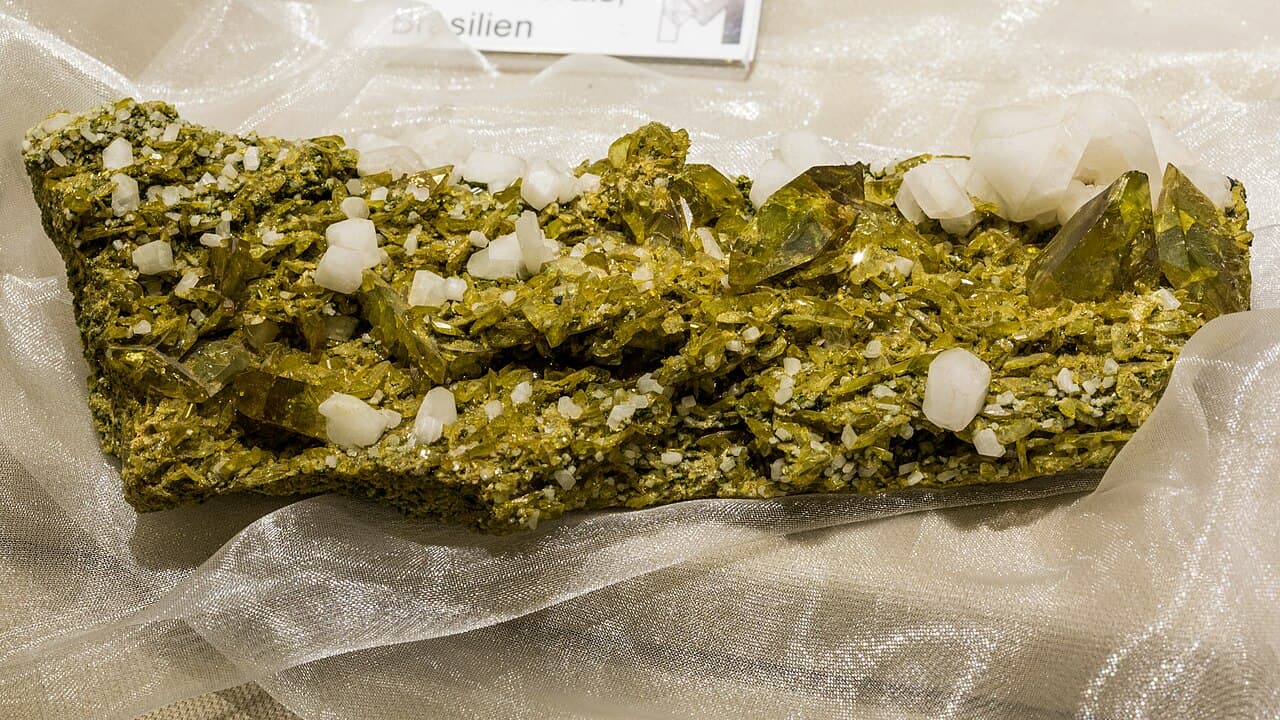
Titanite is a calcium titanium silicate mineral, CaTiSiO₅, far better known to gem buyers by its older name, sphene. It typically forms green, yellow, or brown crystals with a distinctive flattened, wedge-shaped outline — the source of the name 'sphene', from the Greek for wedge. Found in granites, metamorphic rocks, and some gem gravels, it is both a common accessory mineral and, in clean transparent pieces, a prized collector gemstone.
What makes titanite genuinely special is its fire. The mineral has extraordinarily high dispersion — the ability to split white light into rainbow flashes — that actually exceeds that of diamond. In a well-cut faceted stone this produces vivid bursts of color, and combined with its high luster and strong birefringence, a fine green or yellow titanite is one of the most fiery gems in the mineral kingdom, even if it is too soft to wear casually.
Titanite at a glance
- Classification
- Mineral — calcium titanium silicate (nesosilicate)
- Composition
- CaTiSiO₅
- Hardness
- 5–5.5 (Mohs)
- Luster
- Adamantine to resinous (often very bright)
- Streak
- White
- Colors
- Green, yellow-green, yellow, brown, orange-brown, occasionally black or colorless
- Crystal system
- Monoclinic
- Transparency
- Transparent to translucent (opaque when dark and iron-rich)
- Magnetic
- Not magnetic
How to identify it
The classic clue to titanite is its wedge- or envelope-shaped crystals — flattened, often skewed prisms with a sharp edge — in a yellow-green to brown color, set in or on granite, gneiss, or schist. The luster is unusually bright (adamantine to resinous), and on a faceted stone the standout feature is its fire: dispersion higher than diamond throws strong flashes of red, orange, and green. Its hardness of 5 to 5.5 means a steel knife will scratch it and it will not scratch glass, which helps separate it from harder green gems.
Two optical features confirm titanite when you can see into the stone. First, strong birefringence (double refraction) makes the back facets of a cut gem look noticeably doubled when viewed through the table — a 'fuzzy' or twinned appearance to the facet edges. Second, many titanites show pleochroism, shifting subtly in color as the stone is turned. Together, the wedge habit, intense fire, doubled facets, white streak, and modest hardness make a reliable case.
Colors and varieties
Titanite's most familiar and most valued colors are vivid chartreuse-green and yellow-green, prized because they showcase the stone's fire best. It also occurs in pure yellow, honey to orange-brown, and brown, with the browner, iron- and rare-earth-rich material grading toward translucent or opaque. Some titanite is essentially colorless, and rare iron-rich crystals can be nearly black.
There are no formal trade 'varieties', but gem dealers often distinguish material by source and color — bright green Alpine and Pakistani/Afghan crystals, and the famous gemmy green sphene from Madagascar and Brazil, are especially sought after. Heat or the exact balance of titanium, iron, and rare-earth elements influences the final hue, and the strongest dispersion is generally most visible in the lighter green and yellow stones.
Meaning and properties
In crystal lore, titanite (sphene) is sometimes associated with mental clarity, focus, and grounded creativity, ideas loosely tied to its bright fire and earthy green-and-brown palette. As with all such associations, these are cultural and spiritual rather than scientifically demonstrated effects.
Practically, the more useful 'property' to keep in mind is that titanite is a relatively soft, somewhat brittle gem. It is a wonderful display and collector stone and can be worn in protected settings such as earrings or pendants, but it is not well suited to everyday rings, where knocks and abrasion would quickly dull or chip it.
Value: what titanite is worth
Among collectors, fine faceted titanite (sphene) is valued chiefly for color and fire. Bright, clean, well-cut green and yellow-green stones with strong dispersion bring the highest prices, and value climbs with size because large transparent crystals are uncommon. Brownish, included, or poorly cut material is far more affordable, and rough mineral specimens with good wedge-shaped crystals on matrix have their own collector market.
Because titanite is soft and brittle, cutting quality and condition matter a great deal: a stone that is well proportioned to show off its fire, and free of chips and abrasions, is worth considerably more than a battered or windowed example of the same color. Eye-clean, vividly green Madagascar and similar material occupies the top of the range.
Real vs. fake titanite
Titanite is rarely faked with synthetics, but it is easily confused with other fiery green and yellow gems, and softer imitations or glass can be passed off to the unwary. The strongest natural confirmations are its exceptionally high fire combined with strongly doubled back facets (from its high birefringence) — a feature glass and most simulants lack — plus a white streak and a hardness of only 5 to 5.5, so it is scratched by a knife and will not scratch glass.
If a 'sphene' is notably hard, shows no doubling of the back facets, and lacks the trademark rainbow fire, be skeptical: it may be peridot, chrysoberyl, demantoid garnet, glass, or another stone (see the look-alikes below). Reputable dealers will disclose the gem species, and a basic refractometer or a quick check for facet doubling under magnification usually settles the question.
Care
Because titanite is soft (5–5.5) and somewhat brittle, handle it gently and store it separately from harder gems and jewelry so it is not scratched. Clean it only with warm water, mild soap, and a soft cloth or brush; avoid ultrasonic and steam cleaners, which can chip or fracture this fragile stone.
Keep titanite away from hard knocks and abrasive surfaces, and reserve it for protected jewelry settings or the display case rather than rough daily wear. Avoid harsh chemicals and sudden temperature changes, and lift faceted stones by their girdle or setting rather than touching the polished facets.
Titanite look-alikes
Frequently asked questions
Is titanite the same thing as sphene?
Yes. Titanite is the official mineralogical name, while 'sphene' is the older, traditional name still widely used in the gem trade. They refer to exactly the same calcium titanium silicate mineral, CaTiSiO₅; you will see faceted gems sold as sphene and mineral specimens labeled titanite.
Does titanite really have more fire than diamond?
In terms of dispersion — the optical property that splits white light into spectral colors — yes, titanite's dispersion value exceeds that of diamond. A well-cut green or yellow titanite shows vivid rainbow flashes, though diamond's far greater hardness and brilliance still make it the more practical everyday gem.
Can I wear a titanite (sphene) ring every day?
It is not ideal. At 5 to 5.5 on the Mohs scale titanite is relatively soft and somewhat brittle, so a daily-wear ring would scratch, abrade, and risk chipping. It is much better suited to earrings, pendants, or protected settings, and to collectors' display cases.
How do I tell titanite from peridot?
Both can be yellow-green and both show doubled back facets, but titanite has dramatically more fire (dispersion above diamond's) and is softer — it is scratched by a steel knife, whereas peridot at 6.5–7 is not. The intense rainbow flashes are the quickest giveaway for titanite.
Is yours titanite? Find out from a photo
Photograph your mineral in good light and get an identification with an honest confidence level, the look-alikes to rule out and the at-home tests that confirm it.
Identify my mineral freeOn Android? Get the free rock identifier app
Related
More minerals in the field guide
Keep exploring
More on minerals: how to identify a mineral, the streak test and the full list of crystal types.
Last updated 2026-06-25. Identification guidance is educational — confirm important results with the diagnostic tests described or a qualified expert.