Travertine
Also known as: Calcareous sinter, Travertine limestone, Spring stone
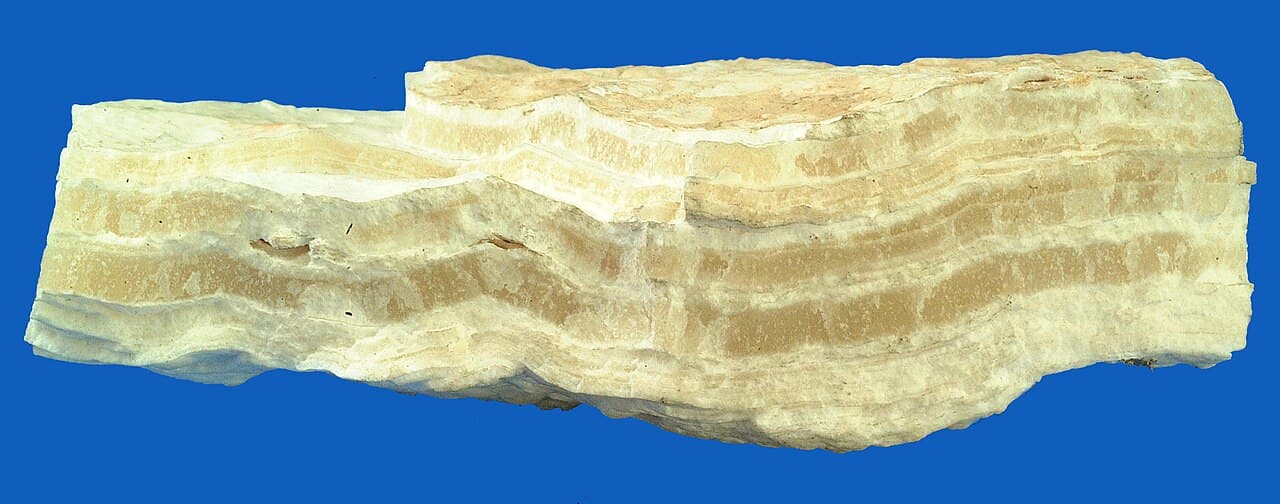
Travertine is a sedimentary rock — a banded, freshwater variety of limestone made of calcium carbonate that precipitates out of mineral-rich spring water. It typically forms at hot springs and in limestone caves and streams, where water that is saturated with dissolved lime loses carbon dioxide and deposits its mineral load layer by layer. The result is a creamy tan, beige, or warm brown stone with distinctive flowing bands and a characteristically porous, pitted surface, riddled with the small holes and cavities left behind as the deposit built up around gas bubbles, plant stems, and other obstacles.
It is one of the oldest and most beloved building stones in the world: the Romans quarried vast quantities of it, and the Colosseum is faced largely in travertine. Today the same stone is cut into tiles, pavers, countertops, and facade panels, valued for its earthy color and soft, natural texture (the holes are often filled and polished for indoor use). Because travertine is just a particular form of limestone, it shares limestone's chemistry and behavior — it is fairly soft and it fizzes when a drop of weak acid touches it — which makes those two properties, together with its banded, pitted look, the keys to recognizing it.
Travertine at a glance
- Classification
- Sedimentary rock — chemical (carbonate); a variety of limestone
- Rock type
- Sedimentary (chemical)
- Composition
- Calcium carbonate (CaCO3), mainly as calcite
- Hardness
- About 3 (calcite); easily scratched by a steel knife
- Luster
- Dull to earthy on natural surfaces; can be polished to a soft shine
- Colors
- Cream, ivory, tan, and beige to warm gold and reddish brown
- Texture
- Banded and layered; characteristically porous and pitted with cavities
What type of rock is travertine?
Travertine is a sedimentary rock, and more precisely a chemical sedimentary rock — it forms when a mineral, in this case calcium carbonate, precipitates directly out of water rather than being built from broken fragments of older rock. It is best understood as a specific kind of limestone: limestone is the broad family of calcium-carbonate rocks, and travertine is the banded variety deposited from freshwater springs. That places travertine squarely alongside other carbonate rocks while giving it its own distinctive origin story.
Because it is a carbonate, travertine behaves chemically just like ordinary limestone: it is composed of calcite, it is relatively soft, and it reacts with acid. What sets it apart within the limestone family is the freshwater-spring setting in which it grows and the textures that setting produces — the fine internal banding and the abundant pore spaces. It should not be confused with marble, which is what limestone or travertine becomes after deep heat and pressure recrystallize it into a harder, denser metamorphic rock.
How travertine forms
Travertine forms when groundwater that has dissolved limestone at depth re-emerges at the surface and deposits that dissolved lime back out. As the water rises and reaches springs — especially warm or hot springs — the pressure drops and carbon dioxide escapes from it, much like the fizz leaving an opened bottle of soda. Removing that carbon dioxide makes the water unable to hold its dissolved calcium carbonate, so the mineral crystallizes out as calcite and accumulates around the spring. Layer upon layer is added as the water keeps flowing, producing the rock's signature banding.
The same process operates in limestone caves and along mineral-rich streams, where carbonate is laid down to make the closely related cave deposits and stream crusts. The porous, pitted texture comes from the way the deposit grows: gas bubbles, sprigs of moss and algae, leaves, and twigs all get coated and then decay or escape, leaving voids behind. In actively growing hot-spring settings, layered terraces and rounded mounds of travertine can build into striking natural formations over time, recording every pulse of mineral-laden water.
How to identify travertine
Three features identify travertine: its color, its texture, and its chemistry. Look first for the warm, pale palette — cream, ivory, tan, and beige grading into gold and reddish brown — and for the distinctive banding, often visible as flowing, sweeping layers of slightly different shades. Then examine the surface for porosity: natural travertine is dotted with small holes and elongated cavities, giving it a pitted, somewhat sponge-like appearance that is unusual among building stones. (Note that commercial tiles are frequently filled and honed, which hides the holes.)
Confirm the identification with two simple physical checks. Travertine is soft — it is made of calcite — so a steel knife will scratch it without much effort, ruling out harder stones. The most diagnostic test is the acid test: place a drop of dilute hydrochloric acid (or even strong vinegar) on a fresh surface and travertine will fizz, releasing tiny bubbles of carbon dioxide, because it is calcium carbonate. To separate it from look-alikes, remember that marble is harder and denser with little or no porosity and usually a sugary or veined look, while ordinary limestone is the broader family that simply lacks travertine's banded, spring-deposited, porous character.
What travertine is used for
Travertine is above all a building and ornamental stone. The Romans used it extensively for major structures — the Colosseum is the most famous example — and it has been a prized facing and paving material ever since. In modern construction it is cut into floor and wall tiles, countertops, vanity tops, pavers for patios and pool surrounds, stair treads, and cladding panels for building exteriors, where its earthy tones and natural texture give a warm, classic look.
The stone is finished in different ways for different jobs: the natural holes can be left open for a rustic, textured surface, or filled and then honed or polished for a smoother indoor finish. Because it is a limestone, travertine is also a carbonate raw material and, where it is abundant, can be quarried and crushed for the same industrial uses as other limestones, such as making lime and serving as a construction aggregate. As a relatively soft, acid-sensitive stone, it is best kept sealed and away from acidic spills when used on countertops and floors.
Travertine look-alikes
Frequently asked questions
What type of rock is travertine?
Travertine is a sedimentary rock — specifically a chemical sedimentary rock and a banded variety of limestone made of calcium carbonate. It precipitates out of mineral-rich spring water at hot springs and in caves, rather than being built from fragments of older rock.
What is the difference between travertine and marble?
Travertine is a soft, porous, banded limestone deposited from spring water, while marble is what limestone or travertine becomes after heat and pressure recrystallize it. Marble is harder, denser, and non-porous and takes a high polish; travertine is softer and characteristically pitted with holes.
How can I identify travertine?
Look for a warm cream-to-brown stone with flowing bands and a pitted, porous surface full of small holes. Confirm with two tests: a steel knife scratches it easily because it is soft, and a drop of dilute acid or vinegar makes it fizz because it is calcium carbonate.
Is travertine the same as limestone?
Travertine is a specific type of limestone. Limestone is the broad family of calcium-carbonate rocks; travertine is the banded variety deposited from freshwater springs. They share the same chemistry and both fizz in acid, but travertine has its distinctive layered, porous, spring-formed texture.
Is yours travertine? Find out from a photo
Photograph your rock in good light and get an identification with an honest confidence level, the look-alikes to rule out and the at-home tests that confirm it.
Identify my rock freeOn Android? Get the free rock identifier app
Related
More rocks in the field guide
Keep exploring
More on rocks: how to identify a rock, what kind of rock is this and the Mohs hardness scale.
Last updated 2026-06-25. Identification guidance is educational — confirm important results with the diagnostic tests described or a qualified expert.