Garnet
Also known as: Almandine, Pyrope, Spessartine, Grossular (incl. tsavorite), Andradite (incl. demantoid)
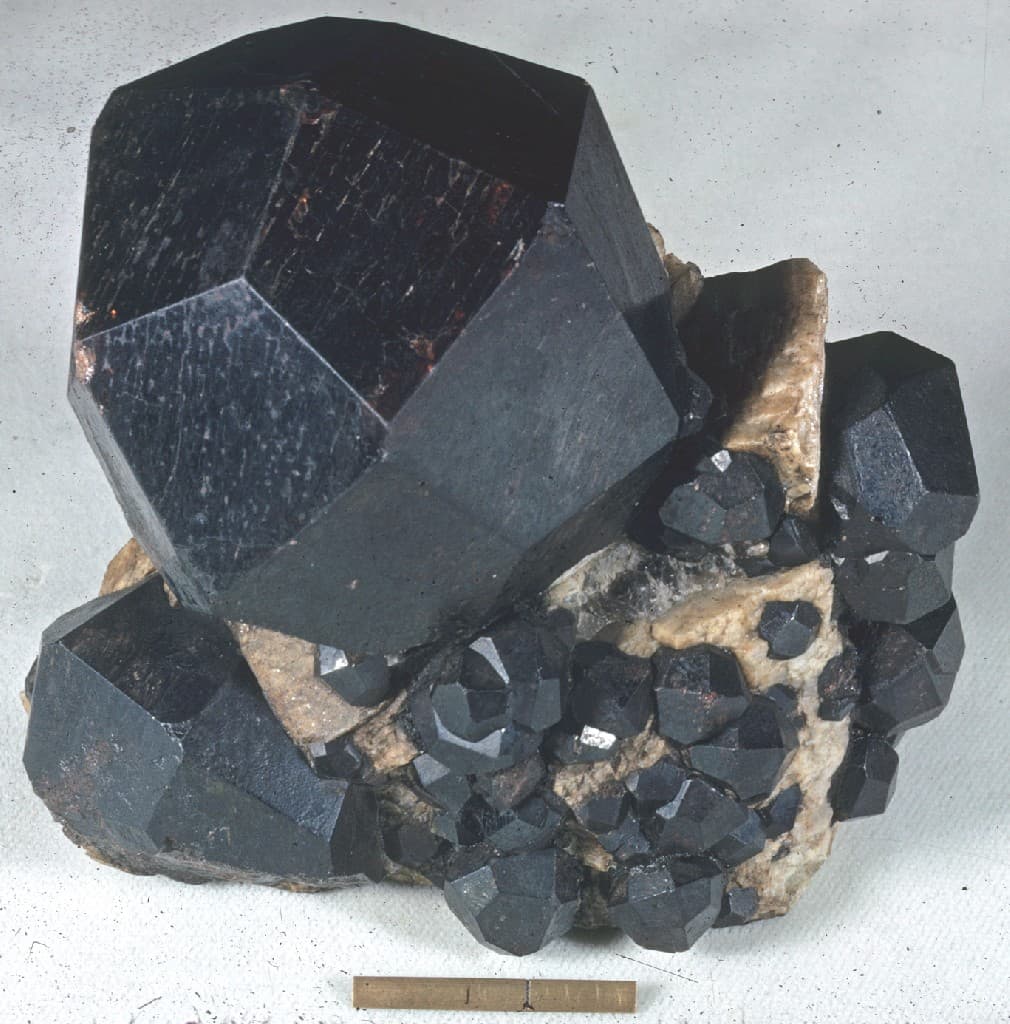
Garnet is not a single mineral but a whole family of closely related silicates that share the same cubic crystal structure while differing in chemistry. The gem trade groups them into species such as almandine, pyrope, spessartine, grossular and andradite, and the colors that result span far more than the deep wine-red most people picture. Iron-rich almandine and magnesium-rich pyrope give the classic dark reds; spessartine adds vivid orange; grossular includes the brilliant green tsavorite; and andradite includes the fiery green demantoid. Because the species blend into one another in nature, most gem garnets are actually mixtures sitting somewhere between two end members.
What ties the group together is a distinctive habit and a set of physical properties. Garnets crystallize in the cubic system and often form well-shaped twelve-sided (dodecahedral) or twenty-four-sided (trapezohedral) crystals — a shape so characteristic that good garnet crystals are instantly recognizable in a hand sample. They are moderately hard at roughly 6.5 to 7.5 on the Mohs scale, have a bright glassy luster, leave a white streak, and, crucially for identification, have no cleavage. As the birthstone for January, garnet is also one of the oldest gem materials in continuous human use, carved and set since antiquity.
Garnet at a glance
- Classification
- Mineral group — silicates (almandine, pyrope, spessartine, grossular, andradite)
- Composition
- General X₃Y₂(SiO₄)₃ (X = Fe, Mg, Mn, Ca; Y = Al, Fe, Cr)
- Hardness
- 6.5–7.5 (Mohs)
- Luster
- Vitreous (glassy), sometimes subadamantine in demantoid
- Streak
- White
- Colors
- Deep red most familiar; also orange, green, yellow, brown, pink, rarely colorless or blue-shifting
- Crystal system
- Cubic (isometric) — commonly dodecahedral or trapezohedral crystals
- Transparency
- Transparent to translucent
How to identify garnet
Start with the crystal shape if you have a rough specimen. Garnets very often grow as well-formed, rounded, many-faced crystals — most commonly the rhombic dodecahedron (twelve diamond-shaped faces) or the trapezohedron (twenty-four faces), or a combination of the two. Few other common gem minerals form these tidy isometric balls, so a chunky multi-faceted red-to-brown crystal embedded in schist or gneiss is a strong garnet candidate before you test anything else.
For the physical checks, garnet is hard enough to scratch glass and will resist a steel knife, placing it in the 6.5 to 7.5 range. The single most useful diagnostic is the absence of cleavage: garnet breaks with an uneven to conchoidal fracture rather than splitting along flat planes, which separates it from minerals that cleave cleanly. It shows a bright vitreous luster and a white streak. Color alone is unreliable because garnet spans red, orange, green and brown, so lean on the crystal habit, the no-cleavage fracture, and the hardness together rather than on color by itself.
Colors and varieties
The familiar deep red garnets are almandine (iron aluminum garnet) and pyrope (magnesium aluminum garnet); most natural reds are blends of the two, with almandine tending toward a brownish or purplish red and pyrope toward a brighter blood red. Rhodolite is a popular pink-to-purplish-red pyrope-almandine blend. Spessartine, the manganese member, produces glowing orange to reddish-orange stones sometimes marketed as mandarin garnet. These red-and-orange garnets make up the great majority of the material people encounter.
The grossular and andradite species break the red stereotype. Grossular ranges from honey and cinnamon browns to a rich chromium-and-vanadium green known as tsavorite, and a milky pink-orange form is called hessonite. Andradite includes demantoid, a green garnet with exceptional fire and a glassy-to-near-adamantine luster, plus the yellow variety topazolite and black melanite. A few garnets even change apparent color between daylight and incandescent light. Because the green members are far rarer than the reds, color is one of the biggest drivers of which garnet you are holding.
Meaning and properties
Garnet has carried associations with vitality, warmth and protection for thousands of years. Roman soldiers reportedly wore garnet for safe return, medieval travelers carried it as a guard against misfortune on the road, and its blood-red color tied it in folklore to the heart, circulation and life force. As the January birthstone it is often given as a token of steadfastness, friendship and enduring devotion, and crystal traditions link it to energy, motivation and grounding.
These meanings are cultural, spiritual and historical rather than medically established facts. Garnet is wonderful to wear and collect for its beauty and its long human story, but it is not a treatment for any physical or psychological condition and should never replace advice or care from a qualified professional.
Value: what garnet is worth
Garnet value swings dramatically by species, which surprises people who think of it as an inexpensive stone. Common red almandine and pyrope are among the more affordable gems, widely available as faceted stones, beads and tumbled pieces, with value rising for clean, bright, well-cut material free of the overly dark or brownish tone that dulls cheaper reds. Rhodolite and good orange spessartine command a step up for their livelier color.
The green garnets are a different market entirely. Fine tsavorite and especially demantoid — prized for its dispersion and, in Russian material, for the distinctive horsetail inclusions collectors look for — are genuinely rare and can rival or exceed many better-known colored stones in price. Across all garnets, the usual gem factors apply: saturated but not overdark color, good clarity, a lively cut, and larger clean sizes all push value upward. Because untreated stones are the norm for garnet, naturalness is less of a price lever here than it is for many other gems.
Real vs. fake garnet
Outright synthetic garnet is uncommon in jewelry, so the bigger identification issues are confusing natural garnet with other red stones and spotting glass imitations. Glass fakes are the easiest to catch: they often hold tiny round gas bubbles visible under magnification, can show swirl marks, feel warmer to the touch than a real garnet, and frequently have molded or rounded facet edges rather than the crisp, flat facets of a cut stone. Real garnet shows sharp facets, a white streak, no cleavage planes, and the characteristic crystal habit in rough form.
Among genuine gems, garnet is most often confused with ruby and red spinel, both of which are harder, and with red tourmaline. A hardness check helps separate garnet from corundum, but the safest non-destructive tells are optical: most garnets are singly refractive and show no doubling of back facets through a loupe, whereas ruby and tourmaline are doubly refractive. Inclusions also differ between species and localities. When real money is involved, a gemologist's refractive index and specific gravity readings will pin down both that it is garnet and which garnet it is — far more reliably than eyeballing color.
Care
Garnet is durable enough for everyday wear thanks to its 6.5 to 7.5 hardness and lack of cleavage, and it stands up well to normal handling. Clean it with warm water, mild soap and a soft brush, then rinse and dry. This gentle routine suits all species.
Avoid harsh chemicals, abrupt temperature changes and hard knocks, since a sharp impact can still chip or fracture any gem regardless of hardness. Ultrasonic and steam cleaners are best avoided as a precaution, particularly for stones with visible inclusions or fractures, which are common in demantoid and some almandine. Store garnet separately from harder gems like sapphire and diamond so it does not get scratched, and keep it away from prolonged high heat.
Garnet look-alikes
Frequently asked questions
Is garnet always red?
No. Red is the most familiar and most common color because the iron and magnesium species almandine and pyrope dominate the market, but garnet is a mineral group that also produces orange spessartine, green tsavorite and demantoid, honey-brown grossular, yellow topazolite and more. Some garnets even appear to shift color between daylight and incandescent lighting.
How can I tell garnet from ruby?
Hardness and optics are the reliable tells. Ruby is corundum at Mohs 9 and will scratch garnet, which sits at 6.5 to 7.5. Under a loupe, ruby is doubly refractive and can show doubling of its back facets, while most garnets are singly refractive and show no doubling. Color alone is not enough, since fine red garnet and ruby can look similar to the unaided eye.
What is the most valuable type of garnet?
The green garnets generally command the highest prices: fine tsavorite (a chromium-and-vanadium grossular) and demantoid (an andradite prized for its fire) are genuinely rare and can be very valuable, especially in larger clean sizes. Common red almandine and pyrope are far more affordable. Within any species, saturated color, good clarity, a lively cut and larger size all raise value.
Does garnet have cleavage?
No, and that is one of its most useful identifying features. Garnet has no cleavage and breaks with an uneven to conchoidal fracture rather than splitting along flat planes. This sets it apart from many other gem minerals that cleave cleanly, and it also means garnet holds up well to everyday wear despite its moderate hardness.
What birthstone is garnet?
Garnet is the birthstone for January, on both the traditional and modern lists and unchallenged for as long as birthstone lists have existed. The classic January garnet is the deep pomegranate-red variety, though the garnet family itself comes in almost every color. See our January birthstone guide for more.
What does garnet symbolize?
Garnet has long been a stone of protection, vitality and safe travel — Roman soldiers and later travelers carried it as a talisman, and its blood-red color tied it to life force, passion and the heart. As January's birthstone it stands for constancy, friendship and trust. These associations are cultural and historical rather than medical, so enjoy garnet for its beauty and lore, not as a remedy.
Is yours garnet? Find out from a photo
Photograph your gemstone in good light and get an identification with an honest confidence level, the look-alikes to rule out and the at-home tests that confirm it.
Identify my gemstone freeOn Android? Get the free rock identifier app
Related
Compare garnet with look-alikes
More gemstones in the field guide
Keep exploring
More on gemstones: the full list of crystal and gem types, how to identify gemstones and the polished-stone identifier.
Last updated 2026-07-19. Identification guidance is educational — confirm important results with the diagnostic tests described or a qualified expert.